

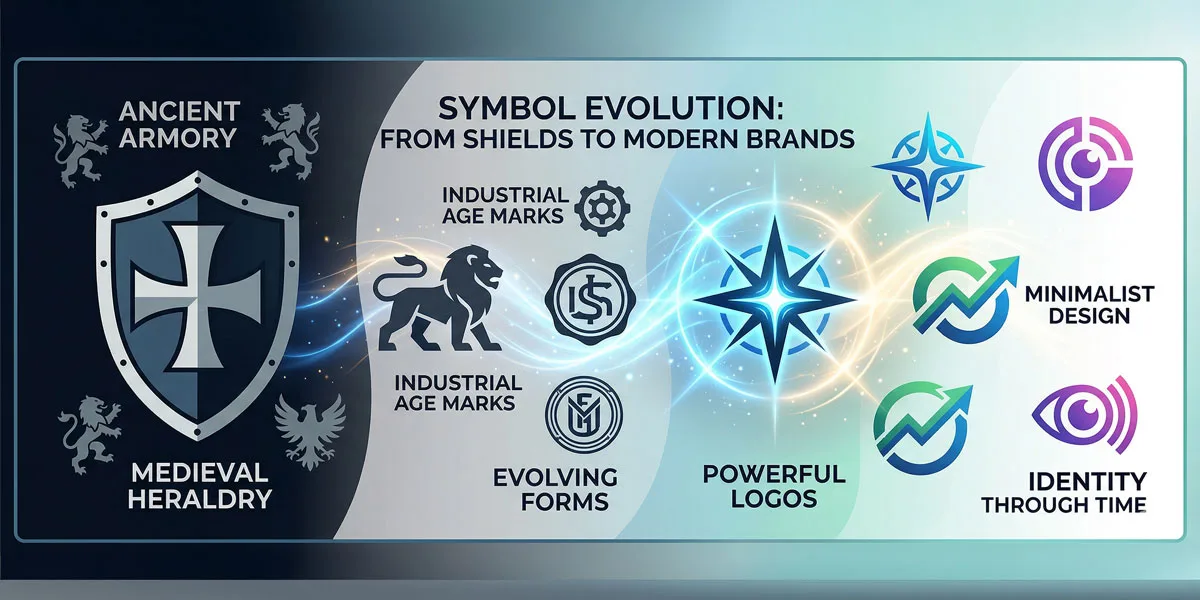
Learn how logos, shields, arrows and simple symbols carry history, authority and emotion in modern branding and identity design.
Table of Contents
Logos as Charged Symbols: Understanding the Power of Corporate Identity
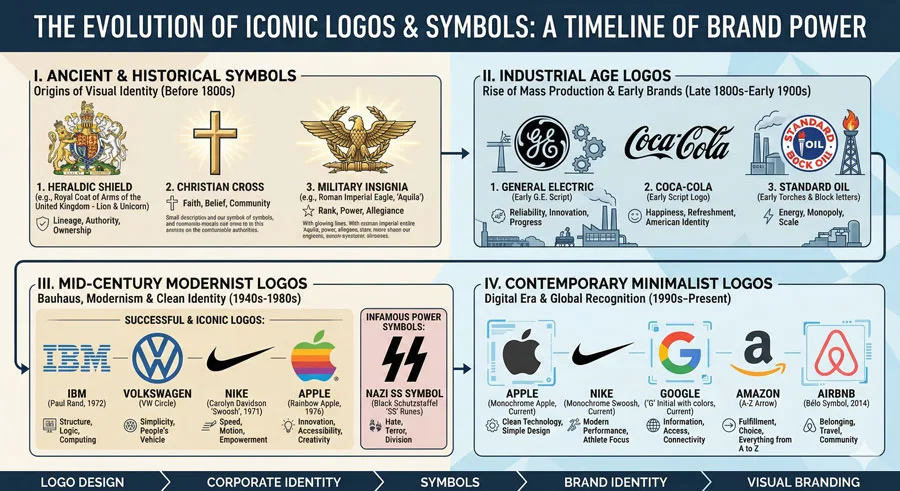
Logos are charged symbols that embody and radiate the ethos as well as the aspirations of a company or institution.
The intensity of meaning encoded in this simple iconic mark must not be underestimated, but neither should it be worshiped as sacred. A corporate logo is not as mystical as J.R.R. Tolkien’s famous Ring because it depends on external forces for its power.
Even Superman’s “S” signifies strength not because the S itself has superhuman powers but because the one who wears it—in this case a symbolic, fictional character—is a superman.
Similarly, the Nazi SS rune lightning bolt logo represented an organization of self-styled supermen, but it became shorthand for its members’ inhumanity and crimes toward millions of victims.
No matter how startling or elegant, beautiful or ugly, ultimately a logo is only as good or bad as the entity it represents.
Related Topics:
Shields and Arrows – Ancient Symbols in Modern Design
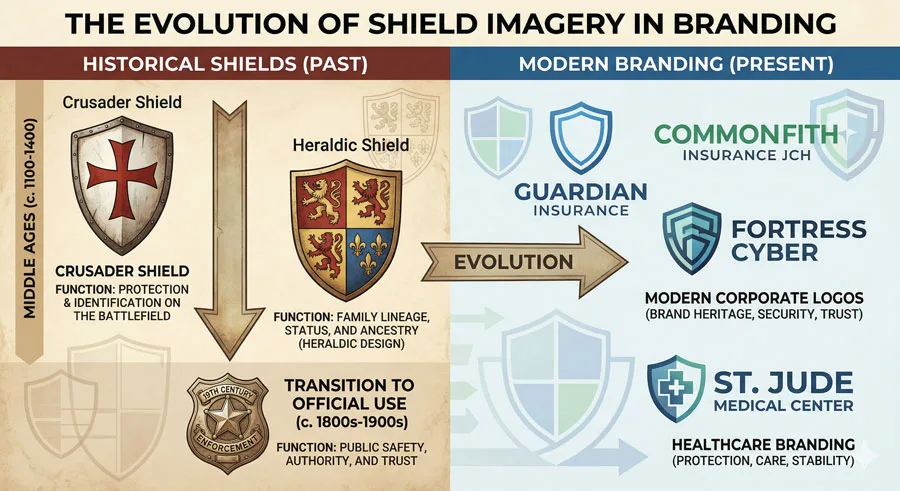
Aside from the cross, the shield is the most historically significant of the design elements in modern branding. Familiarity is actually a modest understatement. The shield dates to pre-Christian history but is common iconography of the Crusades.
Crusaders marched with huge cross-emblazoned shields that, in addition to protecting themselves from their enemies, announced their territorial ambitions.
Today, shields signify authority—like a police badge, also known as a shield. In graphic terms, shields frame visual ideas; like an adjective, a shield describes the fundamental concept.
The bold arrow, a device almost as old as the shield—and arguably the first graphic symbol, and one that appears in all cultures—suggests assertive motion in whatever direction it points.
It implies thrust, motive, and outcome. Arrows lead and we follow, right or wrong.
Related Topics:
St. Vincent’s Hospital Ambulance – Merging Heritage with Modernity
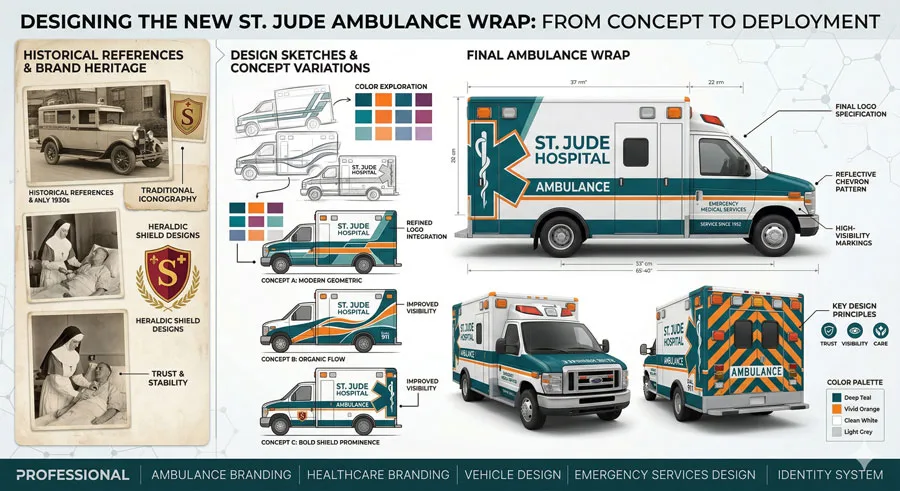
In 1998, when Tom Kluepfel and Stephen Doyle of Doyle Partners redesigned the identity scheme for St. Vincent’s Hospital in New York City, the mandate was to unify the attributes of this neighborhood institution under a single contemporary banner.
St. Vincent’s had merged with eight other hospitals into a citywide healthcare system, so the designers sought an identity that built on its existing recognition in the community, signaled its newfound reach, and exemplified its distinct holdings.
All the hospitals had a common Catholic heritage and iconography—the colors, the cross, the shield—that were expressed through light (“as in the light seen through the stained-glass window of a hospital chapel”) and science (“implied in the precise way the shapes and colors intersect”).
The ambulance graphics must be bold, clear and unmistakable; they must announce that this is an emergency vehicle as well as promote the institution that operates it.
Related Topics:
The Power of Simplicity in Logo Design – Learning from the Burek Project
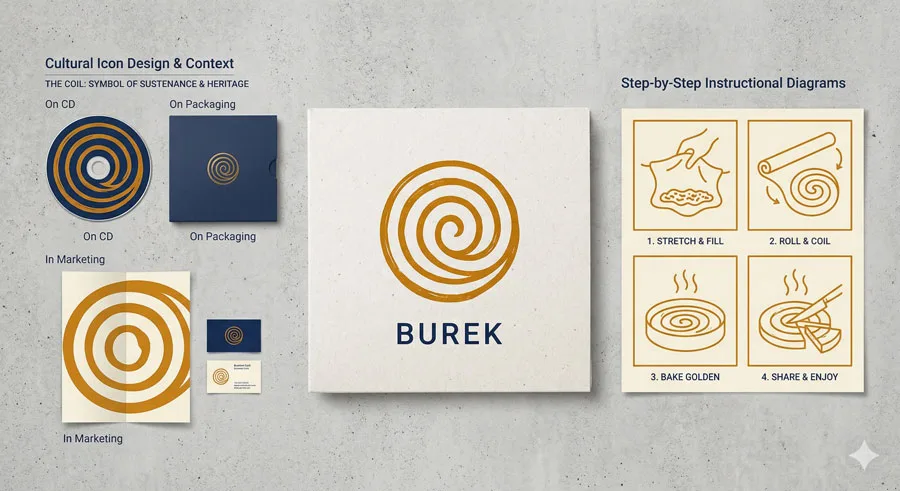
Dino Merlin is a famous Bosnian singer; Burek is the title of his CD and also the name of a traditional Bosnian pie made in a coil and stuffed with meat—a common delicacy.
It may seem like a peculiar theme on which to base an entire CD, but when reduced to a fundamental graphic icon, the burek is a hypnotically mnemonic mark that, if nothing else, triggers comfort.
Like many of the world’s most effective logos, this design’s virtue is its stark simplicity that draws on cultural and visual references packed into one seemingly abstract container.
Although the literal reference to the burek may not be understandable to all who see it, its graphic nature nonetheless projects a contemporary ethos owing to the reductionist symbols found on many CD covers today.
Simplicity works best when it rises from a heap of complexity.
Related Topics:
Bar Codes and Fingerprints – Identity and Individuality in Modern Design
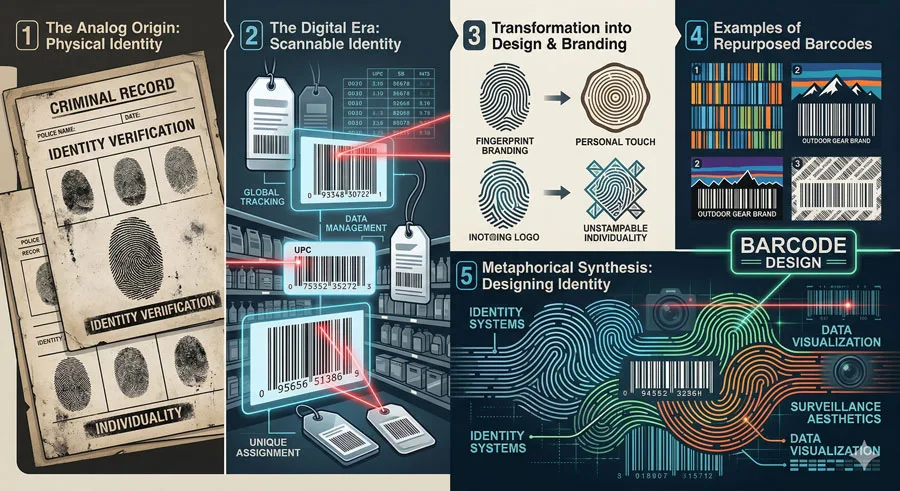
The fingerprint has become a venerable recurring motif in graphic design. No two fingerprints are alike, yet the fingerprint is richly symbolic, suggesting a range of notions from individuality to criminality.
The Universal Pricing Code (UPC) or bar code, developed in 1952 by Joseph Woodland, is similarly unique and ubiquitous. Like the fingerprint, it is commonly employed as a conceptual graphic sign representing a broad range of messages.
During the late twentieth century, the computer-generated bar code nudged out the fingerprint as a primary symbol of identity and individuality (or the lack thereof).
In many instances it has been used as a metaphor for such concepts as imprisonment, governance, and economy. How often have we seen it tattooed on the human body, eerily suggesting the specter of official surveillance?
Often the bar code is used as a kind of cityscape symbolizing the over-arching control of a benign faceless power over the quality of human life.
Related Topics:
About the Author
Lalit M. S. Adhikari is a Digital Nomad and Educator since 2009 in design education, graphic design and animation. He’s taught 500+ students and created 200+ educational articles on design topics. His teaching approach emphasizes clarity, practical application and helping learners.
Learn more about Lalit Adhikari.
This guide is regularly updated with the latest information about Adobe tools and design best practices. Last Updated: Mar 2026
Related Topics:
- The Psychology of Typography: Font Influence
- Comic Sans – Accessibility & Gatekeeping Critique
- Gotham – Political Design & Elections Power
- Futura – Geometric Modernism Revolution
- The Anatomy of Design: Understanding How Design Works Like the Human Body