

Explore how graphic design functions like a living system—history, influences and hidden structures behind logos, posters and visual identities.
Graphic design is far more than creating beautiful visuals. It is a composite of many influences and inspirations that interact like organs within a living body, each playing a specific role in the overall system.
Table of Contents
What Is Graphic Design, Really?
Beyond Pretty Pictures
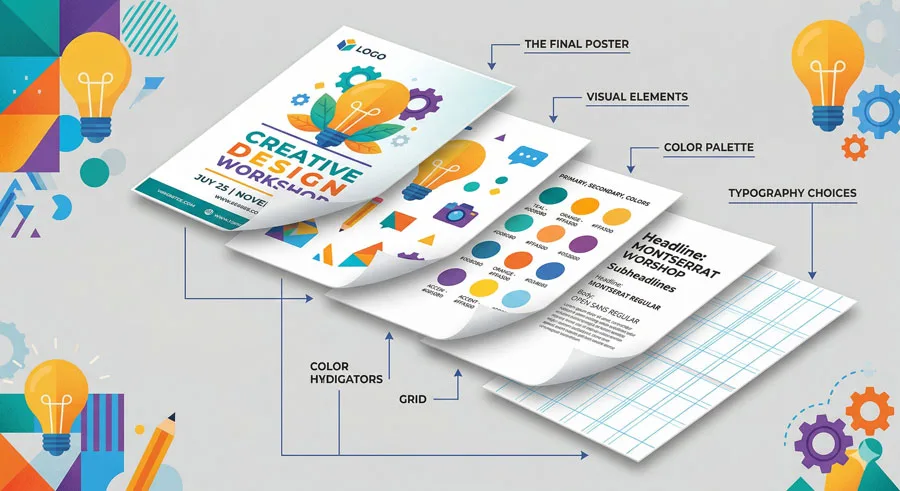
Graphic design is a composite of many influences and inspirations that work together as an integrated system.
When you peel away the outer layer of any design—whether it is a poster, package, book cover or billboard—you find a skeleton of distinct, individual parts that function together in harmony.
Just as removing a single bone from the human body alters its entire structure and function, removing one element from a design changes its entire “pathology.”
A logo, for example, is not merely a pretty symbol; it is a charged symbol that embodies and radiates the ethos and aspirations of a company or institution.
Logos as Living Symbols
The intensity of meaning encoded in a simple iconic mark must not be underestimated. A corporate logo is not mystical in itself; like Superman’s “S,” its power comes from the character, story, and behaviour behind it.
No matter how startling or elegant, beautiful or ugly, a logo is only as good or bad as the entity it represents.
Related Topics:
The Historical Evolution of Graphic Design – From Gutenberg to Modern Day
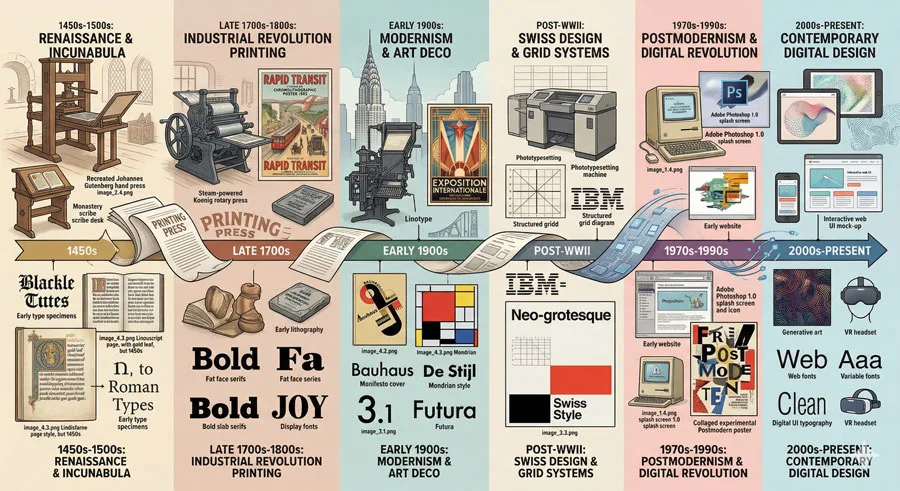
The history of graphic design is an archeological record of strata and substrata of detritus from different eras. Johannes Gutenberg, the inventor of movable type, was inspired by the beauty of illuminated manuscripts.
Although cognizant of the need for mass communication, he replicated the hand-scribed letterforms found on sacred religious texts, forging old and new into the most revolutionary technology since the wheel.
Graphic design methods, manners, and styles emerged only as fast as technology allowed or culture demanded.
In the late nineteenth century, advertising art developed to meet the needs of a new commercial culture and became the cornerstone on which all modern graphic design would ultimately stand.
Printers and designers often mindlessly followed conventions, styles, and tropes until new ones took their place.
Related Topics:
How Graphic Design Evolved Over Time
From Gutenberg to Mass Communication
The history of graphic design is an archaeological record of strata and substrata from different eras. Johannes Gutenberg, the inventor of movable type, was inspired by the beauty of illuminated manuscripts.
Aware of the need for mass communication, he replicated the hand-scribed letterforms found on sacred religious texts, forging old and new into one of the most revolutionary technologies since the wheel.
Graphic design methods, manners, and styles emerged only as quickly as technology allowed or culture demanded.
In the late nineteenth century, advertising art developed to meet the needs of a new commercial culture and became the cornerstone on which modern graphic design would stand.
Design as Fashion and Archaeology
Printers and designers often followed conventions, styles, and tropes until new ones took their place.
Viewed archaeologically, every decade—even every year or month—designers produce stylistic manifestations that, when they fall out of favour, are discarded.
Like fashion, passé graphic design artifacts are ignored until someone rediscovers and reintroduces them as “new” inspiration.
Old becomes new at breakneck speed, and just as quickly becomes old again. Yet each rediscovery adds to an ever-expanding design vocabulary.
Related Topics:
The Design Bloodstream: How Influences Circulate
Design as a Circulatory System
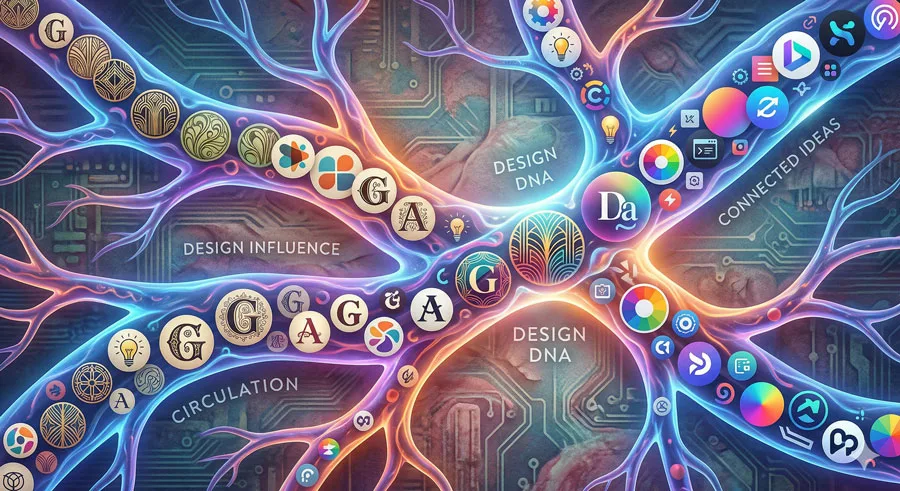
All graphic design elements move through a bloodstream that nourishes the field, regardless of when they were created or why. No design exists in isolation; it is part of a continuous flow of ideas, references and reinterpretations.
Designers constantly absorb visual influences—from historical posters to contemporary branding—and these influences recirculate through their work, often unconsciously.
Old forms are sampled, remixed and re-contextualized, keeping the visual bloodstream rich and active.
Old Forms, New Contexts
Each time an old style, typeface, or visual motif is revived, it enters a new cultural moment with a different meaning. A slab serif once inspired by Egyptian tombs, for example, can resurface in minimalist branding or retro packaging.
The field of design grows as these visual “cells” are reused in new bodies of work.
Related Topics:
The Anatomy Metaphor: Design as a Body
Breaking Design into Integral Parts
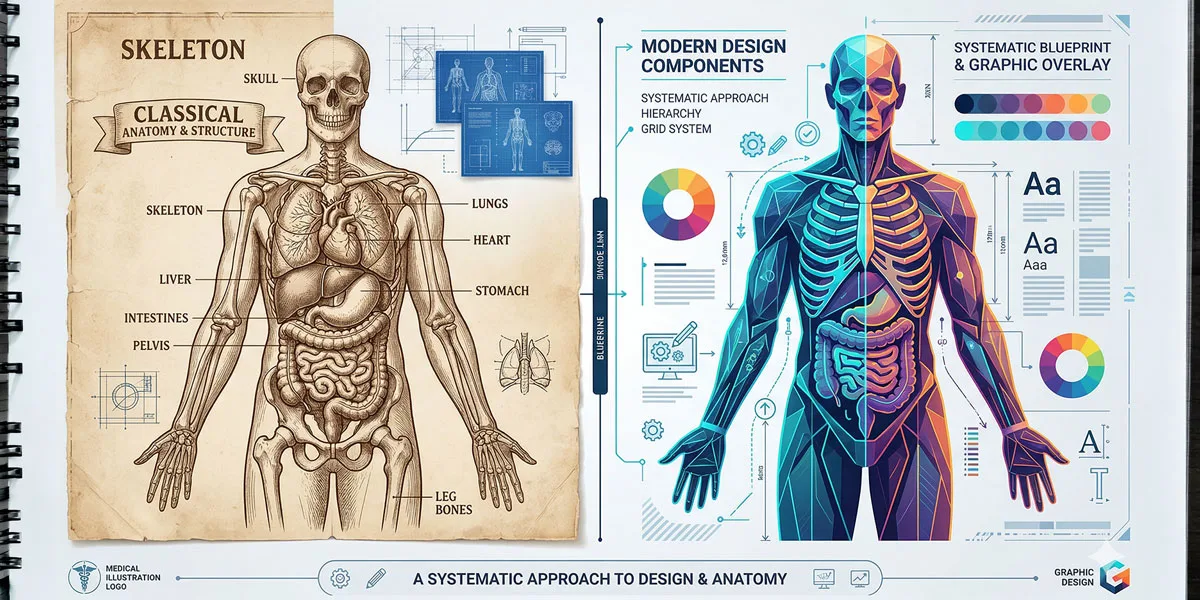
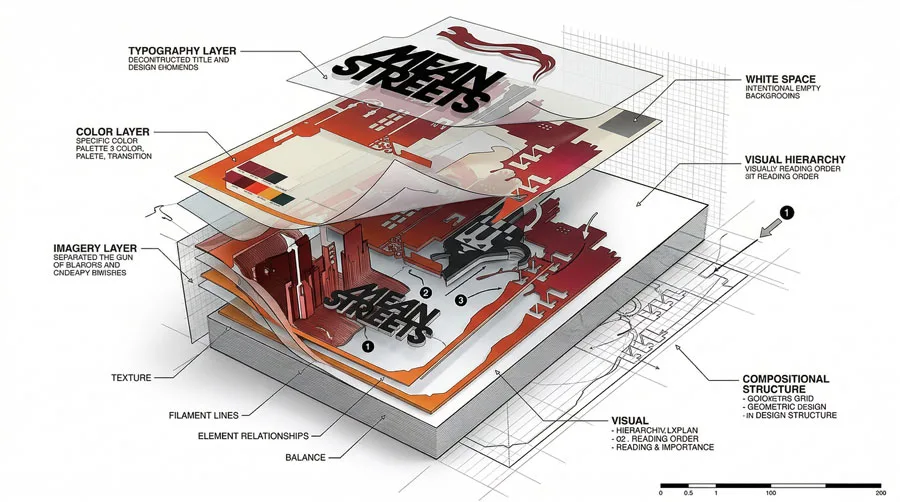
A piece of graphic design is the sum of integral parts. Peel away the outer skin and you find a supportive skeleton of grids, structure, and hierarchy. Wrapped around that skeleton are muscles of typography, color and imagery.
The “organs” might be the concept, narrative or emotional tone that keeps the design alive.
Remove one part—type, image, structure, or concept—and the design’s function changes or collapses. Understanding these internal workings helps designers appreciate the complexity of their craft, rather than seeing design as mere surface decoration.
Learning from Design Anatomy
Just as anatomy teaches how the human body functions—beyond the simple idea that “the shinbone’s connected to the thighbone”—design anatomy reveals the physical and genetic makeup of a particular work.
Beneath the surface of any well-crafted piece are “creative molecules”: choices about scale, contrast, rhythm, metaphor and reference.
By studying these parts in isolation and in combination, designers learn why something works, not just that it works.
Related Topics:
- Comic Sans – Accessibility & Gatekeeping Critique
- Gotham – Political Design & Elections Power
- Futura – Geometric Modernism Revolution
49 Design Case Studies – Why This Anatomical Analysis Matters
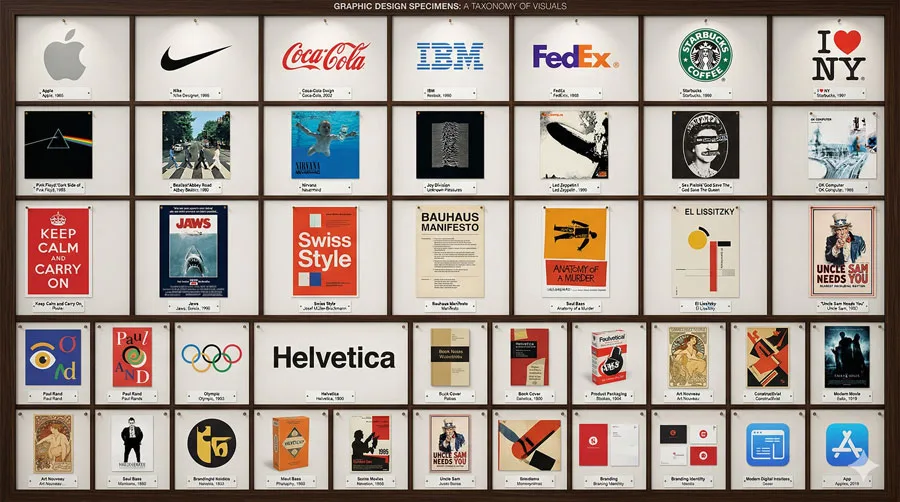
For “The Anatomy of Design,” Steven Heller and Mirko Ilic selected forty-nine examples of graphic design to anatomically disassemble piece by piece—tissue by tissue—to reveal an embedded array of influences and inspirations.
These are not necessarily the best-known or celebrated objects of graphic design, though many contain the genetic codes of canonical works.
Instead, they represent some visible and a few obscure relatively contemporary artifacts that are well conceived, finely crafted, and filled with hidden treasures.
Some are overtly complex—and their influences easy to see with the naked eye—while others are so simple it is hard to believe a storehouse of inspiration is hidden underneath.
Related Topics:
How Designers Create Without Knowing Their Influences

But how do we know for certain what influences a design? Sometimes—actually most times—designers do not know the derivation of their work. Paul Rand once said “you design something and then figure out reasons to justify it.”
Moreover, ideas and images float freely in the air, are breathed in and become part of the circulatory system. They may emerge in a work without the creator knowing where they come from.
So, through critical observation, we identify the parts of the whole. We parse them, deconstruct them, and show them. Out of this anatomical mechanism emerges a timeline of influence and inspiration.
The designs have multiple references, and these can be drawn out to show how interconnected all design truly is.
Related Topics:
About the Author
Lalit M. S. Adhikari is a Digital Nomad and Educator since 2009 in design education, graphic design and animation. He’s taught 500+ students and created 200+ educational articles on design topics. His teaching approach emphasizes clarity, practical application and helping learners.
Learn more about Lalit Adhikari.
This guide is regularly updated with the latest information about Adobe tools and design best practices. Last Updated: Mar 2026
Related Topics: