

Learn what typography really is, how it functions in design, and why macro and micro typography matter to your projects. Discover the basics today.
My name is Lalit Adhikari and we are at LTY. Let’s begin!
Table of Contents
Introduction: Why Typography Fundamentals Matter
Typography is more than choosing a pretty font—it is a refined craft that makes language visible and gives words the power to speak fluently in visual form.
When you understand typography fundamentals, you can shape language so it conveys both information and emotion with clarity and impact in any medium.
In this first part of the series, you will get grounded in what typography is, how it functions, and why macrotypography and microtypography are the twin foundations of typographic practice.
Later posts will build on this with anatomy, type classification, selection, hierarchy, spacing, and grids, but everything starts with a clear definition.
Related Topics:
- Typography in Practice: Type Across Media
- Type Anatomy: Learn the Language of Letterforms
- Typeface Categories: Serifs, Slabs and Sans Serifs
What Typography Is (and Is Not)
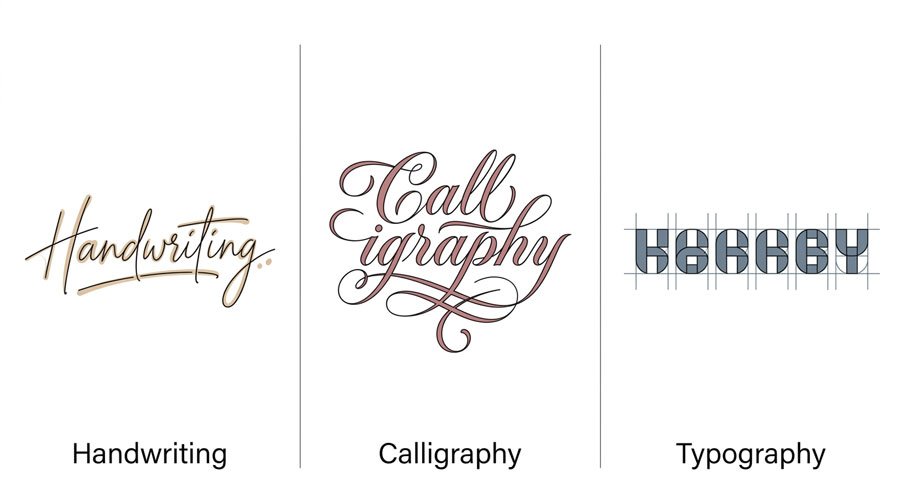
Typography is a process and a refined craft that makes language visible by arranging standardized letterforms into words, lines and paragraphs. Designers shape language with type so that written text can be read, felt and understood, carrying messages and provoking emotion at the same time.
Typography is distinct from handwriting, calligraphy and lettering because it uses systematized character sets that can be rearranged and reproduced in exactly the same way without end.
Handwriting, calligraphy and lettering tend to be reserved for custom, limited or special applications, while typography relies on repeatable typefaces for communication across media.
Related Topics:
- How to Choose Typefaces: Selection Principles That Work
- Combining Typefaces and Building Hierarchy
- Spacing, Alignment and the Color of Type
Typography’s Dual Role: Function and Expression
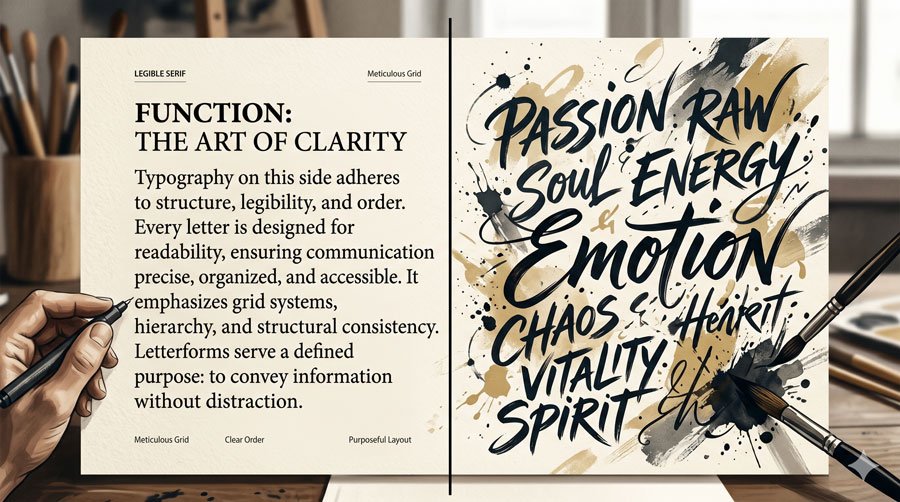
Typography always operates on two levels: semantic and aesthetic.
On the semantic side; words, lines and paragraphs must carry information clearly and assist the reading process so content is accessible and understandable.
On the aesthetic side; type can be commanding, beautiful, dramatic, whimsical, modest or extravagant, influencing how content feels before a single word is consciously read.
The best typography serves both roles at once—conveying information with clarity while expressing tone, personality and mood in a visually inviting way.
Related Topics:
- Baselines, Grids and Advanced Typographic Layouts
- Typography
- The Psychology of Typography: Font Influence
Where Typography Shows Up in Your Daily Work
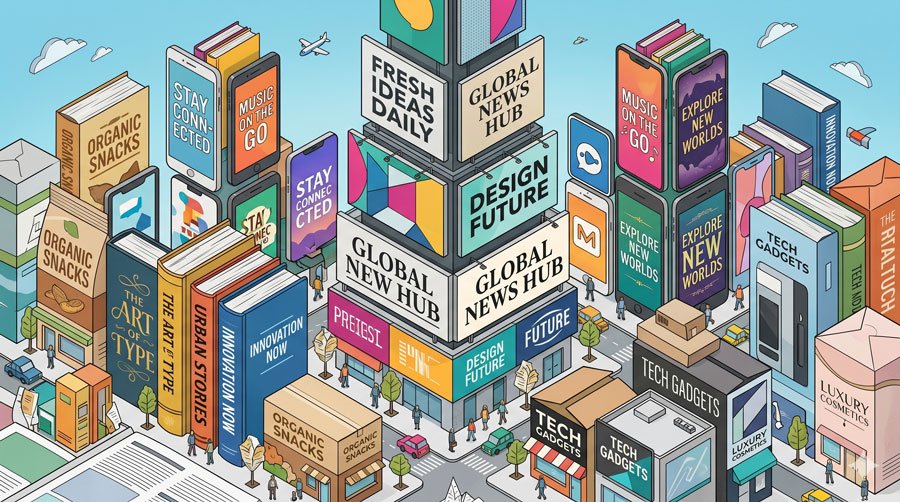
Typography is everywhere: in environments, interfaces, packaging and print, and it is central to contemporary design practice across both physical and digital media.
Environmental signage, websites, motion sequences, posters, books and data visualizations all rely on deliberate typographic decisions to work effectively. In some applications, such as signage systems for wayfinding, typography must be practical and direct because clarity is imperative.
In others, such as motion sequences or expressive posters, letterforms can become highly conceptual and interpretive, personifying voices or visualizing sound while still needing to balance function with aesthetics.
Related Topics:
- Helvetica Effect: One Font Conquered Global Design
- Comic Sans: True Story Behind the World’s Most Hated Font
- Gotham: Font That Won an Election And Changed Design Forever
Core Objectives When You Design with Type
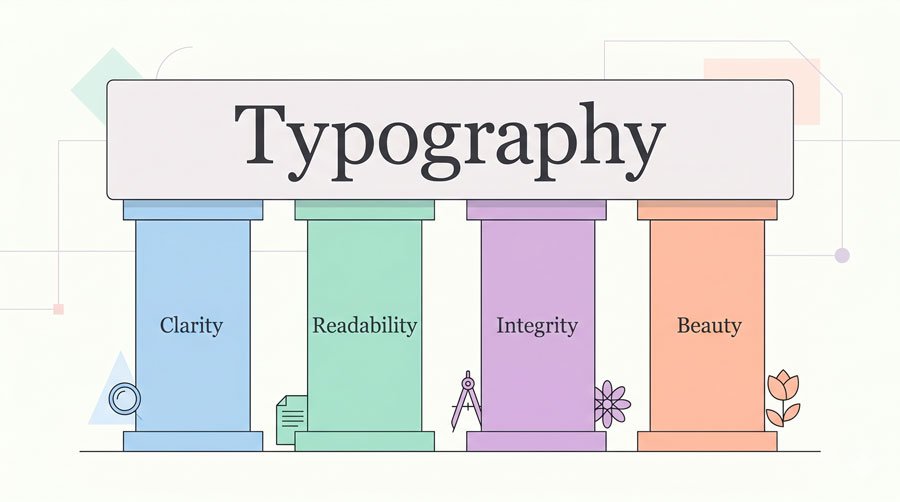
Regardless of the specific project, typography fundamentals point you toward a set of recurring objectives. You should aim to convey information with type so it communicates with clarity and assists, rather than hinders, reading.
At the same time, you should uphold typeface integrity, value the craft and its makers and express text beautifully so the work is visually inviting and appropriate to its context.
When you merge communication with aesthetics and do what best serves each project, you unlock the potential for meaningful and creative visual communication.
Related Topics:
- Futura: The Geometric Vision of Paul Renner
- Gill Sans: Eric Gill’s Humanist Masterpiece
- Baskerville: Elegant Serif That Shaped Print Typography
Macrotypography: The Big Picture of Layout
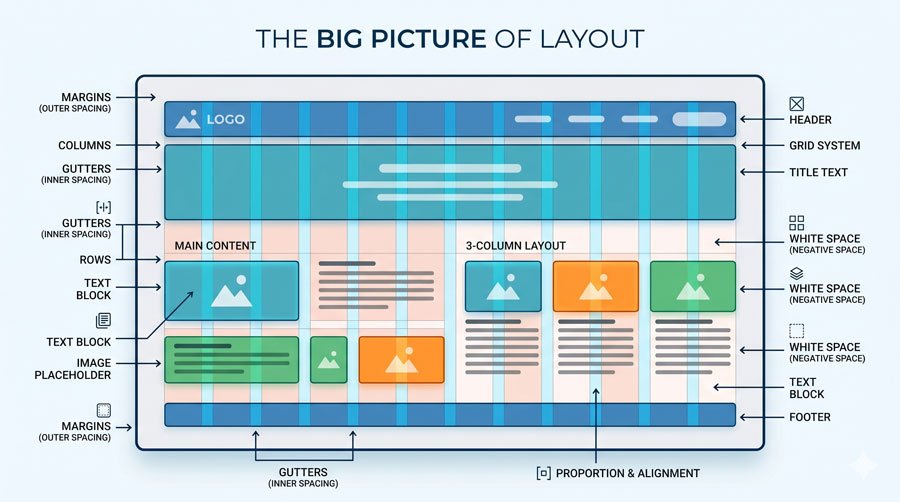
Macrotypography refers to composition or layout—the way you plan and organize typographic elements across a page, screen, or environment.
It focuses on spatial positioning, relationships among elements, and the interplay between type and white space, which together create the first visual impression that either engages or loses the viewer.
At the macro level, you are deciding how blocks of text, headings, images, and other elements relate in scale, alignment, and rhythm, with the goal of ordering, connecting, and balancing type so the overall composition “feels right.”
Related Topics:
- Bodoni Font: Serif That Defined Luxury Typography
- Garamond: Timeless Serif That Defined Classical Typography
- The Worst Fonts in the World: A Typographic Hall of Shame
Microtypography: The Fine Details of Typesetting
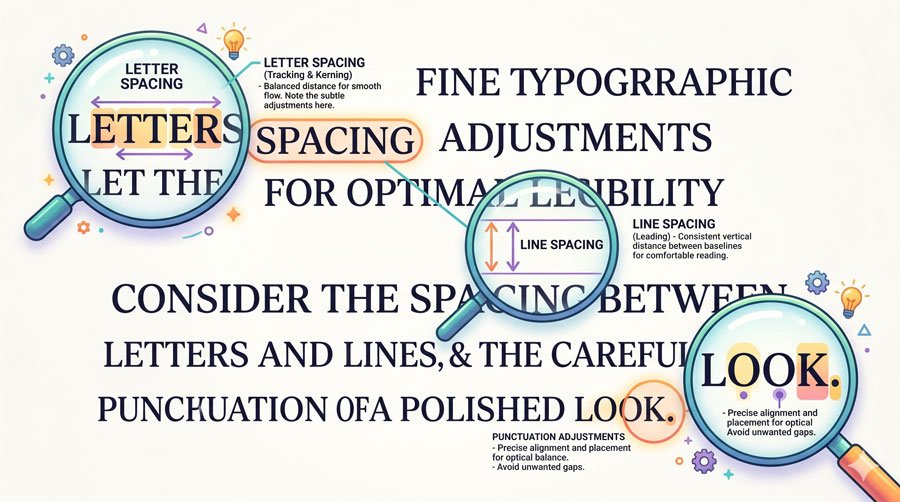
Microtypography focuses on typesetting essentials and details at the level of letterforms, words, lines, and paragraphs.
It includes spacing decisions such as kerning, tracking, and leading, as well as refinements like punctuation handling, ragging, and other subtle adjustments that remove distractions.
A principal microtypographic factor is spacing, which has a strong influence on typographic color—the perceived lightness or darkness of text based on value rather than hue.
Successful microtypography often goes undetected by readers, which is a sign that the details are working smoothly and not calling attention to themselves.
Related Topics:
- Gill Sans and Tube: How Johnston and Gill Defined London
- Baskerville and Eaves: A Tale of Perfection, Passion and Revival
- Futura vs. The World: The Geometric Vision of Paul Renner
How Macro and Micro Typography Depend on Each Other
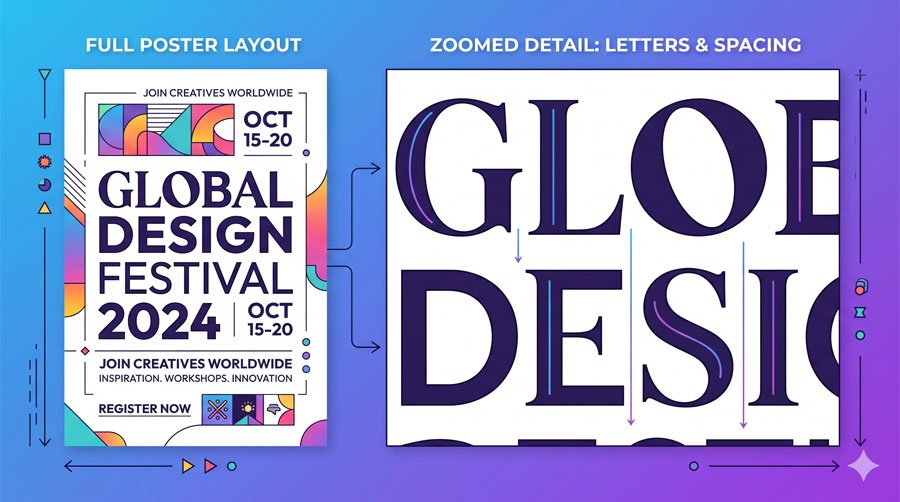
Macrotypography and Microtypography are mutually dependent and the success of the whole depends on the quality of its parts.
A well-composed layout falls apart if line length, spacing, or paragraph details are poorly handled; conversely, beautifully set text cannot compensate for a weak overall structure.
When you design, you continually move between macro and micro views—zooming out to judge overall balance and rhythm, then zooming in to refine spacing and typographic color so the composition reads comfortably and looks considered.
Related Topics:
- Legibility vs. Readability: What Every Designer Needs to Know
- Secret Life of Symbols: History of Ampersand and Interrobang
- Helvetica – Swiss Modernism’s Ubiquity Crisis
Typography as an Ever‑Present, Often Invisible Companion
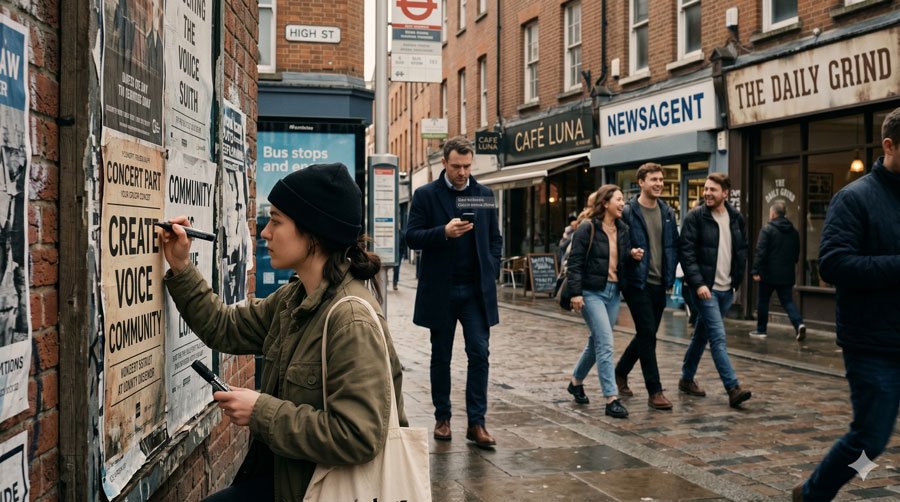
In everyday life, type is ever‑present, sometimes going unnoticed and other times radiating from the surface of a design.
When it is handled with discipline and attention, typography can quietly support content, or it can step forward as a strong visual voice without losing readability.
Typographic practice challenges and fulfills because it is rooted in both everyday communication and long cultural histories, and it continually offers new possibilities to explore as media and technologies evolve.
Related Topics:
- Comic Sans – Accessibility & Gatekeeping Critique
- Gotham – Political Design & Elections Power
- Futura – Geometric Modernism Revolution
How This Series Builds on Typography Fundamentals
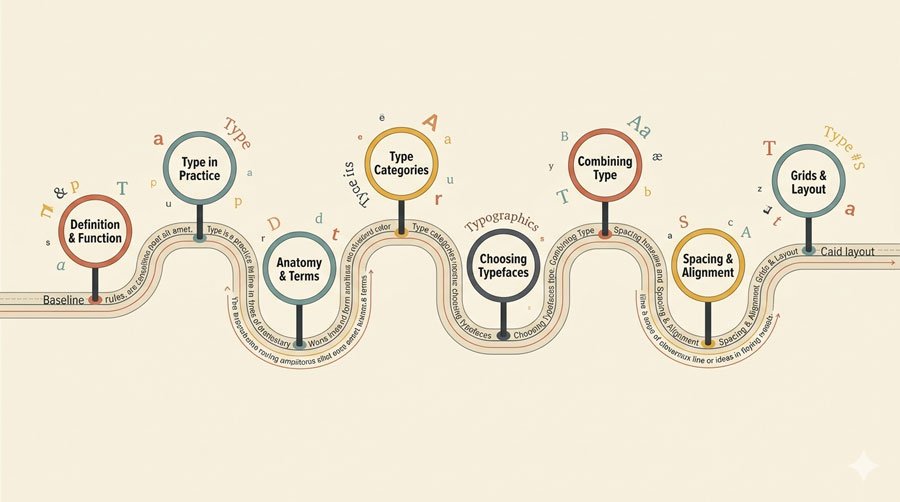
This series is based on a practical, instructional approach rather than a historical survey, focusing on principles that endure regardless of software or tools.
In upcoming parts, you will explore type in context, anatomy and terminology, typeface categories, selection strategies, combining type, spacing and alignment, and grid systems—all grounded in the same fundamentals introduced here.
By the end, you will have a solid foundation to design with type across mediums using well‑founded principles that help you merge content and form with confidence.
Related Topics:
- Gill Sans – Humanist Alternative Modernism
- Baskerville – Print Excellence & Love Story
- Bodoni – Theatrical Prestige Aesthetics
Conclusion and Next Steps
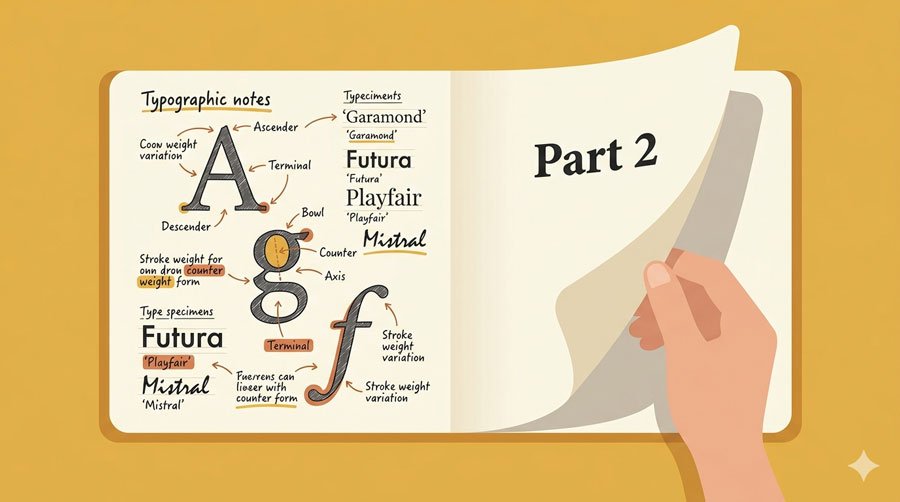
In this first part, you explored what typography is, how it functions, and why macrotypography and microtypography form the backbone of typographic design. As you move through the series, keep returning to these fundamentals: clarity of communication, aesthetic appropriateness, and the interplay between overall composition and fine detail.
In Part 2, you will see typography in practice through concrete examples across media so you can recognize how these fundamentals show up in real projects and apply them to your own work. If you are ready to deepen your typographic skills, keep reading through the series and start consciously observing the type that surrounds you every day.
Related Topics:
- Garamond – Classical Foundation Principles
- Worst Fonts – Criticism & Gatekeeping Analysis
- Gill Sans & The Tube – Urban Identity Infrastructure
About the Author
Lalit M. S. Adhikari is a Digital Nomad and Educator since 2009 in design education, graphic design and animation. He’s taught 500+ students and created 200+ educational articles on design topics. His teaching approach emphasizes clarity, practical application and helping learners.
Learn more about Lalit Adhikari.
We try to keep the guide updated with the latest information about Adobe Tools and Design Best Practices. Lasted Updated: 15th Aug 2026.
Related Topics:
- Baskerville & Mrs. Eaves – Love, Partnership & Revival
- Futura & Paul Renner – Geometric Vision & Revolution
- Legibility vs. Readability – Typography Fundamentals
- Ampersand & Interrobang – Symbol Histories