

Discover how stellar alchemy transformed simple particles into consciousness. Explore the Big Bang, stellar evolution, and cosmic origins of life in this comprehensive guide to the universe’s greatest mystery.
My name is Lalit Adhikari and we are at LTY. Let’s begin!
Table of Contents
Introduction: Why We Should Look Up at the Night Sky
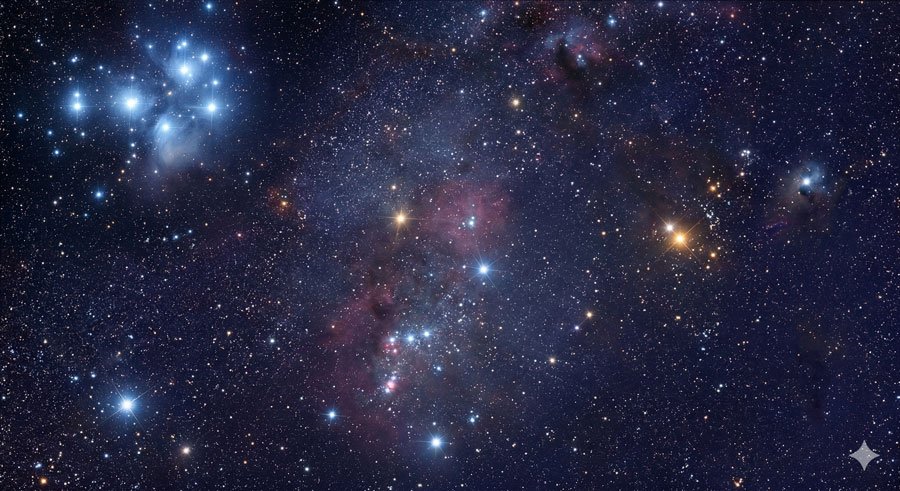
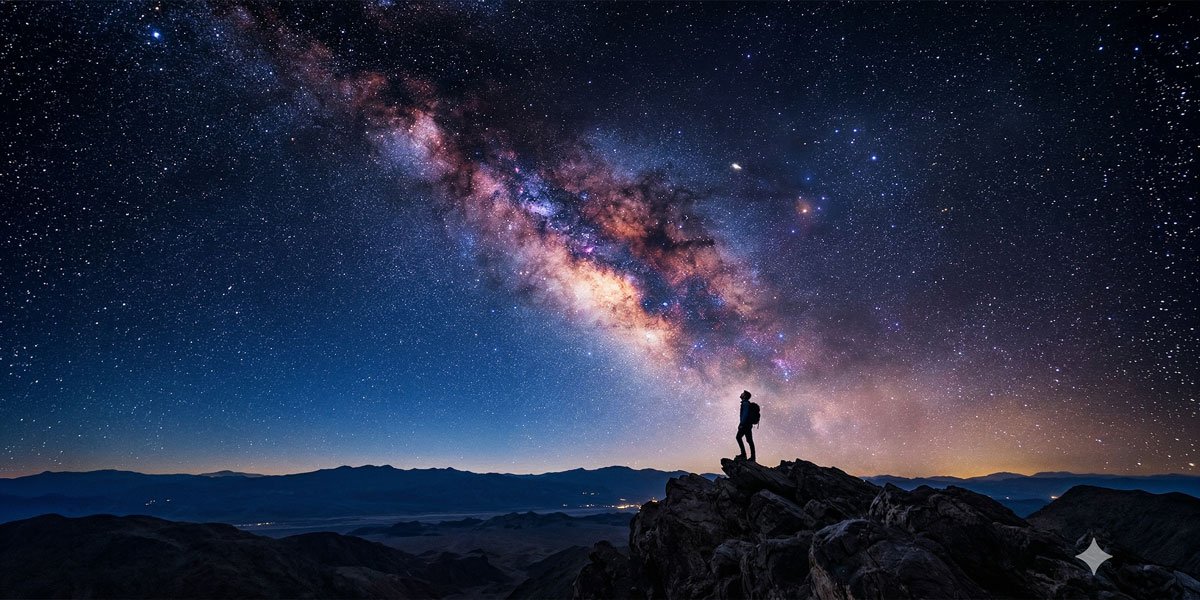
We live under one of nature’s most magnificent displays, yet we rarely take time to appreciate it. The night sky has been there since the dawn of humanity, yet most of us overlook it in our daily rush.
When you pause and look up at those distant points of light, you’re witnessing something far more profound than random stars scattered across darkness.
What we observe in the night sky isn’t merely mysterious balls of light at incomprehensible distances.
Instead, we’re watching starlight that has journeyed across vast cosmic distances through the vacuum of space—light emitted by stars similar to our own, sometimes hundreds of millions of years ago.
This realization transforms the night sky from a simple backdrop into a window to the ancient universe itself.
In this blog post, we’ll explore an extraordinary journey: how simple hydrogen atoms transformed into consciousness, how stellar alchemy literally created us and why understanding this cosmic narrative should humble and inspire us.
The Universe’s Greatest Mystery: From Simplicity to Complexity
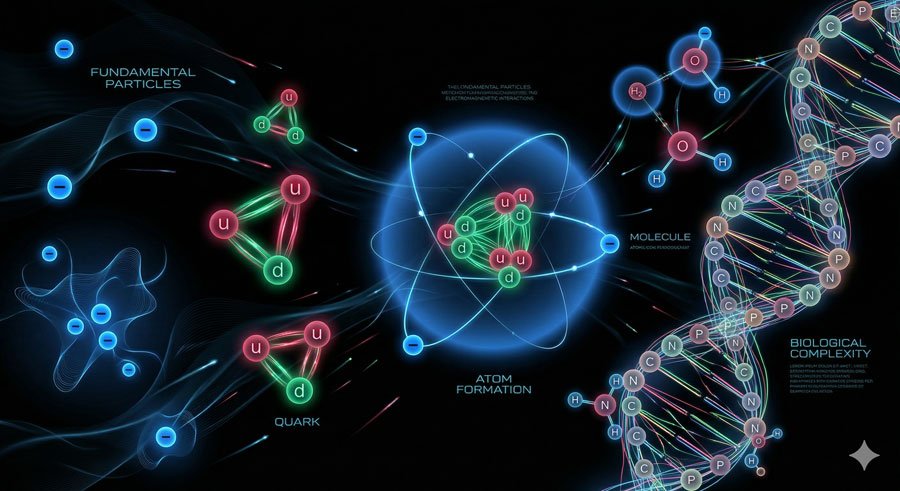
How Three Particles Created Everything
At the heart of all matter in our universe lies stunning simplicity: electrons and quarks. Just three types of particles. From these fundamental building blocks emerges everything we observe—from the molecules in our bodies to galaxies containing billions of stars.
This raises a profound question that has fascinated physicists and philosophers alike: How do you bridge the gap between this fundamental simplicity and incredible complexity?
How do three particles combine to create Leonardo da Vinci’s genius, Albert Einstein’s revolutionary physics, towering galaxies, and mysterious black holes?
Understanding this transformation requires us to journey backward through time—to witness the universe’s birth, the death of stars, and the eventual emergence of consciousness itself.
The Origin Story: The Big Bang and Cosmic Expansion
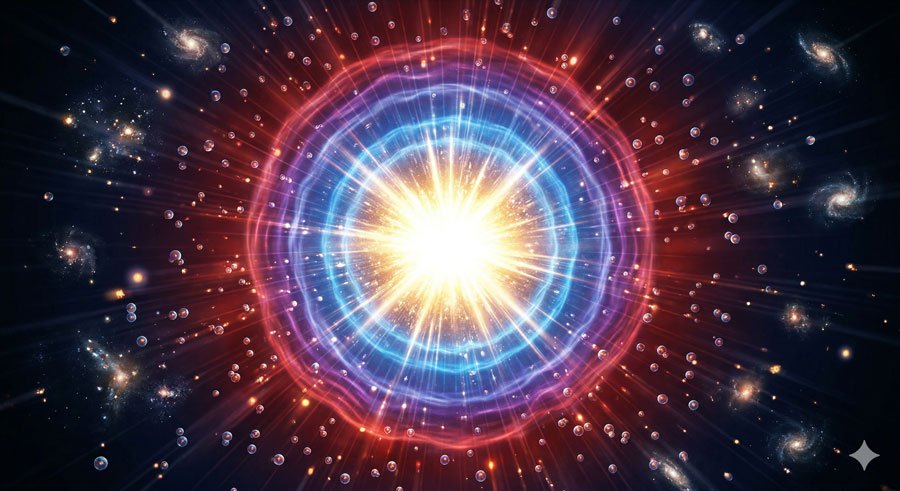
When the Universe Was Born
Approximately 13.8 billion years ago, our universe erupted into existence with the most violent and energetic event possible: the Big Bang.
In that infinitesimal fraction of a second, all matter, energy, space and time sprang forth from what physicists describe as a singularity—a point of infinite density.
What happened next was a cosmic drama unfolding across billions of years:
- Rapid Expansion: The universe expanded at incomprehensible speeds, creating space itself as it grew
- Cooling: As it expanded, the universe cooled from incomprehensibly hot to temperatures where matter could form
- Matter Formation: Energy condensed into the simplest matter—hydrogen atoms, the most abundant element in the universe
- Galaxy Formation: These hydrogen atoms accumulated into vast clouds, rushing away from each other, eventually coalescing into the first galaxies
The cosmos transformed from pure energy into a universe populated by galaxies, but it remained largely dark. The stars had yet to be born.
The First Generation of Stars: When Light Flooded the Cosmos
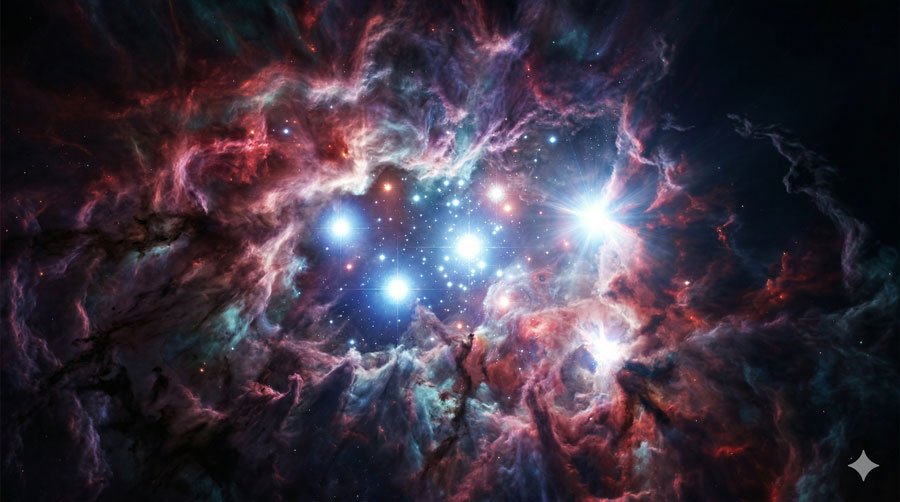
Stars as Cosmic Furnaces
Within these primordial galaxies, something extraordinary happened: the first generation of stars ignited, flooding the cosmos with light for the first time. These ancient stars were massive—far larger than our Sun—burning with intense nuclear fusion at their cores.
The Alchemy Inside Stars: Creating Heavier Elements
Here’s where the magic truly begins. Deep within these stellar furnaces, something remarkable was occurring. Through the process of nuclear fusion, hydrogen atoms were combining into helium and helium was fusing into heavier elements like:
- Carbon
- Oxygen
- Iron
- Silicon
- And many others
These heavier elements became the “leftovers” of stellar fusion—the by-products that would later become absolutely essential for life itself.
But there was a problem: these elements were trapped inside the stars. They couldn’t escape into the universe until something dramatic happened.
Stellar Death and Rebirth: The Supernova Connection
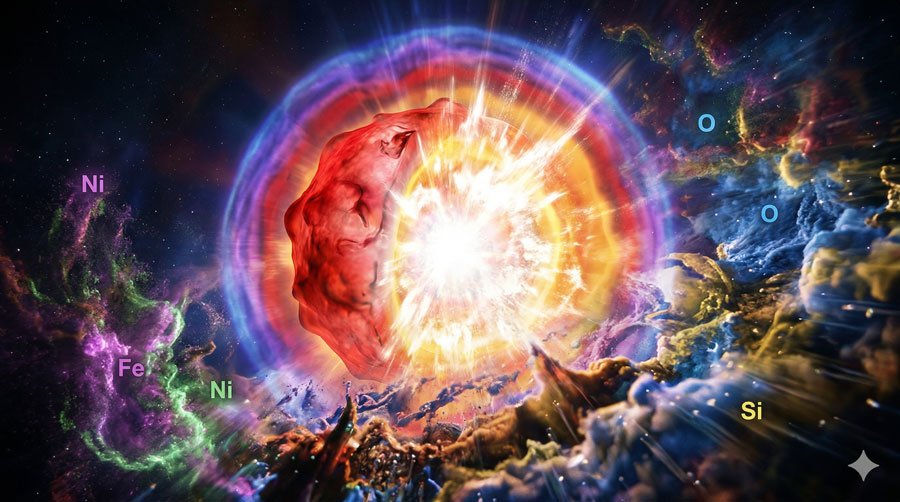
When Massive Stars Exploded
The first generation of stars lived fast and died young. As these massive stars exhausted their nuclear fuel, they faced cosmic catastrophe.
Unable to support themselves against their own immense gravity, they collapsed catastrophically and then exploded in titanic events called supernovae.
These supernovae weren’t mere explosions—they were cosmic scatterings of the precious elements forged in stellar furnaces.
The heavy elements that had been locked inside these dying stars were violently ejected into space, enriching the interstellar gas with the building blocks of worlds and life.
The Recycled Universe
In our Milky Way galaxy, something remarkable occurred: the cosmos recycled itself. The enriched interstellar gas—now containing heavier elements inherited from the stellar ancestors—began forming a new generation of stars. These second-generation stars were different. They carried within them a cosmic legacy: the heavy elements essential for creating rocky planets.
From Stars to Planets: Where Rocky Worlds Are Born
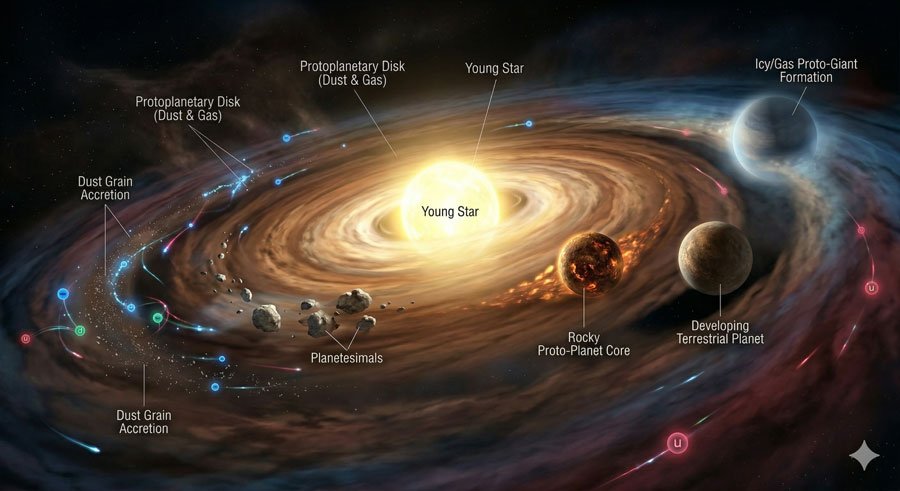
Turbulent Clouds and Stellar Alchemy
In the depths of interstellar space, gravity gathered great turbulent clouds of gas and dust, which were then illuminated by starlight. Within these clouds, something remarkable happened. The heavier elements—carbon, oxygen, silicon, and iron—began to condense.
They formed:
- Rocky dust grains
- Ice crystals
- Complex carbon-based molecules
All of this followed the elegant laws of physics and chemistry. The hydrogen atom, through its interactions, had literally ignited the “stuff of life.”
Planetary Formation
As new stars were formed from these enriched clouds, tiny condensations of matter began accumulating around them. Small clusters of rocks and metals, combined with ice and gas, gradually grew larger through gravitational attraction.
Over millions of years, these collections transformed into full-fledged planets.
And crucially, these planets didn’t form from pure hydrogen and helium. They were composed of heavier elements—the ashes of dead stars.
The organic molecules on these new-born worlds were literally made from atoms that had been cooked inside stars.
The Emergence of Life: Accident Becomes Alchemy
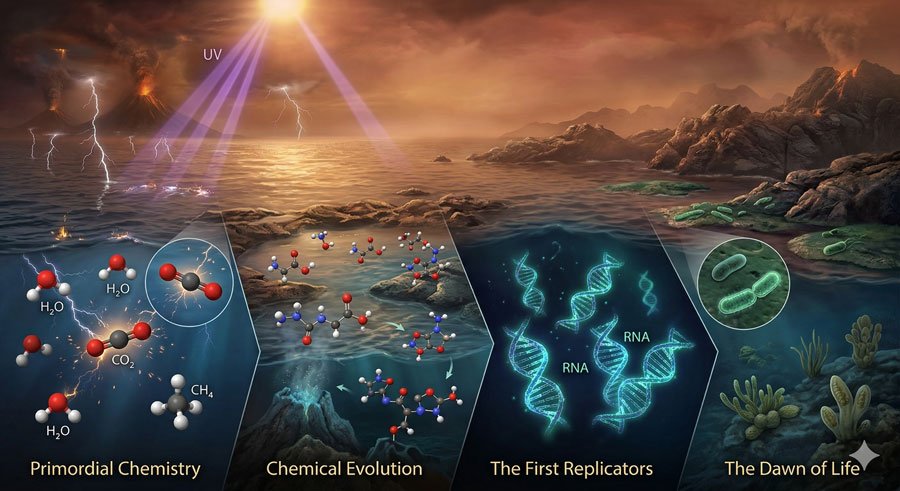
When Molecules Learned to Copy Themselves
On at least one of these rocky worlds—our Earth—something extraordinary occurred. Within the primordial oceans and atmospheres, organic molecules began to form and interact in increasingly complex ways.
Then, by pure accident, a molecule arose with a remarkable property: it could make crude copies of itself. This wasn’t alive in the way we understand life, but it represented something genuinely novel in the universe—self-replication.
Natural Selection Begins
What happened next was the inevitable consequence of any system capable of self-replication: competition and natural selection.
Molecules that copied themselves more accurately produced more copies than those that didn’t. This wasn’t driven by purpose or intent—merely by mathematics and chemistry.
Over countless generations:
- Self-replication became more accurate
- Collectives of organic molecules began cooperating
- Simple molecules gave rise to one-celled organisms
- Single-celled organisms evolved into multi-celled colonies
- Various parts of these colonies specialized into vital organs
The Evolution of Consciousness: From Life to Awareness
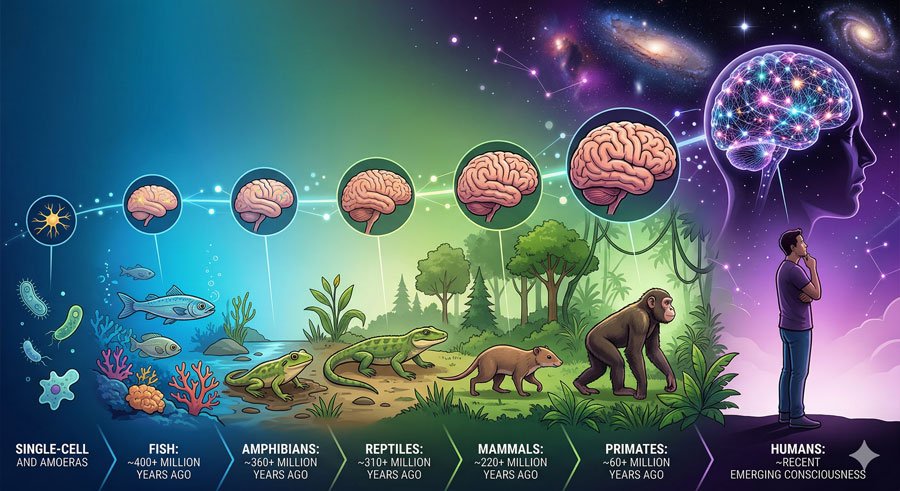
Eyes Evolved and the Cosmos Could See
For billions of years, life remained confined to the oceans. Then some organisms made the leap to land. As life diversified and evolved, something remarkable developed: eyes. This was a turning point in cosmic history.
“Finally, the eyes evolved and the cosmos could see.”
With the emergence of eyes came something previously impossible in the universe—direct visual perception. Life could now observe and react to its environment with unprecedented sophistication.
From Instinct to Curiosity to Consciousness
As organisms continued to evolve, some developed larger brains relative to their body size.
Warm-blooded creatures with bigger brains developed curiosity about their environment. They learned to use tools. They harnessed fire. They gathered knowledge about their world and observed the stars.
And thus, consciousness emerged. Billions of years after the Big Bang, the universe developed the capacity to understand itself.
The stellar alchemy that had created the atoms in our bodies had also created the minds capable of comprehending that very alchemy.
Why This Matters: The Cosmic Perspective
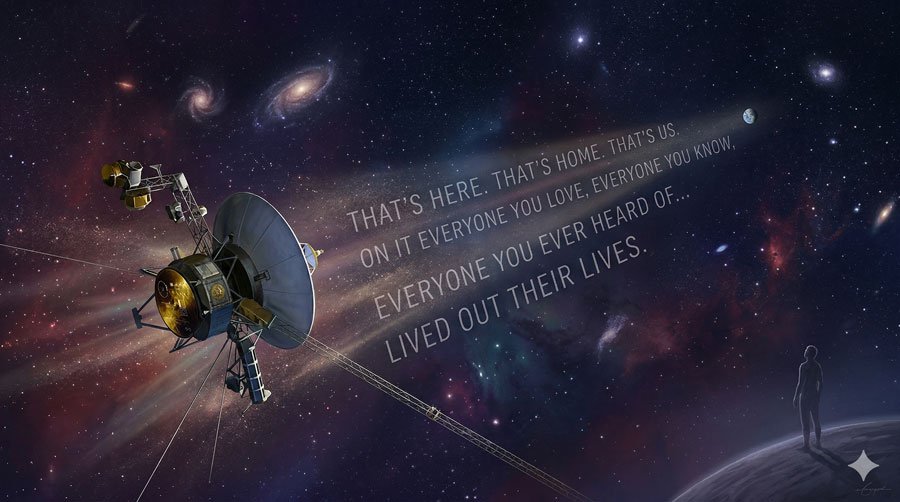
Finding Inspiration in the Cosmos
This journey from quantum simplicity to conscious complexity represents the greatest story ever told. When we grasp this narrative, several profound realizations emerge:
We Are Made of Stardust
- Every carbon atom in your body was forged in a star
- The iron in your blood comes from stellar furnaces
- The calcium in your bones was created in cosmic alchemy
- You are literally a reorganization of stellar material
We Are Products of Cosmic Evolution
- Life emerged not by magic, but through natural processes
- Evolution is written into the physics of our universe
- The same natural laws that created atoms created us
We Are the Universe Awakening
- For the first time in cosmic history, the universe developed eyes to see itself
- For the first time, matter organized itself to understand its own nature
- Consciousness is the universe’s way of comprehending itself
Finding Motivation in Cosmic Wonder
As Carl Sagan, one of the greatest astrophysicists and communicators of science, often said:
“Somewhere something incredible is waiting to be known.”
This quote captures the essence of scientific wonder. In a universe of such magnitude—billions of galaxies, each containing billions of stars—we have barely scratched the surface of understanding. There are countless mysteries waiting for curious minds to unravel them.
When we feel small or insignificant contemplating the cosmos, we should instead feel wonder. We should remember that we are not separate from this universe—we are an expression of it. The same forces that created galaxies created us.
Conclusion: Look Up and Wonder
The night sky that we overlook in our daily routines is far more than a simple backdrop. It is a textbook of cosmic history. Each star is a furnace that created the elements of life.
Each galaxy contains billions of solar systems, some of which might harbor life asking the same questions we ask.
Next time you find yourself with a moment of peace, look up. Observe the night sky not as random dots of light, but as:
- A record of cosmic history
- A gallery of stellar furnaces that created you
- A reminder that you are connected to everything in the universe
- An invitation to wonder and curiosity
As the universe has evolved from simplicity to consciousness, so too can we continue to evolve our understanding. The stellar alchemy that created us continues in the work we do, the questions we ask, and the knowledge we pursue.
The universe is waiting. Are you ready to look up and listen?
About the Author
Lalit M. S. Adhikari is a Digital Nomad and Educator since 2009 in design education, graphic design and animation. He’s taught 500+ students and created 200+ educational articles on design topics. His teaching approach emphasizes clarity, practical application and helping learners.
Learn more about Lalit Adhikari.
This guide is regularly updated with the latest information about Adobe tools and design best practices. Last Updated: Mar 2026