

Explore Einstein’s mind palace and how his 1905 Annus Mirabilis papers, including the famous equation (E = mc2), redefined space, time, mass and energy. Discover the hidden lessons from Einstein’s thought experiments and his journey from failure to genius.
Table of Contents
Introduction: Inside Einstein’s “Mind Palace”

Albert Einstein is often described as the archetype of a genius, yet his greatest discoveries did not come from fancy laboratories or huge teams.
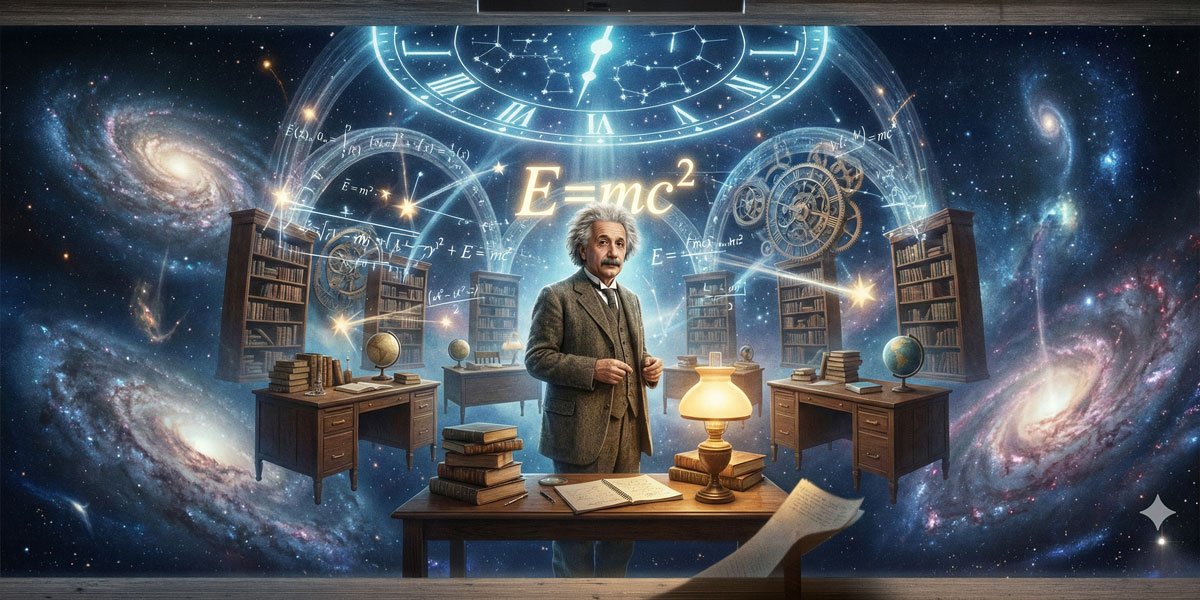
They came from something anyone can develop: the disciplined use of imagination, or what can be called his “mind palace.” Through thought alone, Einstein reshaped humanity’s understanding of space, time, matter and energy.
At the heart of this transformation lies his famous equation (E = mc2), a deceptively simple formula that connects mass and energy. But the story of how Einstein reached this insight, and what it really means, is far richer than a single equation.
Related Topics:
- Life Lessons from Martial Arts: How Bruce Lee‑Style Training Builds Courage and Resilience
- Depression: The Silent Global Epidemic We Can’t Ignore
- How to Master Body Language: 5 Techniques to Boost Confidence & Presence
Why Albert Einstein Became Time’s “Person of the Century”
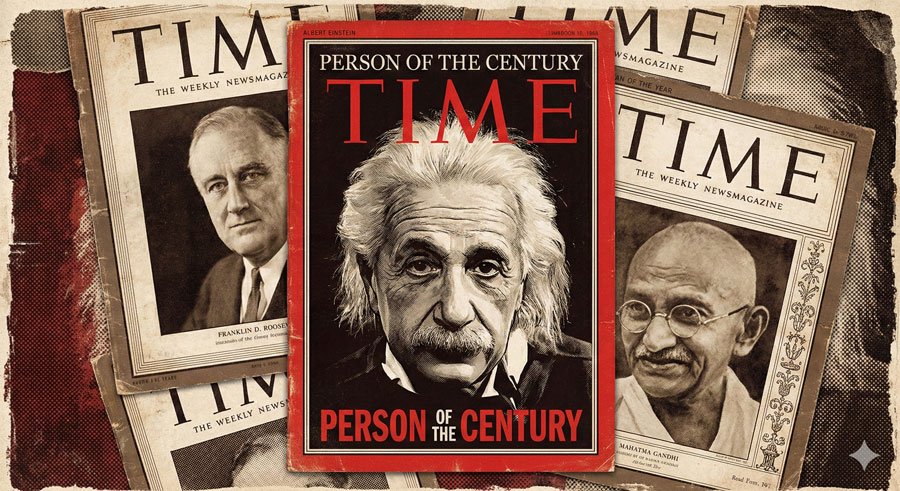
In 1999, as the 20th century came to a close, Time magazine set out to choose its “Person of the Century.”
After considering many influential figures, including Franklin D. Roosevelt for his leadership against fascism and communism and Mahatma Gandhi as a global symbol of non-violence and human rights, the final honour went to Albert Einstein.
Science writer Fredric Golden summarized why Einstein stood apart. Einstein lived in a century dominated by science, and the biggest ideas of that era—atomic energy, the Big Bang, quantum physics and modern electronics—were all touched by his work.
He became the symbol of pure intellect: a “genius among geniuses” who revealed that the universe is not as it first appears, simply by thinking deeply about it.
Related Topics:
- Innovation in Entrepreneurship: How Creative Thinking Drives Business Success
- Healing After Heartbreak: Turn a Broken Heart Into Strength
- Life Lessons from Superheroes: How Fear Makes Us Brave
Einstein’s Miracle Year: The 1905 Annus Mirabilis Papers
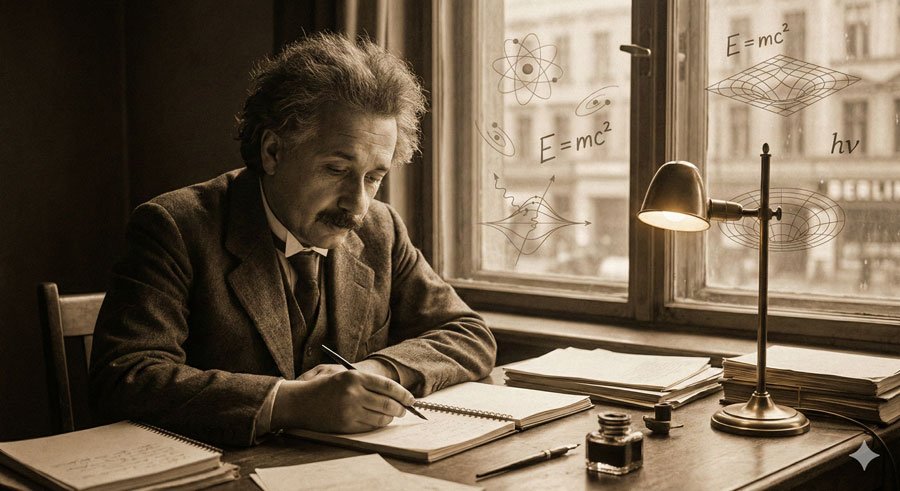
Einstein’s journey was not smooth from the beginning. Although he performed well academically, he struggled to secure a teaching job and faced repeated rejections.
Eventually, he took a position at the Swiss Patent Office in Bern. Far from the prestige of universities and research institutes, he reviewed patent applications by day and worked on physics problems in relative isolation by night.
In 1905, at the age of 26, Einstein published five ground-breaking scientific papers. This extraordinary burst of creativity became known as his Annus Mirabilis—Latin for “miracle year.” Each paper tackled a different problem in physics, and together they helped launch modern physics.
Paper 1: Measuring the Invisible – Molecular Dimensions
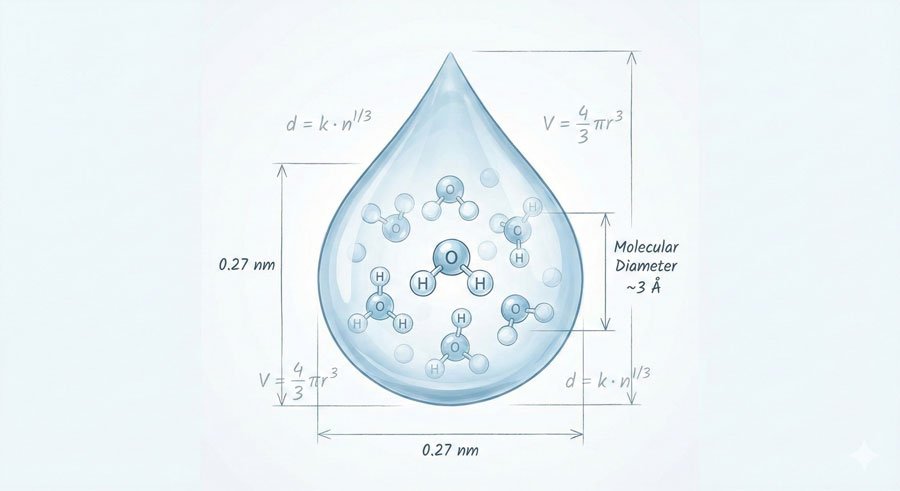
In his first paper, Einstein proposed a new method to determine molecular dimensions, such as the size of water molecules. At a time when atoms and molecules were not universally accepted as real entities, this work provided a powerful way to connect measurable physical properties to the invisible building blocks of matter.
Paper 2: Light Comes in Packets – Birth of the Photon

Einstein’s second paper introduced a radical idea: light is not just a continuous wave but can also behave as discrete packets of energy, which later came to be known as photons. He argued that radiation is emitted and absorbed in specific “quanta” of energy, with each packet’s energy proportional to the frequency of the light.
This bold proposal challenged the classical wave-only view of light and laid the foundation for quantum theory. It hinted that nature, at a fundamental level, is granular and probabilistic rather than purely smooth and continuous.
Paper 3: Brownian Motion and the Reality of Atoms

In the third paper, Einstein analysed Brownian motion—the random, jittery movement of tiny particles suspended in a fluid. By explaining this motion using atomic theory, he provided strong evidence that atoms and molecules are real physical entities, not just useful mathematical ideas. This work helped convince the scientific community that the atomic theory of matter was correct.
Paper 4: Special Relativity and the End of Absolute Time

Einstein’s fourth paper introduced the special theory of relativity, which overturned the long-held belief that time and space are absolute. Instead, it showed that measurements of time and distance depend on the relative motion between observers.
This theory revealed that:
- The speed of light in a vacuum is the same for all observers
- Time can dilate (slow down) and lengths can contract for objects moving close to the speed of light
- Events that seem simultaneous in one frame may not be simultaneous in another
Special relativity redefined fundamental concepts like simultaneity, space and time, preparing the ground for an even deeper understanding of the universe.
Paper 5: E=mc2 and the Equivalence of Mass and Energy
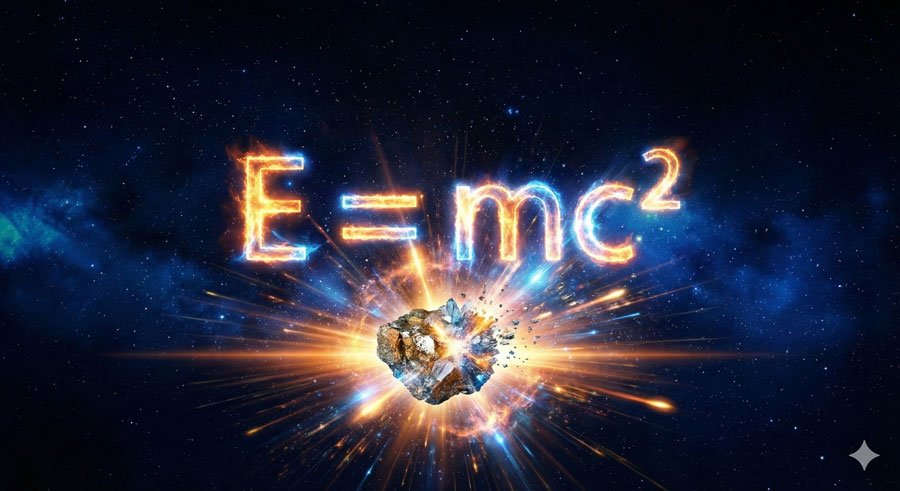
In the fifth paper of 1905, Einstein introduced what would become the most famous equation in the world: (E = mc^2). This formula states that energy (E) and mass (m) are equivalent and connected by the square of the speed of light (c).
In simple terms, mass is a highly concentrated form of energy. A small amount of mass can, in principle, be converted into a vast amount of energy because (c) is such a large number.
This insight underpins nuclear power, nuclear weapons and many processes in astrophysics, from how stars shine to how particles behave in accelerators.
Related Topics:
Beyond E=mc2: The Full Energy–Mass–Momentum Equation
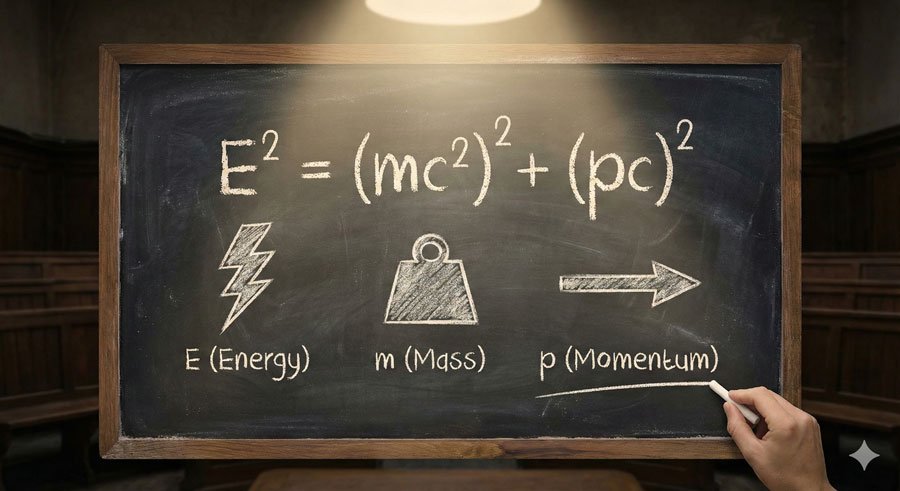
The iconic equation (E = mc2) is actually a special case. It applies to objects with mass that are at rest. The more general relationship between energy, mass and momentum in special relativity is:
[ E2 = (mc2)2 + (pc)2 ]
Here, (E) is the total energy of the object, (m) is its mass, (p) is its momentum and (c) is the speed of light.
- For an object at rest, its momentum (p = 0), so the equation reduces to (E = mc^2).
- For a massless particle, such as a photon, (m = 0) and the equation becomes (E = pc).
This shows that the energy of a massless particle is directly related to its momentum. The closer the ratio of an object’s energy to (pc), the more it behaves like light.
This full equation is a compact summary of how energy, mass and motion are tied together in the fabric of spacetime.
Einstein, Newton and the Power of Solitude
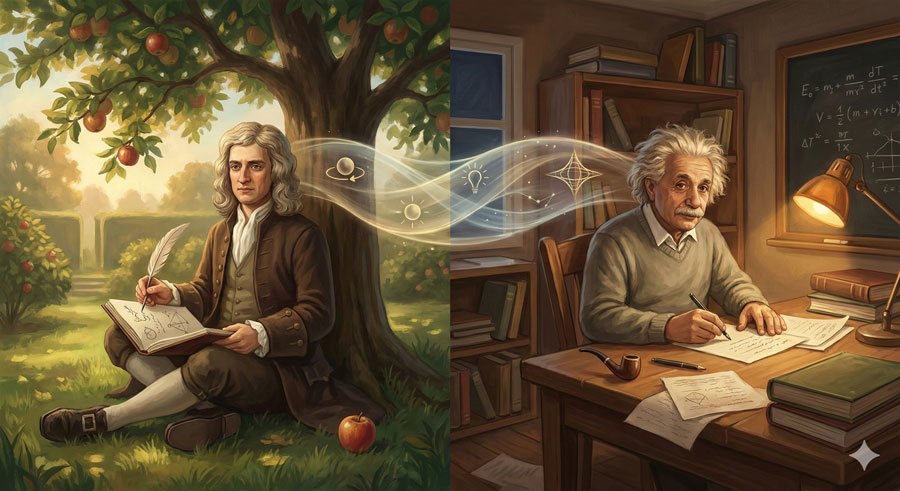
Einstein’s miracle year has an intriguing parallel in the life of Isaac Newton.
In 1666, the University of Cambridge closed temporarily due to the plague, and Newton retreated to the countryside.
In this period of isolation, he developed core ideas in calculus, optics and gravitation.
Centuries later, Einstein, working largely alone in a modest patent office, reshaped physics from his desk.
Both stories highlight an important theme: periods of solitude, far from being wasted time, can become incubators for deep, focused thinking that changes the world.
Inside Einstein’s Mind Palace: Thought Experiments and Daydreams

Einstein possessed a remarkable ability to transform complex physical problems into vivid mental images and thought experiments.
Instead of relying primarily on elaborate apparatus, he imagined scenarios—like riding alongside a beam of light or watching clocks from different moving frames—to expose hidden assumptions in existing theories.
Popular culture, including TV shows like The Big Bang Theory, has often referenced Einstein’s thought experiments, but their true power lies in how they blend creativity with rigorous logic.
They show that imagination, when paired with persistence and critical thinking, can be as powerful as any laboratory.
Einstein’s Childhood: Curiosity, Rebellion and Persistence

Einstein’s unique way of thinking did not appear overnight. As a child in Munich, he was slow to speak, enough to worry his parents and send them to a doctor. He was a daydreamer and often a loner, more interested in abstract questions than in following rigid school routines.
Yet he was also intensely curious and deeply persistent. Rather than memorizing answers, he wanted to understand the underlying laws of nature. This combination of rebellion against rote learning and devotion to understanding laid the foundation for his later breakthroughs.
Life Lessons from Einstein’s Journey
Einstein’s story is not just about physics; it is also about how to approach life and learning. Several key lessons stand out:
- Failure is not final: Despite academic talent, Einstein initially struggled to secure a teaching job. His persistence in the face of rejection is a powerful reminder that early failures do not define a career.
- Ideas can be world-changing: Many of his greatest contributions emerged from pure thought, not expensive equipment. This underscores the transformative power of a single idea pursued with dedication.
- Curiosity is a lifelong asset: From childhood to old age, Einstein remained driven by a desire to understand the universe more deeply. That curiosity fueled his creativity and sustained his work through obstacles.
- Solitude can be fertile ground: Just as Newton and Einstein both made historic advances during periods of isolation, focused time away from distractions can unlock new levels of insight.
There are only a few moments in the history of science when humanity is forced to completely rethink its picture of reality.
Einstein’s theories created several of those moments. His mind palace was built not from privilege or perfect circumstances, but from imagination, discipline and an unwavering belief in the power of ideas.
About the Author
Lalit M. S. Adhikari is a Digital Nomad and Educator since 2009 in design education, graphic design and animation. He’s taught 500+ students and created 200+ educational articles on design topics. His teaching approach emphasizes clarity, practical application and helping learners.
Learn more about Lalit Adhikari.
This guide is regularly updated with the latest information about Adobe tools and design best practices. Last Updated: Mar 2026