

Learn how to define yourself as a product designer by leveraging your unique background, telling your story and building a compelling portfolio that showcases your value.
Table of Contents
Introduction: You Are More Than Your Skills

You’ve learned the disciplines, practiced the methodologies, and built your foundational knowledge in product design. But here’s what many designers miss: having great skills is necessary but not sufficient.
What sets you apart isn’t just what you can do—it’s who you are, where you’ve been, and the unique perspective you bring to the problems you solve.
This is the second critical area for breaking into product design: defining yourself. This goes beyond creating a resume or portfolio.
It’s about understanding and articulating your unique value, the story behind your work, and why companies should invest in you specifically.
Related Topics:
- Understanding Your Audience: Strategic Positioning for Product Design Success
- The Ultimate Guide to Becoming a Product Designer: Your Complete Career Roadmap
- The Three Critical Areas for Breaking Into Product Design: Master Your Craft
The Three Pillars of Defining Yourself
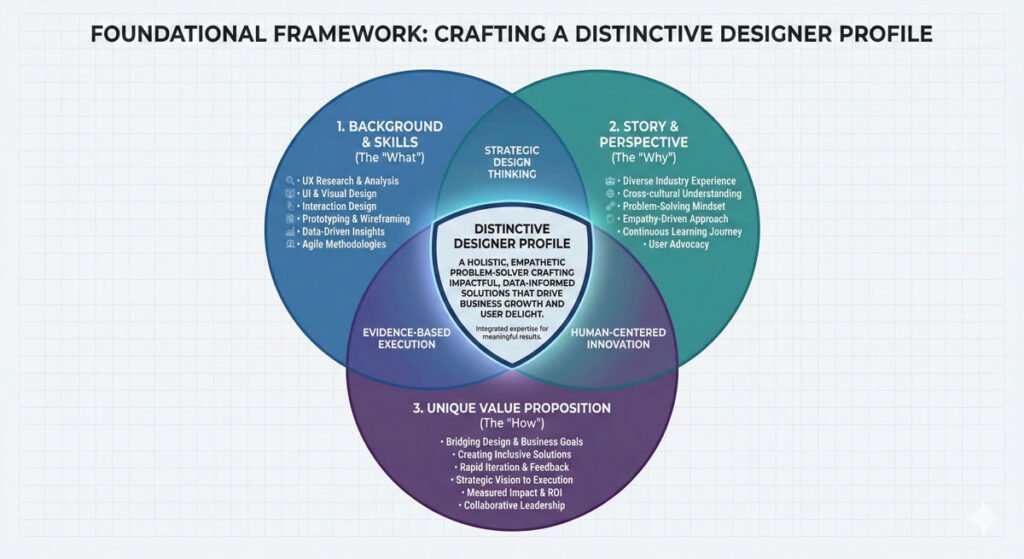
To effectively define yourself as a product designer, you need to work through three interconnected dimensions:
- Be Specific – Know your background, skills, and what gets you excited
- Tell Your Story – Communicate how you leverage your unique background in your work
- Show Your UVP – Demonstrate what makes you uniquely good at this work
Pillar 1: Be Specific About Who You Are
The first step is understanding and articulating your specific background, skills, and interests. This isn’t vanity—it’s strategic clarity.
Understanding Your Background and Transferable Skills
Reflect on these questions:
- What was I doing before product design? What industry or field?
- What skills did I develop in those previous roles?
- What type of problems did I solve?
- What knowledge do I have that most designers don’t?
Your background isn’t a liability—it’s an asset. If you come from marketing, you understand customer acquisition and retention.
If you come from psychology, you understand human behavior deeply. If you come from engineering, you understand technical constraints. If you come from business, you understand strategy and revenue models.
The Competitive Advantage of Diverse Backgrounds:
Designers with diverse backgrounds often outperform those with design-only backgrounds because they bring different perspectives, problem-solving approaches, and domain knowledge. You’re not trying to erase your previous experience—you’re leveraging it.
Identifying Your Areas of Familiarity and Interest
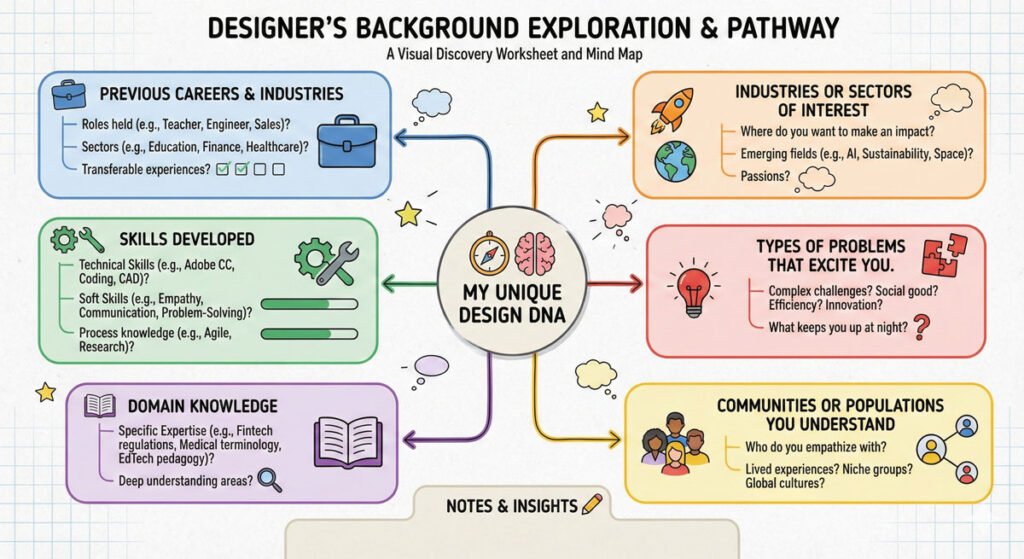
Critical question: What type of people, markets, or industries do you have the most familiarity or interest in? This matters more than many designers realize. Here’s why:
- Knowledge Gaps Cost Time and Energy – If you choose an industry unfamiliar to you, be prepared to spend significant time researching industry-specific knowledge, terminology, and user pain points that an insider would already understand.
- Daily Work Aligns with Interest – You need to be honest about what kinds of problems excite you. If you don’t like working on shopping carts and checkout flows, don’t pursue e-commerce design, no matter how lucrative it seems. You’ll spend your career unhappy.
- Industry Insiders Have Advantages – A designer with healthcare background designing healthcare products understands patient workflows, regulatory constraints, and provider needs intuitively. That’s valuable.
Be Honest About Your Interests and Constraints
Some designers are attracted to fintech because it’s trendy and lucrative. Others are drawn to healthcare because they want to create positive health impact. Still others are excited about environmental and sustainability tech because they care about climate change.
All of these are valid. But here’s the key: be authentic. Your genuine interest shows in your work. Your authentic passion for a problem area will drive you to do deeper research, create more thoughtful solutions, and ultimately create a stronger portfolio.
Equally important is being honest about constraints. You might be interested in complex B2B enterprise software, but if you struggle with large information systems and prefer simple, intuitive interfaces, you’ll be frustrated. Understanding your genuine preferences prevents years of career misalignment.
Pillar 2: Tell Your Story
Having skills and background is one thing. Communicating how you leverage your unique background and interests to inform your work is what makes you memorable and compelling.
The Difference Between Listing Tasks and Telling Your Story
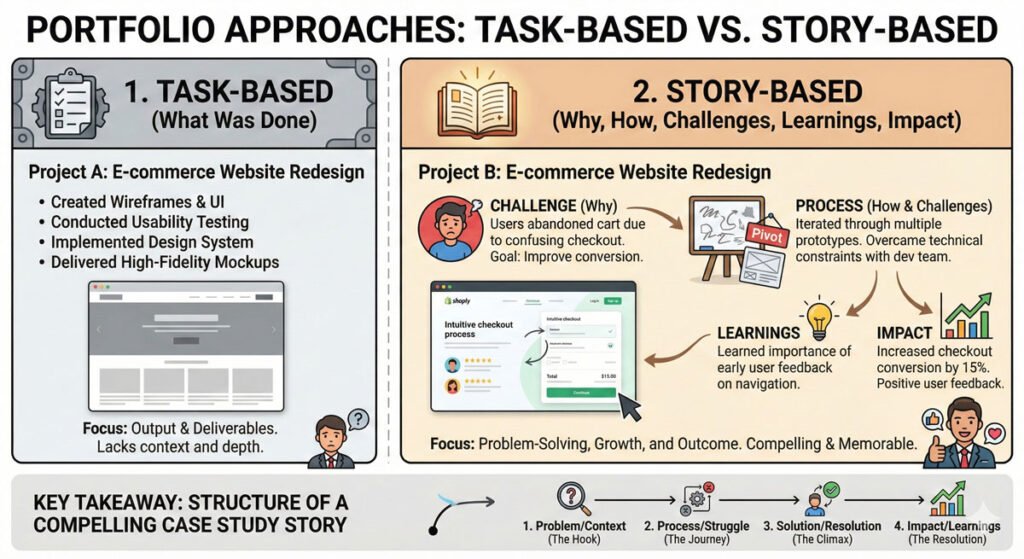
Most designers’ portfolios look the same: they show a project, list the features, mention the tools used, and show the final design. These portfolios are forgettable.
What stands out is storytelling. Instead of just listing tasks, show:
- Why you approached the problem the way you did
- How your unique background informed your approach
- What challenges you faced and how you overcame them
- What you learned and how it changed your thinking
- What the actual outcome or impact was
This transforms your portfolio from a documentation of work into a narrative about your thinking, your approach and your impact.
Key Elements of Your Story
- Context and Background Start by setting the scene. What was the situation? What company or problem were you addressing? What was the state of things before your work
- The Challenge What was the core problem or opportunity? Why was this challenging? What constraints did you face? What made this problem worth solving?
- Your Unique Approach Here’s where your background and perspective shine. How did you approach this differently? What unique insight or experience did you bring? What was your process?
- The Work and Decisions Walk through your work process. Show key decisions and why you made them. This is where you demonstrate your thinking—not just your execution skills.
- The Outcome and Impact What was the result? Quantify impact where possible (increased engagement, improved retention, faster task completion). But also talk about qualitative impact—user satisfaction, business value, or problem solved.
- What You Learned Reflect on the experience. What did you learn? How did this project change your thinking about design? What would you do differently if you did it again?
This structure creates a narrative arc that’s compelling, memorable, and showcases your thinking process.
Getting Specific: Your Personal UVP
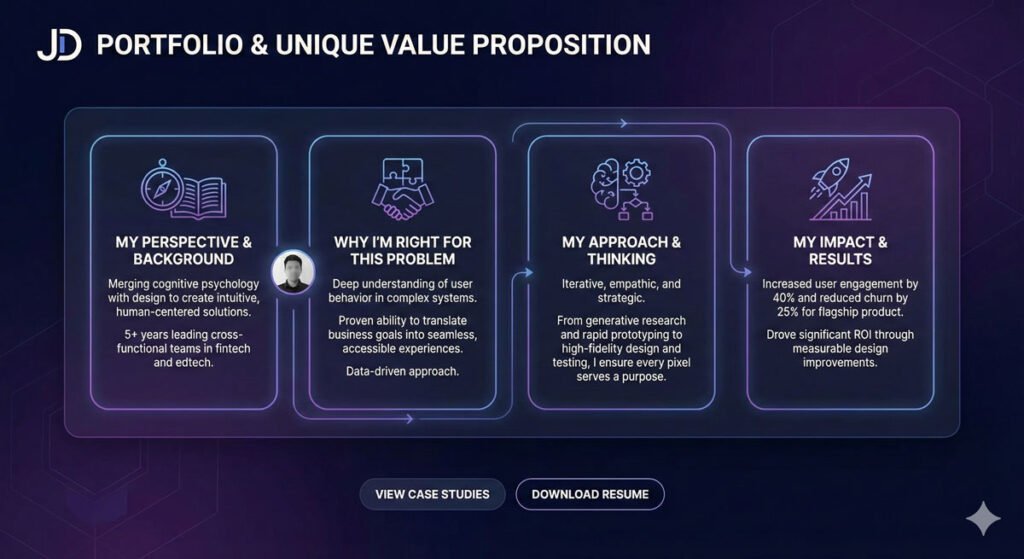
UVP stands for “Unique Value Proposition”—what makes you specifically good at this type of work, doing it in your way?
This isn’t about false modesty or excessive self-promotion. It’s about clarity. What can you do, or how can you approach problems, that’s distinctive because of your background?
Examples:
- A designer with a psychology degree who designs mental health apps understands the nuances of user psychology in ways a typical designer might not
- A designer with e-commerce experience can optimize checkout flows and understand conversion metrics deeply
- A designer with accessibility needs (or who cares about accessibility) will create more inclusive products
- A designer from a non-Western background brings cultural perspectives that create products usable globally
Your UVP isn’t about being “the best” at something. It’s about being distinctively good at something specific because of who you are and what you bring to the table.
Pillar 3: Show Your Process and Outcomes
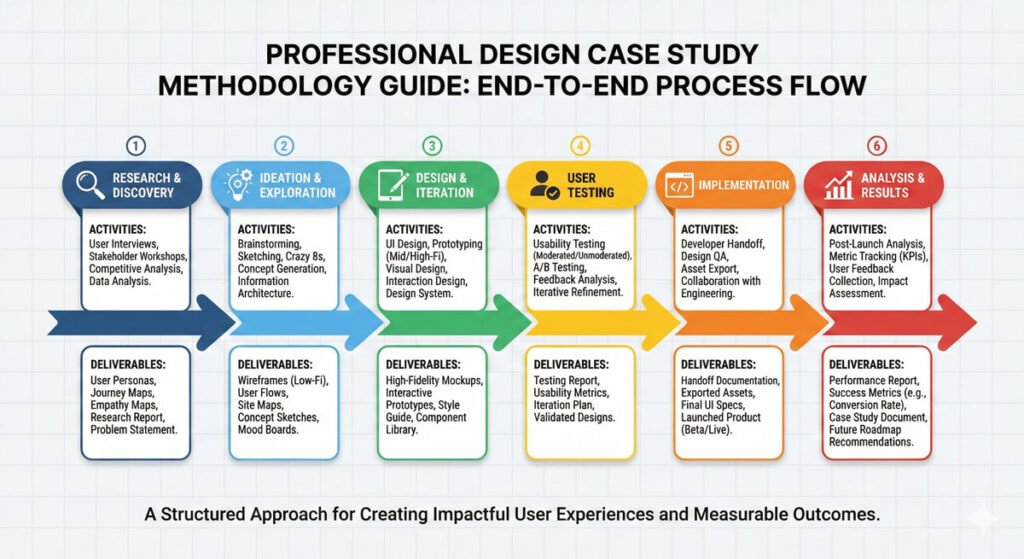
Employers and clients don’t just want to see final designs. They want to understand how you think and whether you’ll create value for their organization.
Beyond the “Final Design”
Your portfolio needs to show:
- Your Research Process – How did you understand the problem? What user research did you conduct? What insights did you uncover?
- Your Ideation and Iteration – Don’t just show the final design. Show early sketches, explorations, and multiple directions. This demonstrates you’re thoughtful, iterative, and willing to explore options.
- Design Decisions – For key screens or features, explain why you designed it that way. What problem does it solve? How does it align with user needs and business goals?
- Collaboration – Show how you worked with engineers, product managers, and other stakeholders. How did you incorporate feedback? How did you navigate constraints?
- Testing and Validation – Did you usability test? What did you learn? How did you iterate based on feedback?
- Results and Impact – What happened after you shipped the work? Did engagement improve? Did user satisfaction increase? Did the business metric move?
This comprehensive approach demonstrates that you’re not just a visual designer—you’re a strategic thinker who understands the entire product development process.
The Importance of Honest Challenges and Learnings
Here’s something many designers miss: showing challenges and what you learned is actually MORE compelling than pretending everything went perfectly.
Real case studies include:
- “I initially approached this problem with X solution, but user testing revealed it didn’t align with user mental models. We pivoted to Y.”
- “We faced technical constraints that prevented our ideal solution. Here’s how we worked within constraints to still deliver value.”
- “In retrospect, I would have conducted more research upfront before jumping to solutions. Here’s what I learned.”
Honesty about challenges and your learning process shows maturity, self-awareness, and the ability to iterate—all highly valued in product design.
The Paradox of Specificity: How Narrowing Actually Expands Opportunity
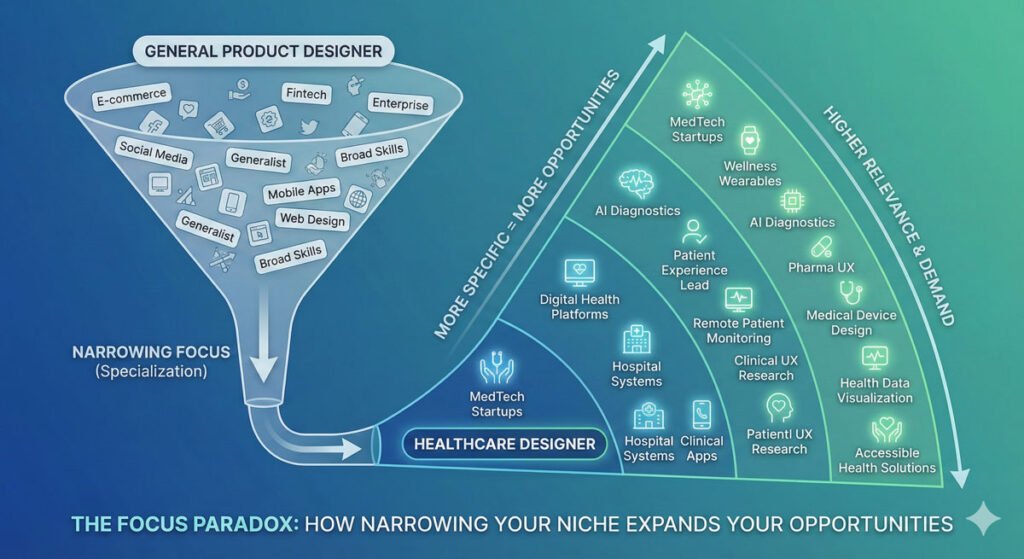
Here’s one of the most counterintuitive yet important principles in building a design career:
“The more specific your goal, the more opportunities you’ll create for yourself. Narrowing your aperture can expand your horizons.”
This paradox is crucial to understand. Many designers try to position themselves as “generalist product designers” who can work on anything. While that seems like a safe strategy, it’s actually limiting.
Why Specificity Creates Opportunity
- You’re More Memorable If you say “I’m a product designer,” you’re one of thousands. If you say “I’m a product designer specializing in healthcare technology,” you’re distinctive.
- You Attract the Right Opportunities Companies looking for healthcare designers will find you. They won’t waste your time, and you won’t waste theirs on wrong-fit opportunities.
- You Build Deeper Expertise By focusing on one industry or problem type, you become expert in that domain faster than generalists. This expertise makes you valuable.
- You Create a Virtuous Cycle First healthcare project → stronger healthcare portfolio → attract more healthcare opportunities → build deeper healthcare expertise → become highly specialized → become highly valuable
- You Network More Strategically In a specific industry, you build deep relationships with key people—other designers, product leaders, executives. This network becomes your greatest asset.
The paradox is real: specificity doesn’t limit opportunity, it multiplies it.
Putting It Together: Your Personal Definition Statement
By working through these three pillars, you should be able to create a personal definition statement—something like:
“I’m a product designer bringing [unique perspective/background] to [specific industry or problem type]. My approach combines [your distinctive methodology or process] with [your key strength or differentiator], resulting in [the type of impact you create].”
This definition statement becomes the core of your portfolio, your case studies, your resume, and your pitch. It clarifies for both yourself and potential employers exactly what value you bring.
Conclusion: Defining Yourself is Strategic Clarity
Defining yourself isn’t about being restrictive or pigeonholing yourself. It’s about strategic clarity that actually opens doors rather than closing them.
The most successful designers aren’t generalists playing it safe. They’re specialists who understand their unique value and communicate it clearly. They know their background matters. They tell compelling stories about their work. They show honest processes and real outcomes.
In the final article of this series, we’ll explore the third critical area: Understanding Your Audience. You’ll learn how to research hiring managers, companies, and industries, then strategically position yourself as the ideal candidate for the opportunities you want.
About the Author
Lalit M. S. Adhikari is a Digital Nomad and Educator since 2009 in design education, graphic design and animation. He’s taught 500+ students and created 200+ educational articles on design topics. His teaching approach emphasizes clarity, practical application and helping learners.
Learn more about Lalit Adhikari.
This guide is regularly updated with the latest information about Adobe tools and design best practices. Last Updated: July 2026