



The Kaizen philosophy isn’t just another self-help methodology—it’s an ancient Japanese system that has transformed countless lives by replacing the myth of overnight transformation with the reality of sustainable change.
Unlike the 21-day diet promises and miracle pills that flood the market, Kaizen teaches us that lasting change comes from tiny, consistent improvements that compound over time.
This comprehensive guide explores how you can apply Kaizen and four other Japanese philosophies to break any addiction, eliminate bad habits, and build the life you truly want—without the guilt, shame, or unrealistic expectations that sabotage most people’s transformation attempts.
Table of Contents
Why All Your Attempts at Change have Failed

Why 99% of People Fail at Breaking Bad Habits
The Breaking Point Story
Imagine this scenario: You’ve spent your entire life battling a bad habit. Maybe it’s excess weight, smoking, alcohol, or endless procrastination. You’ve tried dozens of times to change.
Each attempt started with overwhelming motivation—strict diets, extreme gym regimens, complete lifestyle overhauls. Each time, within days or weeks, everything collapsed. You went back to your old habits, often feeling worse than before.
This pattern isn’t a personal weakness. It’s a systemic failure that affects approximately 99% of people attempting significant behavioral change. The fault lies not in your willpower or character, but in the method itself.
Why the Traditional Approach Fails
When most people decide to change, they make a catastrophic error: they try to win a 40-year war in a two-month battle. Your body took decades to reach its current state. Your mind spent years building these habits. Your neural pathways are deeply entrenched. Yet, the standard approach demands complete transformation in weeks.
Here’s what happens:
- Day 1-3: Initial motivation is high. You’re excited about change.
- Day 4-7: Reality sets in. Your old habits feel safer than new uncertainty.
- Week 2: Social pressure, stress, and normal life complications emerge.
- Week 3: You either slip up or realize the approach is unsustainable.
- Weeks 4+: You abandon the effort and return to old patterns, often worse than before.
This isn’t weakness. It’s neuroscience. Your brain is programmed to resist drastic changes because it interprets them as threats to survival.
The Identity Problem
Most failed attempts share a common element: they focus on actions rather than identity. You might say, “I will lose weight” or “I will stop procrastinating.” But your identity says, “I am someone who has always been overweight” or “I am a procrastinator.”
When your actions conflict with your identity, your brain always chooses identity. It’s the stronger force.
The Hidden Cost of Failure
Each time you fail at change, you reinforce a toxic belief: “I can’t do this. I’m not disciplined. I’m weak.”
This repeated failure creates a dangerous place most people eventually reach: the acceptance of defeat. “That’s just who I am. It’s my genetics. My metabolism. My circumstances. I don’t have the time.”
This acceptance is where real death begins—not physical death, but the slow death of possibility, of hope, of the person you could have been.
Related Topics:
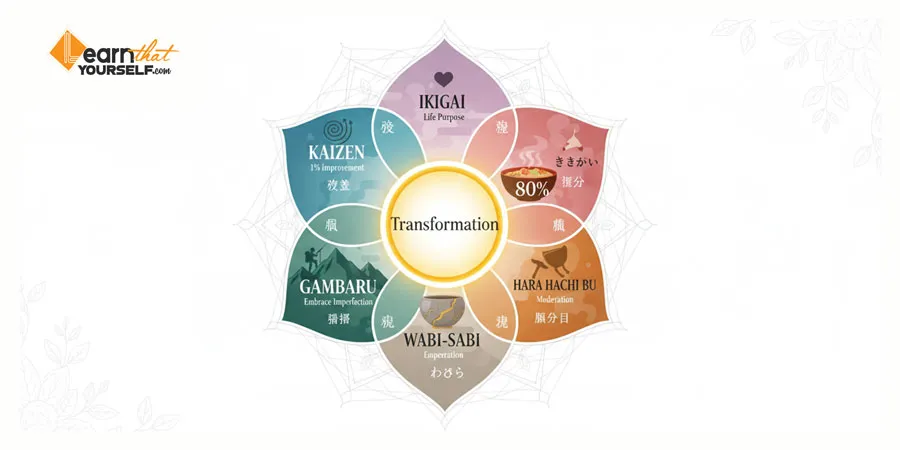
The Five Japanese Philosophies that Transform Lives
Philosophy 1: Kaizen – The 1% Daily Improvement

What Is Kaizen?
Kaizen (改善) literally means “change for better” in Japanese. It’s the philosophy of continuous improvement through small, incremental changes. The core principle is revolutionary in its simplicity: you don’t need to be perfect tomorrow. You just need to be 1% better than today.
The Mathematics of Compound Growth
Here’s the breakthrough: if you improve 1% per day, you don’t improve 365% in a year. You improve 3,778%. This is exponential mathematics at work.
Compare this to decline: if you decline 1% per day for a year, you don’t end up at 365% of your starting point. You end up at essentially zero. Improvement and decline are not linear—they’re exponential.
Keystone Habits: The Domino Effect
When you implement Kaizen correctly, you’re not just changing one behavior. You’re activating what researchers call “keystone habits”—habits that trigger a cascade of positive changes in other areas of your life.
A keystone habit acts like a lever or the first domino in a sequence. By focusing on improving just that core habit, you create small wins that almost automatically facilitate and boost the creation of other good habits.
For example, starting to drink water in the morning doesn’t just hydrate your body—it:
- Proves you can keep a promise to yourself
- Activates your brain earlier in the day
- Reduces hunger cravings
- Improves energy and focus
- Often leads to better breakfast choices
- Can trigger morning exercise
- Contributes to better sleep at night
One small change creates momentum for countless others.
Practical Kaizen Implementation
The key to successful Kaizen is making changes so small they seem almost useless. This is intentional. These “useless” changes are:
- Easy to maintain even on difficult days
- Unlikely to trigger your brain’s threat response
- Simple enough that lack of time cannot be an excuse
- Substantial enough to prove identity shift
Examples of Kaizen changes:
- Drinking one glass of water in the morning
- Five push-ups before bed
- One minute of meditation
- Reading one page of a book
- A 20-meter walk to the mailbox
Philosophy 2: Ikigai – Finding Your True Purpose
What Is Ikigai?
Ikigai (生き甲斐) means “reason for being” or “life purpose.” The Japanese believe that everyone has an ikigai—a profound reason for existing that goes beyond surface motivations.
Why Motivation Fades But Purpose Remains
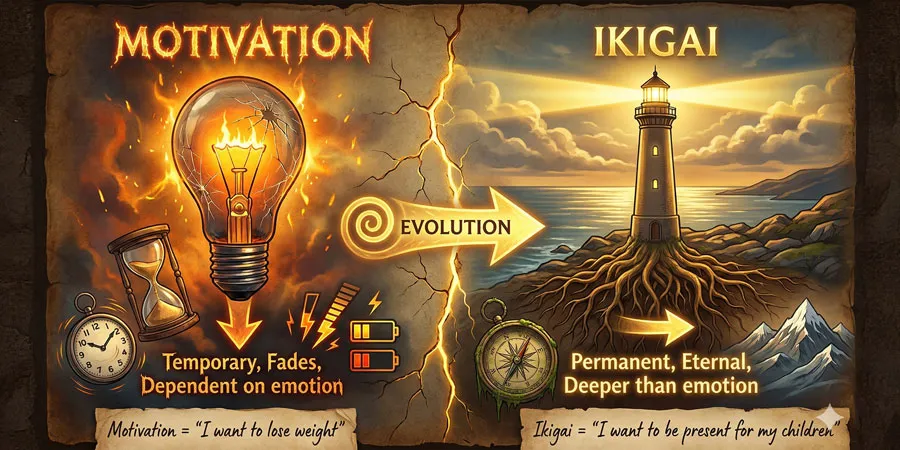
This is the critical distinction: motivation is temporary and fleeting. Purpose is eternal fuel.
Motivation tells you to start. Purpose keeps you going when starting becomes difficult. Motivation says, “I should lose weight because I want to look good.” Purpose says, “I need to be healthy because my children need their father.”
When you rely on motivation, you’re dependent on your emotional state. When you tap into purpose, you access something deeper than emotion—you access meaning.
Discovering Your Ikigai
Your ikigai is rarely on the surface. It’s not usually “lose weight” or “make money.” Those are outcomes. Your ikigai is the reason behind those outcomes.
Ask yourself these questions:
- Why do I really want to change this?
- What would this transformation allow me to do or be?
- Who depends on me changing?
- What am I robbing from myself by not changing?
- What would my life look like if I finally succeeded?
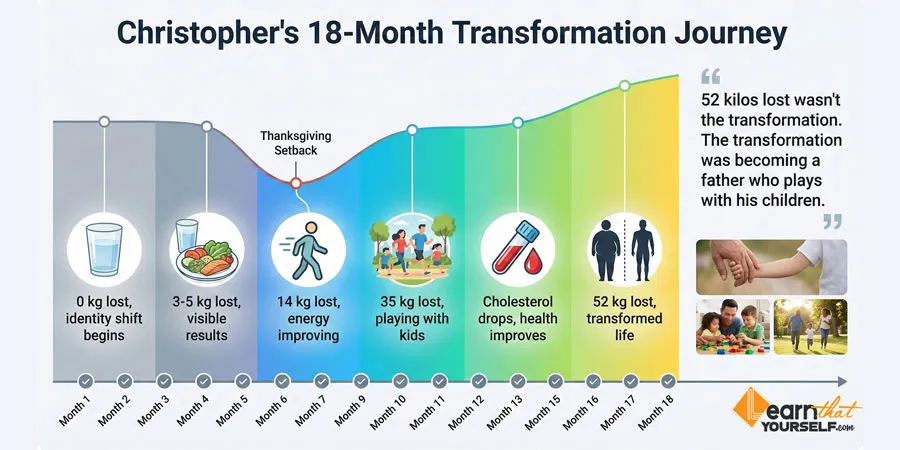
In Christopher’s story, his initial ikigai was “lose weight.” But his true ikigai was “be present for my family and see my children grow up.” When he focused on the true ikigai, everything changed.
When he didn’t want to wake up early, he didn’t think about water or dieting. He thought about his daughter holding his hand. When he wanted to overfill his plate, he thought about walking her down the aisle someday.
Philosophy 3: Hara Hachi Bu – Moderation and Mindful Eating
What Is Hara Hachi Bu?
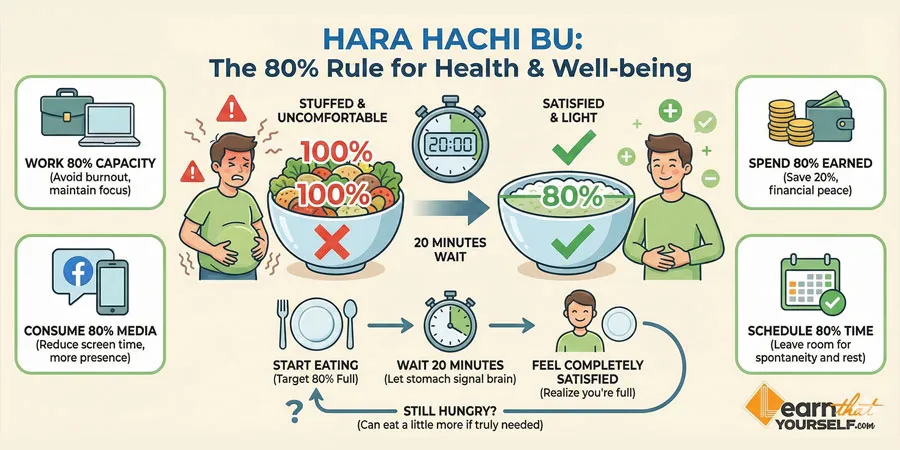
Hara Hachi Bu (腹八分目) is the Okinawan principle of eating until you’re 80% full, not 100% full or beyond. The people of Okinawa have the longest life expectancy in the world—and this principle is foundational to their longevity.
The 20-Minute Gap
Your stomach takes approximately 20 minutes to signal to your brain that it’s satisfied. Most people eat quickly, finishing their meal and feeling famished, only to realize 30 minutes later that they’re uncomfortably full.
Hara Hachi Bu leverages this biological fact:
- Eat slowly and mindfully
- Stop when you feel 80% full
- Wait 20 minutes
- If you’re still genuinely hungry, eat more
In practice, this simple principle has remarkable effects. In Christopher’s case, he went back for seconds only twice in three weeks—because his body wasn’t actually hungry; it was just spoiled.
Hara Hachi Bu Beyond Food
While originating in eating habits, the principle extends to all areas of life. It’s the art of knowing when “enough” is enough:
- Work until you’re 80% productive, not burned out
- Consume entertainment until 80% satisfied, not mindless scrolling
- Save 80% of your money, spend 20%
- Use 80% of your energy on what matters, preserve 20% for recovery
Philosophy 4: Wabi-Sabi – Embracing Imperfection
What Is Wabi-Sabi?
Wabi-Sabi (侘寂) is perhaps the most misunderstood Japanese philosophy in the West. It’s often translated as acceptance of imperfection, but it’s deeper than that—it’s the celebration of imperfection as where true beauty exists.
The fundamental principles of Wabi-Sabi are:
- Impermanence: Nothing lasts forever
- Imperfection: Nothing is perfect or complete
- Incompleteness: Beauty exists in what’s unfinished
- Authenticity: Reality is more valuable than illusion
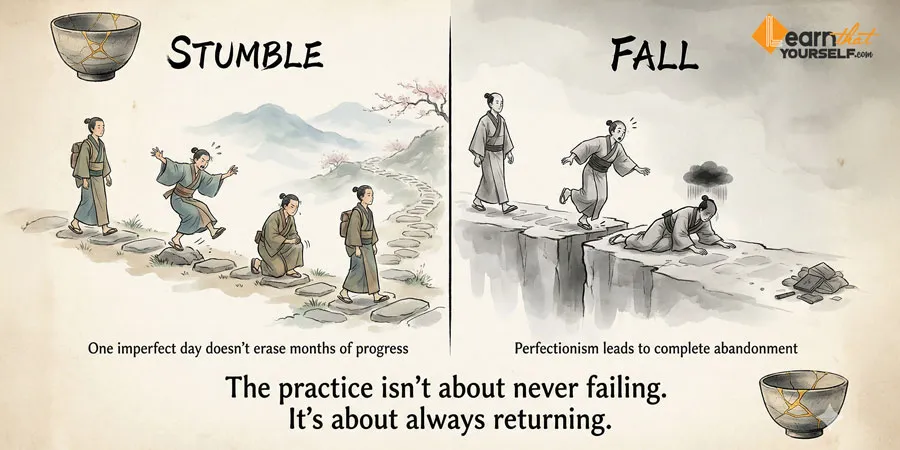
The Stumble vs. The Fall
Here’s the critical distinction Wabi-Sabi teaches: there’s a massive difference between stumbling and falling.
When you stumble, you lose your balance for a moment but keep moving. When you fall, you stop moving completely.
In change work, most people don’t fail because of one mistake. They fail because one mistake causes them to stop entirely. Thanksgiving comes, they overeat, and they interpret this as failure of the entire 14-week journey. They think, “I’ve ruined everything, so I might as well give up completely.”
Wabi-Sabi teaches that one imperfect day doesn’t erase months of consistent improvement. Overeating once doesn’t erase 14 kilos lost or 3 months of waking up early.
The Practice Isn’t Perfection
The practice—whether it’s dieting, exercising, creating art, or anything meaningful—isn’t about never failing. It’s about always returning. This is the radical reframe that Wabi-Sabi offers.
When you stumble:
- Acknowledge the stumble without judgment
- Return to your practice the very next day
- Do the minimum necessary to maintain momentum
- Continue improving from where you are
Philosophy 5: Gambaru – The Strength to Endure
What Is Gambaru?
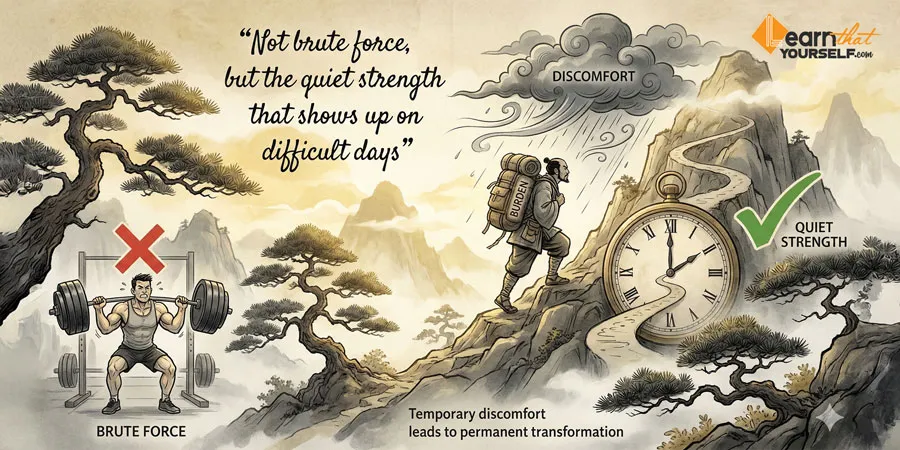
Gambaru (頑張る) means perseverance or the strength to endure through difficulty. It’s not about brute force; it’s about the kind of patient, quiet strength that shows up even when conditions are difficult.
Uncomfortable Moments Are Temporary
Gambaru operates on a simple principle: discomfort is temporary. Yes, waking up at 5 a.m. is uncomfortable. Yes, eating less is uncomfortable. Yes, exercise is uncomfortable. But all of this discomfort is temporary.
The temptation is to avoid discomfort entirely. Gambaru teaches that you can endure it because:
- It’s not permanent (tomorrow you do it again, fresh)
- It doesn’t require heroic effort (just showing up)
- It gets easier each time (your brain adapts)
- It leads somewhere meaningful (your ikigai)
Gambaru on Difficult Days
The true test of transformation isn’t performing well on good days. It’s showing up on difficult days—when you’re stressed, tired, sick, or facing setbacks.
This is where Gambaru becomes essential. On days when you don’t want to continue, when every fiber of your being wants to give up, Gambaru says: do the minimum. Drink the water. Do the walk. That’s all. The minimum to maintain momentum.
Over time, something remarkable happens. These difficult days become less frequent. Your brain learns, “We don’t give up anymore. We just keep going.”
Related Topics:
The Complete Transformation System
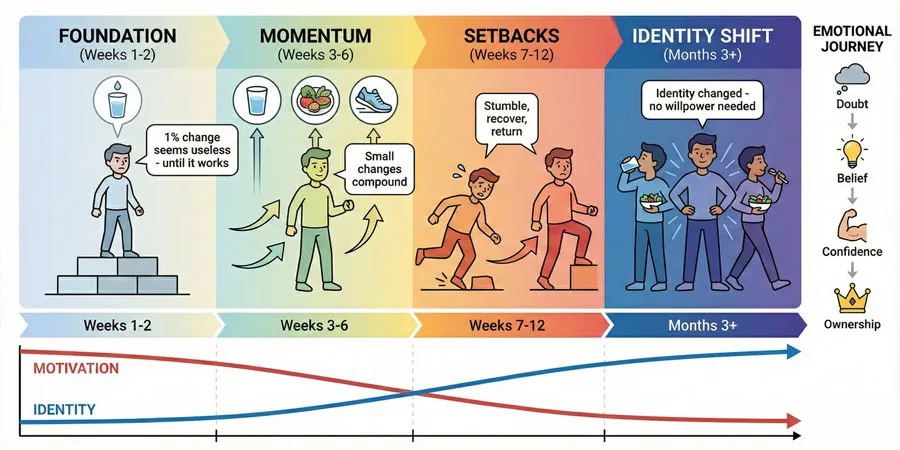
The Four Stages of Transformation
Stage 1: The Foundation (Weeks 1-2)
Begin with one change so small it seems laughable. The goal isn’t immediate results—it’s to prove you can keep a promise to yourself.
Typical foundation habits:
- Glass of water first thing in the morning
- 10 deep breaths
- One minute of meditation
- Five push-ups
- Reading one page
Why this works:
- Builds self-trust through consistency
- Activates neural pathways for change
- Proves identity shift is possible
- Creates emotional momentum
Stage 2: Adding Momentum (Weeks 3-6)
After proving you can execute the first habit, add one more small change. Still nothing dramatic—just another 1% improvement.
Example progression:
- Week 1-2: Water in morning
- Week 3-4: Add eating until 80% full
- Week 5-6: Add 20-minute walk
Why this works:
- Each habit builds on momentum of previous ones
- Brain doesn’t trigger threat response with multiple small changes
- You’re creating identity evidence: “I’m someone who does these things”
- Keystone habits activate (water leads to better choices, walks lead to family bonding)
Stage 3: Navigating Setbacks (Weeks 7-12)
This is where Wabi-Sabi and Gambaru become crucial. Setbacks are inevitable. The question is how you respond.
When you stumble:
- Immediately acknowledge it without judgment
- Text someone (accountability)
- Return to practice the very next day
- Do the minimum for that day (maintain momentum)
- Gradually increase effort as you recover
Why this works:
- Separates stumbles from falls
- Builds resilience (real confidence comes from recovery, not perfection)
- Prevents the “all or nothing” thinking that sabotages change
- Reinforces identity: “I’m someone who keeps going”
Stage 4: The Identity Shift (Months 3+)
The remarkable moment arrives when you stop trying and start being. You no longer drink water because you “have to”—you drink it because you’re “someone who does.” Exercise isn’t a chore—it’s what you do. Moderation isn’t a restriction—it’s your natural state.
This is the difference between temporary change and permanent transformation.
The 12-Month Timeline: What to Expect
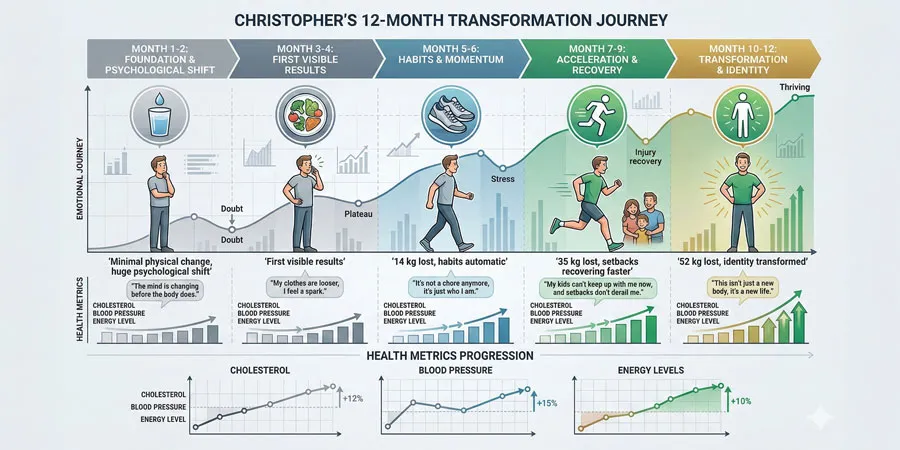
Months 1-2:
- Weight/habit change: minimal
- Psychological change: significant
- You’ve proven you can keep promises to yourself
- Identity: “I’m someone who’s trying”
Months 3-4:
- Physical results: visible
- Confidence: increasing
- Energy: noticeably higher
- Identity: “I’m someone who’s succeeding”
Months 5-6:
- Results: measurable and consistent
- Habits: automatic (less willpower required)
- Side effects: sleep improves, mood improves, relationships improve
- Identity: “I’m someone who takes care of myself”
Months 7-9:
- Setbacks: less frequent, less severe
- Recovery time: shorter
- Energy: sustained throughout day
- Identity: “I’m someone who’s committed”
Months 10-12:
- Transformation: evident to everyone around you
- Habits: completely automatic
- Purpose: clear and motivating
- Identity: completely shifted
- Bonus effects: career improvement, relationship deepening, ripple effects throughout life
Related Topics:
The Transformation Ripple Effect
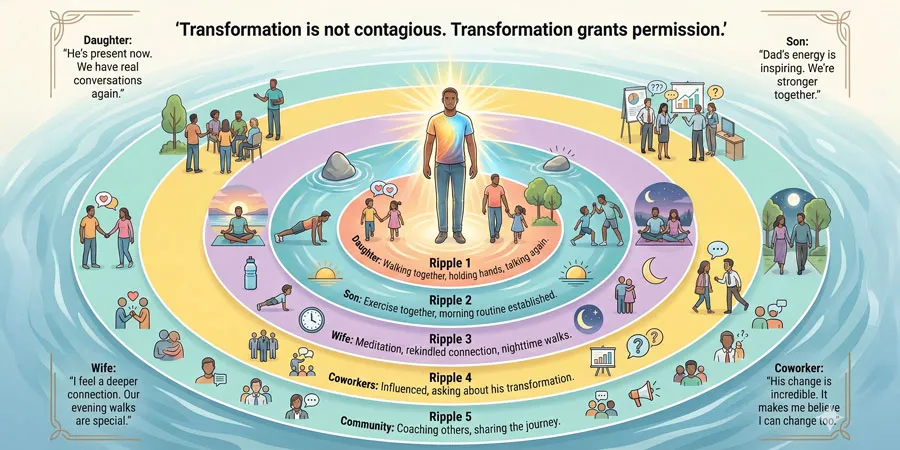
How Your Transformation Changes Everyone Around You
When Christopher changed, something unexpected happened. It wasn’t just his life that transformed—it was his entire family’s.
Permission Over Pressure
Real transformation isn’t contagious through guilt or pressure. It’s contagious through permission.
When people see you changing—not through heroic effort or crash diets, but through consistent, patient improvement—they unconsciously receive permission to change too. They think, “If he can do it, maybe I can too. And it doesn’t have to be as extreme as I thought.”
The Family Effect
Christopher’s daughter started walking with him to the mailbox, began talking about school and friendships again, and developed a deep connection with her father. His son started waking up early to exercise without being told—simply because he saw his father doing it. His wife started meditating because she saw that change was possible.
But here’s the most profound effect: Christopher’s daughter grew up watching him drink water every day, walk every day, stumble, fall, get up, and keep going. She grew up seeing that transformation isn’t about motivation—it’s about identity.
Years later, when her father asked what she loved most about his transformation, she said: “It’s that you came back. The man I married, the father our children deserve. You were here physically, but you weren’t present. Now you are.”
Building a Legacy
The true legacy of transformation isn’t a transformed body or even health improvements. It’s living proof that change is possible.
Related Topics:
The Complete Application System
How to Start Your Own Kaizen Journey Today
Step 1: Identify Your Ikigai (Days 1-2)
Don’t jump into action. Start with purpose.
Ask yourself:
- Why do I really want to change?
- What will this transformation allow me to do?
- Who am I denying this transformation to?
- What’s the deepest reason—beyond weight, productivity, or money?
Write it down. Not your surface motivation, but your true ikigai.
Step 2: Choose Your First Kaizen Change (Day 3)
Select one change so small it seems almost silly:
- Not “exercise regularly” but “walk to the mailbox”
- Not “eat healthily” but “drink water in the morning”
- Not “be more productive” but “read one page”
- Not “reduce stress” but “meditate for one minute”
The key: it must be so small that lack of time cannot be an excuse.
Step 3: Commit to 14 Days (Days 4-17)
Commit to this single change for exactly 14 days. Not “until you feel better” or “until you see results”—exactly 14 days.
Why 14 days?
- Long enough for the habit to become automatic
- Short enough to see the end
- Scientific sweet spot for neural pathway formation
- Proof point for self-trust
Step 4: Document Your Journey (Days 1-14)
Track your habit. Not obsessively, but visibly. Put an X on a calendar for each day completed. The visual record of consistency is powerful.
After day 7, something shifts. Your brain begins to expect it.
Step 5: The 14-Day Reflection (Day 14)
On day 14, reflect:
- How do you feel?
- What has changed internally (confidence, self-trust, energy)?
- What insights have you gained?
- Are you ready for the next small change?
Celebrate this moment. You’ve just proven something to yourself: you can keep a promise.
Step 6: Stack the Next Change (Day 15+)
Add one more small change. Still nothing dramatic—just another 1% improvement. Keep the first habit. Add the second. Over time, these compound.
The Anti-Perfection Approach
Embrace the Stumble
You will stumble. Christopher did—multiple times. At Thanksgiving, he overate. At his son’s birthday, he ate too much cake. On stressful weekends, he returned to pizza and beer.
Each time, he applied Wabi-Sabi: acknowledged the stumble, returned the next day, did the minimum, and continued improving.
Each stumble taught him something. Each recovery proved his commitment. Each failure became evidence of his identity: “I’m someone who keeps going.”
The 80% Rule Across Life
Hara Hachi Bu extends beyond food. Apply it everywhere:
- Work at 80% capacity, not burnout (sustainable)
- Consume at 80% satisfaction, not excess (prevents addiction)
- Spend at 80% earned, save 20% (financial security)
- Engage at 80% presence, preserve 20% energy (sustainable relationships)
This moderation is what makes change permanent.
Related Topics:
Overcoming the Obstacles
The Social Pressure Challenge
When you start changing, not everyone will celebrate. Some will feel threatened. Others will try to pull you back.
Why This Happens:
Your transformation makes them uncomfortable about their own choices. It’s much easier if you’re struggling together than if you’re advancing alone.
How to Navigate:
- Don’t preach or judge
- Simply model the behavior
- When invited to old patterns, use Gambaru: “I’ll try again tomorrow”
- Find or build a community of people committed to similar transformation
- Remember your ikigai when social pressure intensifies
The Motivation Valley
Around week 3-4, initial motivation fades. The novelty wears off. This is where most people quit.
This is where Gambaru becomes essential.
You don’t need motivation now. You need stubbornness. You do the habit because you’re someone who does it, not because you feel like it.
This is actually progress. This is where lasting change begins.
The Plateau
Around month 3-4, you’ll likely hit a plateau. Results slow down. The excitement fades. Everything feels harder.
This is perfectly normal. Your body and brain are adapting. Progress isn’t always linear.
How to respond:
- Remember your ikigai
- Apply Wabi-Sabi: accept this phase as part of the journey
- Apply Kaizen: look for the next 1% improvement
- Apply Gambaru: do the minimum to maintain momentum
- Trust the system
Most people quit right before the breakthrough.
Related Topics:
The Science Behind the System
Why Kaizen Works: The Neuroscience
Stanford University researcher studying habit formation discovered that most changes fail not because people are weak, but because they try to change too quickly.
The Brain’s Threat Response:
Your brain is programmed to resist drastic changes because it interprets them as threats to survival. When you announce, “Starting tomorrow, I’m completely changing my life,” your brain’s threat-detection systems activate.
But when you introduce microscopic changes—less than a 1% difference per day—the brain doesn’t trigger the resistance alarms. You essentially hack your own nervous system.
The Longevity Connection
Researchers studying Blue Zones (regions with the world’s longest-living populations) found that populations living longest don’t follow radical diets or extreme protocols.
Instead, they follow five simple principles:
- Moderation in eating (Hara Hachi Bu)
- Constant, gentle movement (Kaizen in physical activity)
- Clear purpose in life (Ikigai)
- Acceptance of imperfection (Wabi-Sabi)
- Perseverance through difficulty (Gambaru)
These five characteristics appear consistently across all Blue Zones.
The Identity Transformation
A neuroscientist at the University of London studying self-discipline explains:
“Willpower is a limited resource. It depletes throughout the day. But when you transform behaviors into identity—when you stop trying to do and start being someone who does—you no longer need willpower. The behavior becomes automatic because it’s part of who you are.”
This is the fundamental shift. You’re not trying to lose weight. You’re becoming someone who takes care of themselves. You’re not trying to be productive. You’re becoming someone who shows up.
Related Topics:
CONCLUSION: YOUR TRANSFORMATION BEGINS TODAY
The Truth Nobody Wants to Hear
You don’t need more motivation. You need a system that respects your humanity, accepts your imperfection, and transforms small choices into permanent identity.
You’ve been given that system.
The Challenge
Here’s the same challenge Dr. Yamamoto gave Christopher:
Choose one change. The smallest one possible. So small that you’ll feel like an idiot doing it. So small that it seems like it won’t make any difference at all.
It could be:
- A glass of water in the morning
- Five push-ups before bed
- One minute of meditation
- A page from a book
- A 20-meter walk
- One conscious breath
Anything. But it has to be so small that you can’t use an excuse not to do it.
Do this for 2 weeks. Don’t try to add anything else. Don’t try to speed things up. Just do this one small thing every single day for 14 days.
When you get to day 14, you will have proven something to yourself. Not that you can lose weight or quit smoking or change your life—but that you can keep a promise to yourself.
And that proof is the only thing you really need.
The Long View
Christopher took a year and a half. Maybe it will take you three years. Maybe five. It doesn’t matter, because time will pass anyway.
The question is: in 5 years, will you be in the same place looking in the mirror with shame? Or will you be looking in the mirror and seeing someone who fulfilled every promise they made to themselves?
Remember
- Ikigai gives you purpose
- Kaizen gives you method
- Hara Hachi Bu gives you moderation
- Wabi-Sabi gives you compassion
- Gambaru gives you strength
You don’t need them all at once. You just need to start with one thing today. And when you stumble—because you will—you don’t give up. You just get back up.
Because practice isn’t about never falling. It’s about always getting back up. The transformation isn’t in the result. The transformation is in the person you become in pursuit of it.
Related Topics: