


Discover why innovation is the key to entrepreneurial success. Learn the 3 steps to innovation, why creativity matters more than money and how to build an environment that fosters breakthrough ideas.
Innovation is not invention. It is not a scientific discovery, nor is it a mathematical proof. Yet, it remains one of the most powerful forces behind entrepreneurial success.
Innovation is the process of transforming ideas and technologies into practical applications that make things better, more significant, and more meaningful. It is about changing the world — one breakthrough at a time.[1][2]
But here’s the truth: innovation is hard. It demands courage to take chances, the willingness to challenge deeply held assumptions, and the boldness to break rules that others follow without question.[1]
Table of Contents
What Is Innovation and Why Does It Matter?

Innovation is the process of using creative skills to develop unique ideas and implement them to introduce new products, services, and methodologies. Unlike invention, which focuses on creating something entirely new, innovation is about improving and applying existing ideas in ways that create real value for people.[1]
Innovation makes previously impossible things possible. From the airplane to the smartphone, every transformative product started as an innovative idea that someone dared to pursue. In the world of entrepreneurship, innovation is the engine that separates thriving businesses from those that fade into irrelevance.[2][1]
Related Topics:
- Healing After Heartbreak: Turn a Broken Heart Into Strength
- Life Lessons from Superheroes: How Fear Makes Us Brave
- Creativity Is a Journey, Not a Destination
The Innovator’s Dilemma: Why Big Companies Fail to Innovate

One of the most insightful perspectives on innovation comes from the classic book The Innovator’s Dilemma by Clayton M. Christensen, a Harvard Business School professor. In this ground-breaking work, Christensen demonstrated something counterintuitive: the lack of innovation in big companies is not a failure of management — it is actually a result of prudent, sound management.[3][4]
Christensen showed that successful companies do everything “right” — they listen to their customers, invest in high-value products, and follow proven strategies — and yet they still lose market share to smaller, scrappier competitors. The reason is that established firms focus so heavily on sustaining innovations (improving current products) that they completely miss disruptive innovations — the smaller, initially inferior technologies that eventually overtake entire industries.[4][5][3]
The classic example is Kodak. When digital photography first emerged, it did not meet the standards of “serious” photographers. Kodak, the industry giant, chose not to prioritize it. But over time, digital photography improved until it eclipsed film entirely — and Kodak was displaced.[5]
The key takeaway for entrepreneurs is clear: disruption often comes from the edges, not the centre. Staying too focused on what works today can blind you to what will work tomorrow.[6]
Creativity: The Most Important Factor for Business Success
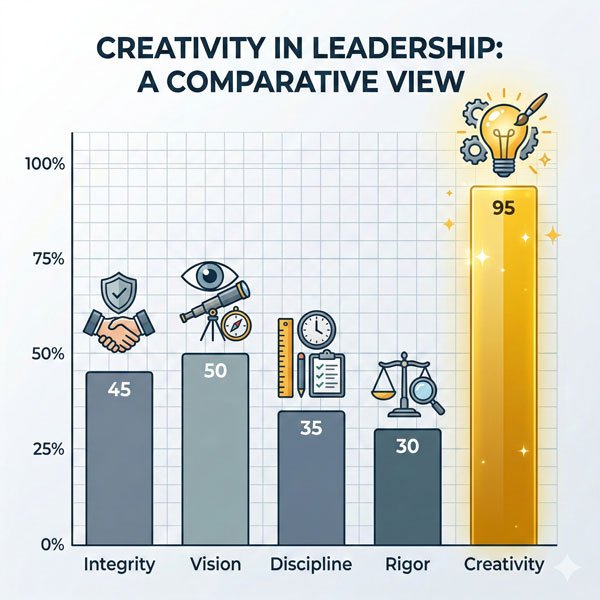
According to a landmark 2010 IBM Global CEO Study, which surveyed more than 1,500 Chief Executive Officers from 60 countries and 33 industries, creativity was identified as the number one leadership quality for future business success — ranking above rigor, management discipline, integrity, and even vision.[7][8]
CEOs told IBM that the business environment had become increasingly volatile and complex, and the ability to create something both novel and appropriate was more important than ever before. More than 60 percent of CEOs believed that industry transformation was the top factor contributing to uncertainty, making creative problem-solving an essential survival skill.[9][7]
Yet there is a paradox. While industries acknowledge that creativity is core to success, many unknowingly stifle it within their own organizations. Rigid hierarchies, pressure for quick results, and over-reliance on established processes leave little room for genuine creative thinking.[10][9]
Debunking the Creativity Myth: It’s Not Just for “Right-Brain” Thinkers

A fundamental misunderstanding holds back innovation in many organizations — the myth that creativity belongs exclusively to “right-brain” thinkers: the painters, writers, and poets. This leaves so-called “left-brain” thinkers — mathematicians, engineers, and computer scientists — believing they are not creative.[11]
Modern neuroscience has thoroughly debunked this myth. Research shows that both hemispheres of the brain collaborate extensively during creative tasks. There is no evidence that people are dominantly “right-brained” or “left-brained”. Creativity often requires a foundation of analytical thinking to structure ideas and solve problems, while analytical tasks benefit from creative approaches to generate innovative solutions.[12][13][11]
The takeaway for entrepreneurs? Creativity is not a genetic gift reserved for artists. It is a skill that engineers, analysts, marketers, and business leaders can all develop and apply.[13][11]
Three Steps to Building an Innovative Environment

Innovation does not happen by accident. It requires a deliberate environment built on three foundational pillars:
The Right People to Generate Inspiration
Innovation is ultimately done by individuals. The skills required — imagination, creativity, and problem-solving — are individual skills that need to be cultivated. Surrounding a team with curious, diverse thinkers who challenge each other’s assumptions is the first step toward generating breakthrough ideas.[14]
Research from Harvard Business School suggests that the best results come when individuals brainstorm independently first, then collaborate to refine ideas together — combining the depth of solo exploration with the power of collective intelligence.[14]
Appropriate Rewards and Incentives
People innovate when they feel valued and rewarded for taking creative risks. High-performing CEOs practice and encourage experimentation throughout their organizations. Creating a culture where calculated risk-taking is celebrated — not punished — is essential for sustained innovation.[8]
A Common Language
Teams need a shared vocabulary around innovation. When everyone understands what “disruptive innovation,” “iteration,” and “customer-centric design” mean, communication flows faster and ideas move from concept to execution more efficiently.
Start With Meaning, Not Money

Innovation begins with the desire to make meaning — not to make money. When entrepreneurs set out to genuinely change the world, financial success often follows as a natural by-product. But when the sole motivation is profit, both meaning and money tend to slip away.[15]
The Google Example
Google is a perfect case study. From its inception, Google’s mission was to “organize the world’s information and make it universally accessible and useful”.
The company focused on democratizing information, making products and services freely available and empowering users to improve them.
This purpose-driven approach fuelled ground-breaking innovations — from Google Search to Google Scholar to Google Workspace — and ultimately made Google one of the most successful companies in history.[15]
The lesson is straightforward: if you truly want to innovate, start by asking what meaningful problem you can solve for the world. Financial success will follow purpose.[15]
The Three Steps Toward True Innovation

Building on the foundational environment, here are three actionable steps every entrepreneur should follow:
Step 1: Define Your Meaning
Determine how your idea will create meaning. Can it change lives, simplify a process, or solve a long-standing problem? Articulate this meaning in just a few words. This clarity becomes the North Star for every decision you make.
Step 2: Describe Why Your Meaning Should Exist
Go deeper. Why does the world need your solution? What gap does it fill? A compelling “why” not only guides product development but also attracts customers, investors, and talent who believe in the same mission.[2]
Step 3: Aim High and Take a Leap of Faith
Staying on the same trajectory will produce the same results. Great innovation requires jumping to an entirely new curve. Incremental improvements sustain existing products, but disruptive leaps create new markets. This demands courage, conviction, and a willingness to abandon the comfort of the known.[2]
Why Great Ideas Get Rejected (And Why You Shouldn’t Care)

One of the harshest realities of innovation is that the initial reaction to most great ideas is rejection. When something is truly new, it is unknown. It threatens the status quo. And people instinctively judge new ideas using the framework of old ones — which almost guarantees they will fail to see the potential.[4][6]
For an idea to be truly innovative, it must satisfy two criteria:
- It must be new — offering something the market has not seen before.
- It must be useful — solving a real problem or fulfilling a genuine need.
The challenge is that newness and usefulness are difficult to reconcile. New ideas disrupt established paradigms, and established paradigms are the lens through which usefulness is traditionally judged. This creates a built-in bias against innovation.[3][6]
To be an innovator, an entrepreneur must develop a kind of productive denial — the ability to hear criticism, acknowledge it, and then keep walking forward. The naysayers will always be there. The ones who have successfully changed the world stopped listening to them long ago.
Let the Customer Define Your Product

At the start of any great innovation, the creator often thinks they know exactly who the customer is and how the product will be used. But reality rarely follows the plan. Customers will use products in unexpected ways, discover applications the creator never imagined, and ultimately define the product’s true identity through their behaviour.[5][6]
Christensen observed this repeatedly in his research — companies that succeeded in disruptive markets were those willing to experiment, iterate, and let user behaviour shape product evolution. Positioning and branding ultimately come down to what the consumer decides, not what the entrepreneur dictates.[6]
The smartest entrepreneurs embrace this uncertainty. They launch, observe, adapt and let the market guide the evolution of their innovation.
Innovation in Education and Business: The Path Forward

The conversation about innovation extends far beyond start-ups and tech companies. In education, the pressing question is how to nurture creativity in students rather than stifle it. In business, leaders constantly ask how to build teams that generate ideas with a sustainable competitive advantage.[9][8]
But perhaps the real challenge is not generating more great ideas — it is getting better at recognizing the great ideas that are already being presented. The world is full of innovators whose ideas go unnoticed because the systems designed to evaluate them are rooted in outdated paradigms.[3][4]
The path forward requires:
- Fostering creativity at every level — from classrooms to boardrooms.
- Building cultures of experimentation — where failure is treated as a learning opportunity, not a career-ending mistake.
- Rejecting the false divide between creative and analytical thinkers.[11][12]
- Listening to unconventional voices — the disruptive ideas that sound “crazy” today may be the industry standards of tomorrow.
Key Takeaways for Entrepreneurs
| Principle | What It Means for Your Business |
|---|---|
| Innovation ≠ Invention | Focus on improving and applying ideas practically, not just creating new ones[1] |
| The Innovator’s Dilemma | Good management can blind companies to disruptive change[3][4] |
| Creativity Is #1 | IBM’s global study ranks creativity as the top leadership quality[7][8] |
| Reject the Brain Myth | Creativity belongs to everyone — engineers, analysts, and artists alike[11][12] |
| Meaning Before Money | Purpose-driven innovation leads to both impact and profit[15] |
| Embrace Rejection | The best ideas are often rejected first — persist anyway[6] |
| Let Customers Guide You | Your users will define your product in ways you never imagined[5] |
About the Author
Lalit M. S. Adhikari is a Digital Nomad and Educator since 2009 in design education, graphic design and animation. He’s taught 500+ students and created 200+ educational articles on design topics. His teaching approach emphasizes clarity, practical application and helping learners.
Learn more about Lalit Adhikari.
This guide is regularly updated with the latest information about Adobe tools and design best practices. Last Updated: Mar 2026