

For 400 years, Japanese samurai warriors possessed a secret technique more powerful than any sword—a method to control their minds completely. In feudal Japan, this practice separated legendary warriors from those who died on battlefields.
Today, modern neuroscience confirms what the samurai knew: presence is trainable, presence is measurable, and presence transforms everything.
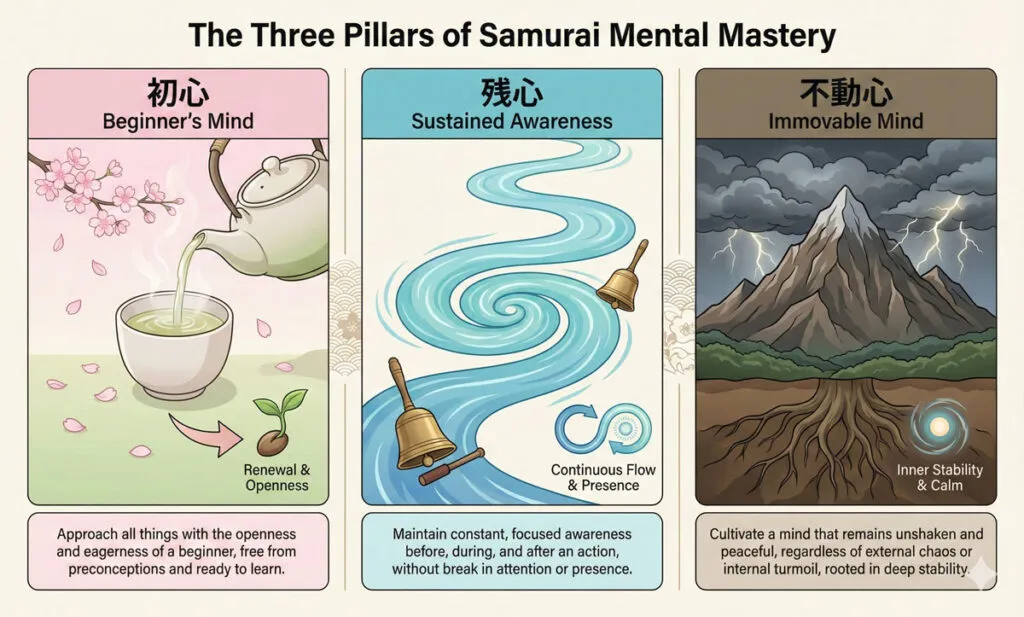
This comprehensive guide reveals the three pillars of samurai mental mastery—Shosin (Beginner’s Mind), Zanshin (Remaining Awareness) and Fudoshin (Immovable Mind)—and shows you exactly how to implement these ancient techniques to overcome fear, master stress and unlock your full potential in the modern world.
My name is Lalit Adhikari and we are at LTY. Let’s begin!
Table of Contents
Introduction: The Paradox of the Samurai
The Ultimate Warrior Question
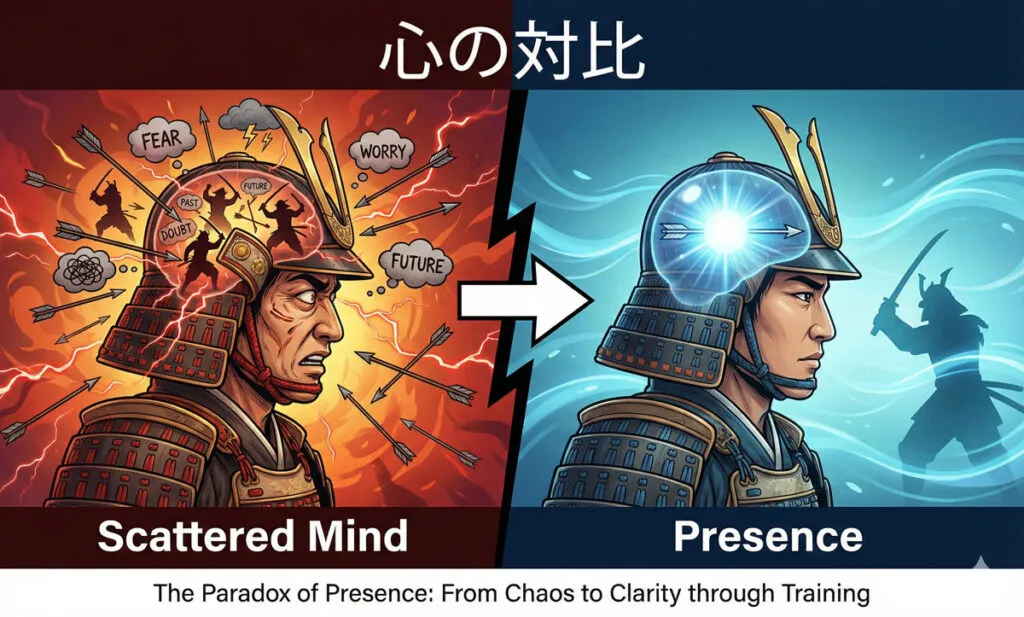
In 1615, a Zen master in feudal Japan posed a question that would define samurai training for centuries: “If you face 10 enemies with your sword, how many can you kill?”
A young samurai answered confidently, “All 10, master.” The master shook his head. “Wrong. You will kill none. Because the moment you think about killing 10, you have already lost to the first.”
This is the paradox that separates legendary warriors from those forgotten by history. The greatest samurai victories weren’t won through technique, strength, or aggression. They were won through something far more powerful: presence.
The ability to be completely here, now, fully aware of only this moment. Not thinking about 10 enemies, but responding to the one in front of you. Not planning outcomes, but experiencing reality exactly as it unfolds.
Why Presence matters more than Technique
In our modern world, we face a different kind of combat. We’re fighting anxiety, overwhelm, distraction, and internal chaos. We’re battling perfectionism, fear of failure, and the constant pressure to perform.
And like the ancient samurai, we’re losing these battles for the same reason: our minds are everywhere except where they need to be.
You’re at work, but your mind is home worrying about bills. You’re with family, but you’re thinking about emails. You’re exercising, but you’re planning tomorrow. You’re always 10 steps ahead, never present for the one moment that’s actually real—now.
The samurai understood something revolutionary: presence isn’t a luxury. It’s the foundation of everything. Better performance comes from presence. Better relationships come from presence. Better health comes from presence. Even joy itself only exists in the present moment.
This guide reveals the exact techniques used by the greatest warrior minds in history—techniques now validated by modern neuroscience—to achieve unshakable presence and mental mastery in any situation.
Related Topics:
Part 1: Shosin – The Beginner’s Mind
What is Shosin and Why It Matters
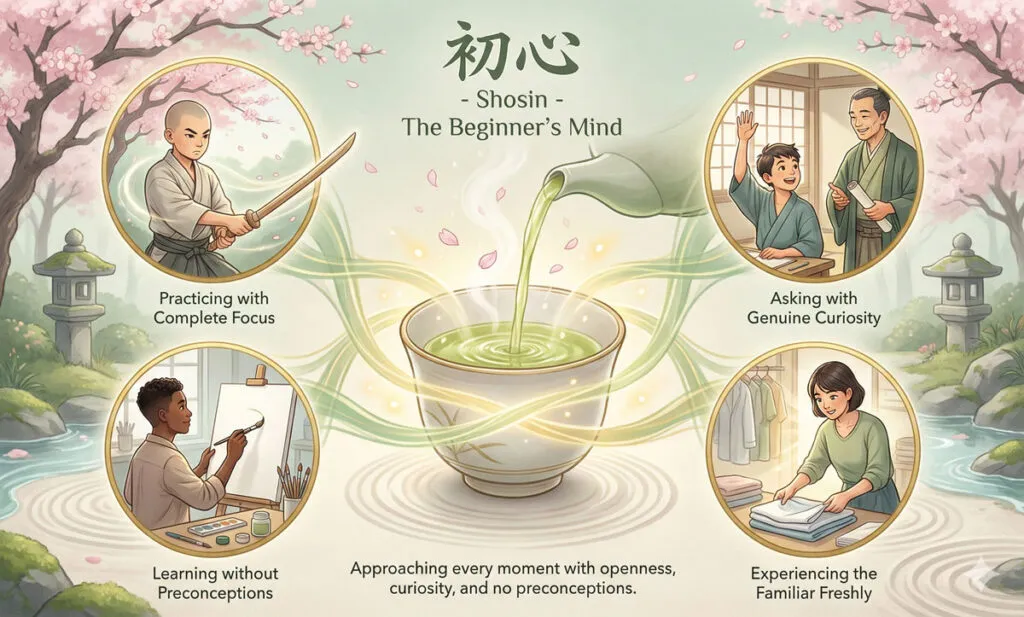
Shosin (初心) literally translates as “beginner’s mind.” But it means far more than simply being new to something. Shosin is a mental state—a specific way of approaching life where you empty yourself of preconceptions, expectations, and assumptions. It’s the mind of a beginner encountering something for the first time.
When a samurai picks up a sword for the first time, what’s in their mind? Curiosity. Focus on learning. Presence with the actual experience. Nothing else. Just the sword, just that moment. Not thinking about being the best swordsman, not worrying about mistakes, not comparing themselves to others. Just here. Just now.
This is Shosin.
The paradox is this: the samurai who had trained for 5 years would often lose to the beginner who possessed Shosin because the experienced warrior’s mind was filled with technique, strategies, expectations, and fear of failure. But the beginner’s mind? Empty. Fully present. Completely responsive.
The Psychology of Beginner’s Mind
Shosin works because of how human consciousness functions. Every time you become an “expert,” your brain literally changes its processing patterns. It starts using shortcuts called “automaticity.”
Your prefrontal cortex (the conscious thinking part) hands over control to your basal ganglia (the automatic pattern part). This is efficient for routine tasks, but it’s deadly when facing novel situations.
An “expert” samurai would think: “When I see this angle of attack, I respond with this specific block.” The beginner with Shosin would simply see the attack and respond naturally, often more effectively because they weren’t constrained by prelearned patterns.
In modern psychology, this is called “functional fixedness”—the inability to see beyond traditional uses of objects or situations. Experts are prone to it. Beginners are free from it. This is why the greatest innovations rarely come from entrenched experts. They come from beginners who approach the problem without preconceptions.
How to Cultivate Shosin in Daily Life
Shosin isn’t just for swordsmen. You can practice it anywhere, anytime:
1. The Sweeping Practice
The samurai would spend hours sweeping the dojo floor. But not mindlessly. With complete attention. Each stroke of the broom deliberate and present. Not thinking about sword practice. Just sweeping. Each movement complete in itself. When you sweep left, you are fully sweeping left. When you sweep right, you are fully sweeping right.
Try this: Pick any routine daily task—showering, eating breakfast, walking to your car. Do it with complete Shosin. No thinking about what’s next. Just this task, fully present.
2. The Question Practice
Approach your work, relationships, and challenges as if you’re seeing them for the first time. Not with the answers you think you know, but with genuine curiosity. What if there’s something I haven’t seen? What if this familiar situation has something new to teach me?
3. The Empty Bowl Practice
A Zen master once said, “In the beginner’s mind there are many possibilities, but in the expert’s mind there are few.” Metaphorically, imagine your mind as a tea bowl. If it’s already full of your opinions, knowledge, and expectations, new tea (new possibilities, new learning) cannot be added. You must empty your bowl to receive.
Breaking Free from Expert’s Trap
The dangerous transition happens when someone transitions from beginner to intermediate. They’ve learned enough to be dangerous but not enough to be truly skilled. This is when the expert’s trap closes.
The samurai solution? Regular periods of returning to Shosin. The greatest masters spent time deliberately practicing as if they were beginners, emptying their minds of accumulated knowledge, approaching fundamental techniques with fresh eyes.
In modern terms, this means:
- Regularly learning new skills to reactivate beginner’s mind
- Questioning your assumptions in familiar domains
- Seeking feedback from “beginners” who see what you’ve stopped seeing
- Practicing meditation to clear the constant mental chatter
- Approaching familiar situations with curiosity rather than certainty
Related Topics:
Part 2: Zanshin – Remaining Awareness
The Power of Sustained Attention
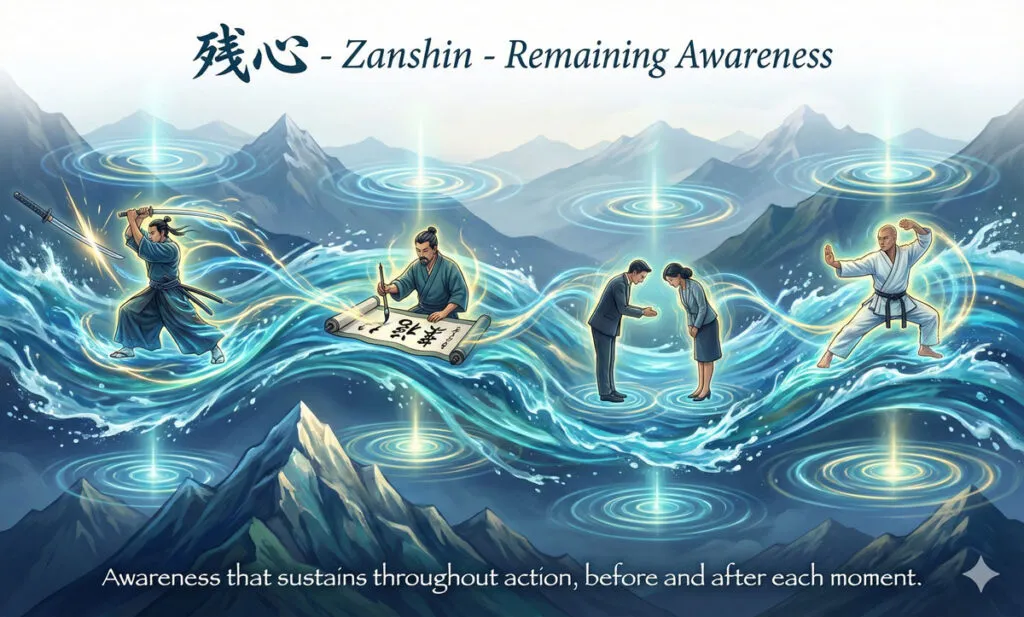
Zanshin (残心) literally means “remaining mind.” In samurai combat, it means the awareness that continues even after you’ve blocked a strike. You don’t relax after defending. You maintain complete readiness for what comes next. Your attention doesn’t reset. It sustains.
This might seem like a technical fighting concept, but Zanshin is one of the most powerful principles for modern life. Most people operate with interrupted attention. They’re focused on task A, then they shift to task B, then task C. Each time they shift, their awareness resets.
But what if you maintained continuous awareness throughout your entire life?
Zanshin Beyond Combat
Imagine these scenarios with and without Zanshin:
Conversation Without Zanshin:
You’re talking to your partner about their day. Your awareness is on their words, but halfway through, you’re mentally forming your response. Or you’re thinking about what’s for dinner. Your attention resets when they finish speaking. You missed the subtle emotion behind their words.
Conversation With Zanshin:
You’re fully present with their words. But your awareness doesn’t stop when they finish speaking. You remain aware. You notice their posture, their tone, what they didn’t say. Your presence carries forward, and you respond not just to their words but to the complete picture of what they’re communicating.
Work Without Zanshin:
You finish a project. Your mind moves on immediately. You’re already thinking about the next project.
Work With Zanshin:
You finish a project. But your awareness remains. What did I learn? What could have been better? What patterns do I notice? Only then do you move forward, taking the learning with you.
Training Your Brain for Continuous Awareness
Zanshin is trainable. The samurai developed specific techniques:
1. The Meditation of Continuous Awareness
Sit in meditation. Your goal isn’t to clear your mind (that’s a misconception about meditation). Your goal is to maintain awareness of whatever arises. Thoughts appear. You notice them. Sensations arise. You’re aware. Emotions come. You acknowledge them. Nothing is pushed away or grasped at. Just continuous awareness of what is.
2. The Walking Practice
Walk with complete attention. Feel each step. Heel striking, weight shifting, toe lifting. The sensation in your leg muscles. The movement of air. Your breathing synchronizing with walking. Don’t let your attention drop for a single step.
3. The Task Immersion
Choose one task and immerse yourself completely. Not multitasking. Not checking your phone. Just this one task with your complete awareness. When the task ends, notice what it feels like to have maintained unbroken attention. That feeling is Zanshin.
Real-World Applications
In Business:
Companies with Zanshin mentality notice market shifts before competitors because their awareness is continuous. They see the small changes happening now, not just looking back at historical data.
In Health:
People practicing Zanshin notice subtle changes in their body before they become health crises. A slight persistent fatigue. A niggling pain. They remain aware and address it early.
In Relationships:
Partners with Zanshin notice the early signs of connection weakening. They don’t suddenly discover a distance that developed over months. They maintain awareness throughout and adjust course constantly.
Related Topics:
Part 3: Fudoshin – The Immovable Mind
Mastering Emotional Resilience
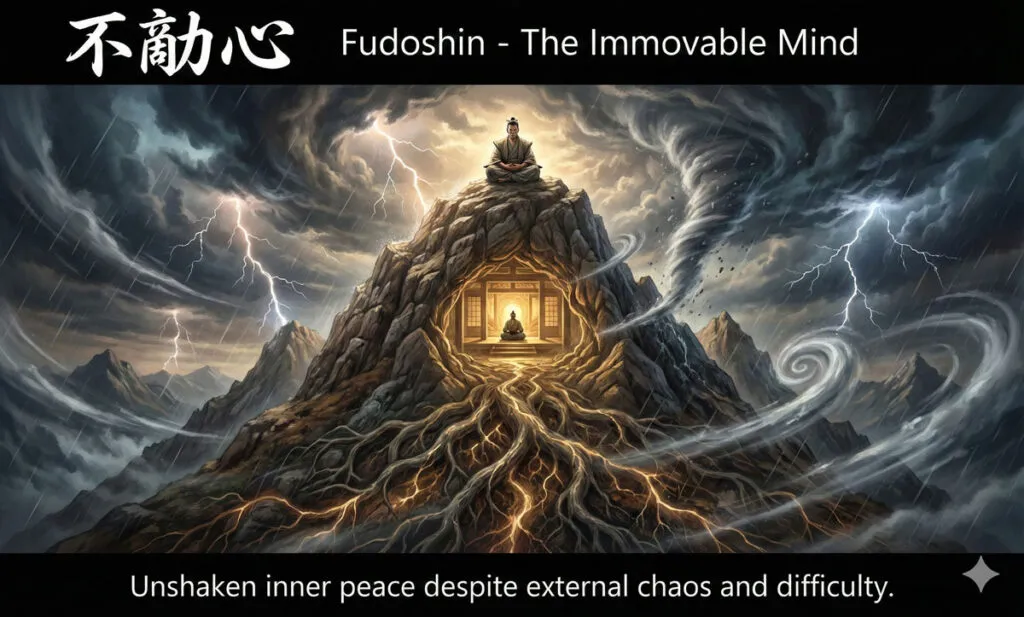
Fudoshin (不動心) translates as “immovable mind.” But here’s what it doesn’t mean: it doesn’t mean being emotionless, cold, or unfeeling. It doesn’t mean suppressing emotions. It means something far more powerful.
Fudoshin means being so rooted in your true nature, so grounded in present awareness, that external circumstances cannot shake your internal peace. You feel fear, but it doesn’t control you. You experience anger, but it doesn’t drive your actions. You encounter setbacks, but they don’t define your worth.
Understanding Fear without Resistance
The samurai taught something counterintuitive: don’t fight fear. That creates resistance, and resistance creates tension, which clouds judgment.
Instead, acknowledge it. Feel it fully. Be present with it. But don’t let it control your actions.
One famous Hagakure practice was “meditation on inevitable death.” Every day, samurai would contemplate being killed in battle. Not morbidly, but realistically. They accepted this possibility completely. And in that acceptance, fear lost its power. They weren’t trying to avoid death or deny its possibility. They were facing it head-on in their minds.
By the time actual combat came, death held no terror. They’d already died a thousand times in their practice. The actual moment was just one more step.
Building Unshakable Inner Peace
Fudoshin is built through consistent practice:
1. Acceptance Practice
Each day, deliberately accept something difficult. Accept that there are things outside your control. Accept that outcomes are uncertain. Accept that you will make mistakes. This sounds passive, but it’s deeply active. You’re training your nervous system to remain calm in uncertainty.
2. Adversity Training
The samurai would deliberately place themselves in challenging situations to train their mind. Not recklessly, but strategically. Cold meditation. Hunger retreats. Physical hardship. Each one training Fudoshin.
Modern equivalents: Taking a cold shower. Fasting occasionally. Doing something slightly terrifying. Not to punish yourself, but to train your mind that you can handle difficulty.
3. Perspective Practice
When facing a difficult situation, ask: “Will this matter in 5 years? 50 years?” Not to dismiss real problems, but to maintain perspective. Most things that feel catastrophic now will be forgotten in time.
Related Topics:
Part 4: The Science of Presence
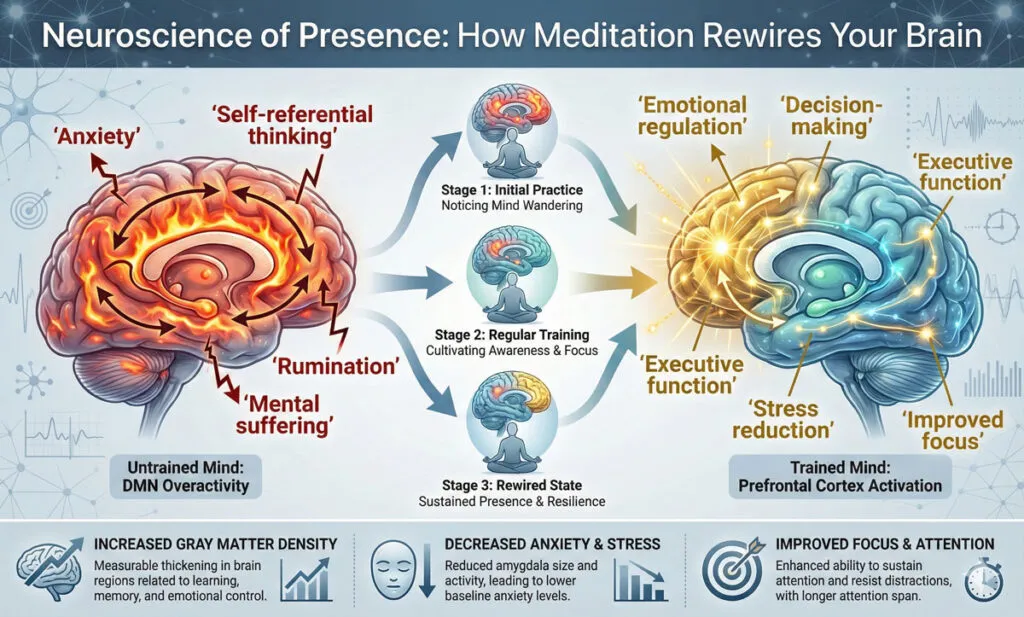
Neuroscience Validates Ancient Wisdom
What’s remarkable is that modern brain imaging has confirmed what samurai masters knew through direct experience. When you practice presence, your brain physically changes.
The Default Mode Network (DMN):
The brain has a default mode network—essentially your “mind wandering” network. It’s responsible for self-referential thinking, rumination, anxiety about the past and future. When someone is deeply anxious or depressed, their DMN is hyperactive.
When you practice presence—through meditation, focused attention, or the samurai techniques—you systematically deactivate your DMN. Not permanently, but during the practice, you’re actually quieting the parts of your brain that generate anxiety and mental suffering.
The Prefrontal Cortex:
Simultaneously, you’re activating and strengthening your prefrontal cortex—the region responsible for emotional regulation, decision-making, and executive function. Neuroscientists have found that regular meditation practitioners show increased gray matter density in these regions.
This isn’t spiritual or mystical. This is measurable brain change. The samurai were literally rewiring their brains through their training.
Mushin and Flow State
The samurai called it mushin (無心)—literally “no mind.” Not the absence of thoughts, but the absence of thinking getting in the way. Thoughts occur, but they don’t control behavior.
Modern psychology calls this flow state—the state of complete immersion where you perform at your peak without conscious deliberation.
Athletes experience it. “I wasn’t thinking, I was just playing.” Musicians experience it. “The music was playing through me, not by me.”
The samurai trained to access this state at will. Most modern people experience it randomly, almost by accident. The difference is systematic practice.
Related Topics:
Part 5: Ancient Masters and their Teachings
Miyamoto Musashi’s Book of Five Rings
Miyamoto Musashi, considered the greatest swordsman in Japanese history, retired from active combat at 30 and spent his final years writing The Book of Five Rings—a masterpiece of warrior philosophy.
His core insight: “In strategy, it is important to see distant things as if they were close and to take a distanced view of close things.”
This is presence with perspective. Be fully here in this moment (close up) while also maintaining awareness of the larger context (distant view). Don’t get lost in details. Don’t lose sight of the moment. Both.
Musashi won over 60 duels in his lifetime. But at the end of his life, he wrote: “Step by step walk the thousand-mile road.” He wasn’t talking about defeating a thousand enemies. He was talking about presence in each step. The journey, not the destination.
Takuan Soho’s Zen Wisdom
Takuan Soho was a Zen master who advised many of Japan’s greatest samurai. His central teaching about the mind:
“The mind must always be in the state of flowing, for when it stops anywhere, the flow is interrupted. And it is this interruption that is injurious to the well-being of the mind.”
This is presence in motion. Don’t freeze your awareness on one thing. Like water flowing, awareness moves to what needs attention, then flows on. It’s not scattered. It’s responsive.
The Hagakure Principles
The Hagakure is a practical manual of samurai behavior compiled in 1716. Its most famous principle: “Meditation on inevitable death should be performed daily.”
This wasn’t morbid fascination. It was psychological training. By fully accepting death, samurai freed themselves from its paralyzing fear. They didn’t live recklessly. They lived freely, unshackled by the terror of mortality.
Bushido Code for Modern Warriors
The Bushido code emphasizes:
- Loyalty – Commitment to something greater than yourself
- Honor – Living by your values regardless of external judgment
- Discipline – Training your mind and body systematically
- Courage – Acting despite fear
- Compassion – Maintaining humanity even in difficult situations
These aren’t outdated. They’re foundational for anyone seeking to master their mind and build an exceptional life.
Related Topics:
Part 6: The Practice – Training for Presence
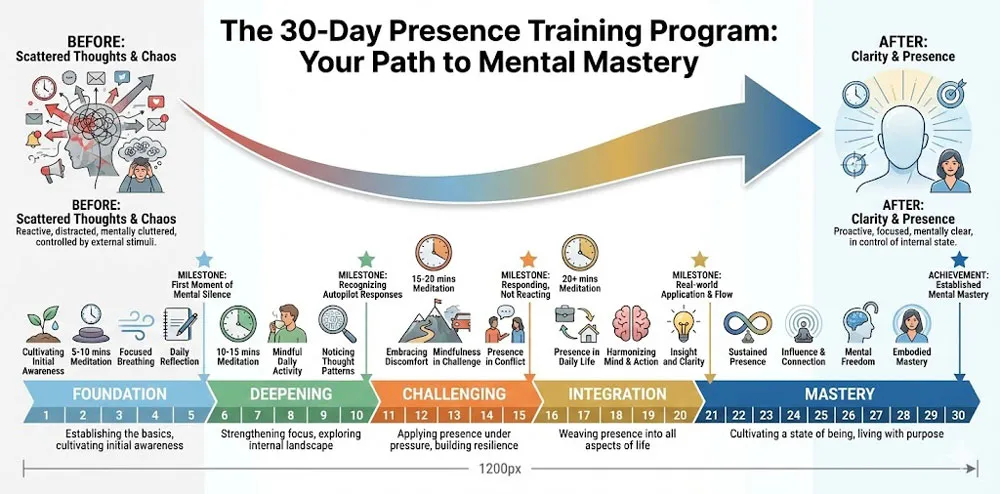
30-Day Presence Training Program
Day 1-5: Foundation
- Morning: 5 minutes of basic meditation (just sit, follow your breath)
- Daily: One activity done with complete Shosin (full presence, no thinking about anything else)
- Evening: 2-minute reflection on where your mind went during the day
Day 6-10: Deepening
- Morning: 10 minutes meditation
- During day: Walking meditation (at least 5 minutes—one step per breath, complete attention)
- One task completed with Zanshin (maintaining awareness before, during, and after the task)
Day 11-15: Challenging
- Morning: 15 minutes meditation
- Add a deliberate discomfort (cold shower, brief fasting, difficult task) to train Fudoshin
- Document what happens to your mind when facing discomfort
Day 16-20: Integration
- Morning: 20 minutes meditation
- Apply all three principles (Shosin, Zanshin, Fudoshin) to at least one major area of your life
- Notice measurable changes (clarity, decision quality, stress levels, relationships)
Day 21-30: Mastery
- Maintain 20 minutes daily meditation
- Practice all techniques across multiple life areas
- Notice that presence becomes more automatic, more accessible
Meditation Techniques Used by Zen Monks
Zazen (Sitting Meditation):
Sit upright in a comfortable position. Close your eyes softly or focus them downward. Follow your natural breath. When your mind wanders (it will, constantly), gently return attention to the breath. That’s the entire practice. Thoughts will come. You’re not trying to stop them. Just return to the breath. Again and again.
Walking Meditation:
Walk slowly, deliberately. Feel each step completely. Heel striking. Weight transferring. Toe lifting. Coordinate with your breath. One step per exhalation, perhaps. The goal isn’t to go anywhere. It’s to be fully present with walking.
Body Scan:
Sit or lie comfortably. Starting with your toes, bring awareness to each part of your body systematically. Notice sensations without judgment. The goal is continuous awareness, training the capacity to be present with whatever sensations arise.
Daily Presence Exercises
The 5-Minute Presence Reset:
At any point during your day when you feel scattered, stop. Take 5 minutes and do just one thing with complete attention. Not checking email while eating. Not thinking about tomorrow while exercising. Just this one thing. Fully here.
The Awareness Anchor:
Choose something you do many times daily (drinking water, opening a door, sitting down). Use it as an anchor. Each time you do it, pause for a full breath and bring complete awareness to the action. Over time, these anchors collect throughout your day, naturally increasing your baseline presence.
The Difficult Conversation Practice:
In your next challenging conversation, commit to complete presence. Not planning your response. Not thinking about how you look. Just listening fully, being present with the other person. This trains presence under real-world pressure.
Related Topics:
Part 7: Overcoming Common Obstacles
Mental Resistance and How to Overcome It
The most common obstacle is your own resistance. “This is pointless. I should be doing something productive. Meditation is a waste of time.”
This thought is actually a sign you need meditation, not that you should avoid it. Your busy mind is telling you that being still is wasteful because your busy mind doesn’t understand stillness’s value.
Solution: Commit to the full 30 days regardless of how pointless it feels initially. The resistance usually decreases significantly after 2-3 weeks.
The Paradox of Trying Too Hard
People try to meditate, try to be present, try to achieve Fudoshin. But trying creates tension. Trying is effort. And effort creates the opposite of what we’re after.
The solution is subtle. You’re not trying to achieve presence. You’re practicing presence. These are different. You show up, do the practice, and let go of whether it’s “working.” Over time, it works.
Dealing with Anxiety and Intrusive Thoughts
“My mind is too busy to meditate.” This is like saying, “I’m too dirty to take a shower.” Meditation isn’t for people with quiet minds. It’s for people with busy minds.
When anxious thoughts arise (they will), you don’t fight them. That’s the mistake. Fighting creates more struggle. Instead, you notice: “Oh, there’s anxiety.” Like watching a cloud pass in the sky. Interesting. But you’re the sky, not the cloud. The anxiety moves through, and you remain.
Maintaining Consistency in Practice
The samurai principle: “Excellence is not an act, but a habit.” Small consistent practice beats sporadic intense effort. 10 minutes daily is more powerful than an hour once a week.
Solution: Link your practice to an existing habit. Meditate right after you pour your morning coffee. Do walking meditation right after lunch. Anchor it to something you already do.
Related Topics:
Part 8: Real-World Applications
Presence in High-Stress Situations
The true test of presence isn’t in meditation. It’s in a high-stakes moment when everything is intense.
A doctor facing a medical emergency. A business leader facing a crisis. A parent facing a frightened child. An athlete facing championship pressure.
In these moments, presence is the difference between panic and clarity, between reactive fear and responsive wisdom.
The training you’ve done in meditation and daily practice has literally rewired your brain. When stress hits, your brain automatically accesses the calm, present state you’ve trained. Not perfectly, but noticeably better than without training.
Business and Professional Performance
In business, presence translates to:
- Better decision-making (decisions from clarity, not fear)
- Better communication (actually listening instead of waiting to speak)
- Better leadership (presence is magnetic; people follow)
- Better innovation (Shosin thinking generates new ideas)
- Better performance under pressure (stress tests reveal presence training)
Relationships and Communication
Presence in relationships is revolutionary. Most people are physically present but mentally absent. Your partner talks, but you’re thinking about work. Your child tells a story, but you’re checking your phone. Your colleague raises a concern, but you’re forming your rebuttal.
Presence means: they have your full attention. Not half your attention while half is elsewhere. This creates connection that people are starving for.
Health, Recovery and Personal Growth
Presence is foundational for:
- Better sleep (actually relaxing instead of lying awake thinking)
- Better recovery (being present with rest instead of rushing through it)
- Better exercise (mind-body connection instead of going through motions)
- Better nutrition (tasting and enjoying food instead of consuming unconsciously)
- Better mental health (catching anxious thought patterns before they spiral)
Related Topics:
Conclusion: The Path of the Modern Warrior
Integrating Ancient Wisdom
The samurai weren’t mystical beings with magical powers. They were ordinary humans who trained their minds systematically over years. They discovered principles about consciousness, attention, and performance that modern neuroscience is now confirming.
These principles aren’t ancient history. They’re not reserved for warriors on battlefields. They’re universally applicable to any human facing challenges, seeking growth, or wanting to perform at their peak.
The beginner’s mind that empowers innovation. The sustained awareness that prevents mistakes and amplifies success. The immovable mind that handles adversity with grace. These are your birth right as a human, not a warrior privilege.
Your Journey Begins Now
You don’t need swords or battlefields to practice these principles. You need only willingness to show up consistently.
Start small. Commit to the 30-day program. Meditate for 10 minutes daily. Do one activity with complete Shosin. Practice Zanshin by maintaining awareness. Build Fudoshin by facing small discomforts with calm presence.
In 30 days, you won’t be a master. But you’ll notice something different. Your mind will be quieter. Your decisions clearer. Your relationships deeper. Your stress more manageable. Your performance improved.
And you’ll understand what the samurai discovered 400 years ago: the ultimate weapon isn’t external. It’s internal. It’s presence. It’s awareness. It’s the power of being completely here, now, in this moment.
This is the path of the warrior. Not violence, but presence. Not domination, but awareness. Not achievement, but being.
Welcome to your training.
Related Topics: