

This post was inspired by Austin Kleon’s book Steal Like an Artist: 10 Things Nobody Told You About Being Creative (Workman Publishing, 2012). Several ideas discussed here, including the swipe file, the “genealogy of ideas” and the 1+1=3 exercise, come from his work and I have credited them where they appear.
I’ve added my own examples from teaching design and animation. If this topic interests you, I highly recommend reading the original.
My name is Lalit Adhikari and we are at LTY. Let’s begin!
Table of Contents
The Honest Truth: Every Artist Steals (But There’s an Art to It)
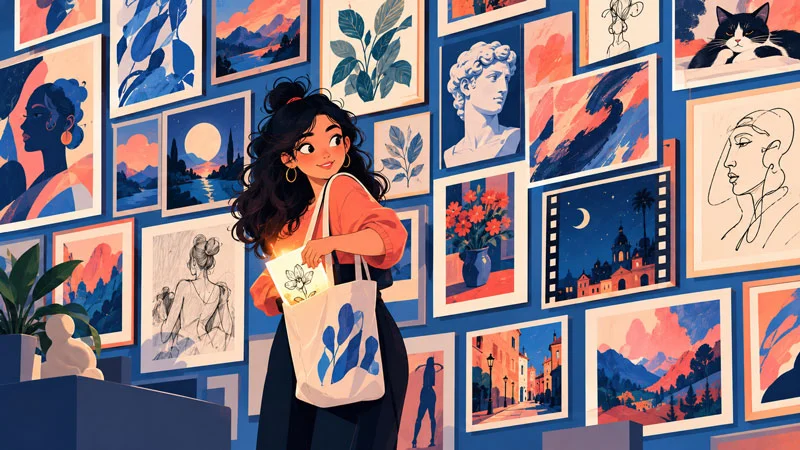
When someone asks an artist, “Where do you get your ideas?” the honest answer is simple: we steal them. This isn’t about plagiarism or dishonesty. It’s about understanding how creativity works in the real world. Every artist, writer, musician and designer looks at the world through a specific lens: they decide what’s worth stealing, and then they move on to the next thing.
The musician David Bowie is often quoted on this idea: “The only art I’ll ever study is stuff that I can steal from.” (David Bowie, as cited in Austin Kleon’s Steal Like an Artist.) It wasn’t a confession of guilt; it was a creative philosophy.
When you start looking at the world this way, you stop worrying about what is “good” and what is “bad” and ask a more useful question: is this worth learning from? Everything becomes potential material for your work.
This perspective frees you from the paralyzing fear of originality. If you don’t find something worth stealing today, you might find it tomorrow, next month or next year. Your job is simply to keep your eyes open and collect the ideas that resonate with you.
Why “Nothing Is Completely Original” Is Actually Good News
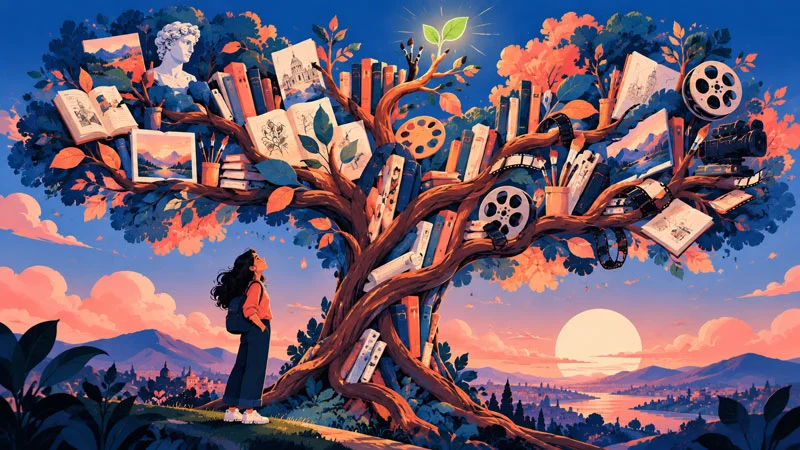
Writer Jonathan Lethem explored this in his essay “The Ecstasy of Influence” (Harper’s Magazine, February 2007). His observation, in short, is that when people call something original, they often simply don’t know its sources. What looks brand new is usually a remix of existing ideas the audience hasn’t met yet.
This is an old idea. The book of Ecclesiastes says, “There is nothing new under the sun” (Ecclesiastes 1:9). All creative work builds on what came before, and that’s wonderful news, because it frees you from the burden of creating something out of absolute nothing. You can stop chasing pure invention and embrace influence instead.
The French writer André Gide put it beautifully: “Everything that needs to be said has already been said. But, since no one was listening, everything must be said again.”
You’re not required to invent entirely new concepts. You’re allowed to take existing ideas and filter them through your own perspective, experience and skill.
Understanding the Difference Between Plagiarism and Creative Stealing

The English writer William Ralph Inge once joked, “What is originality? Undetected plagiarism.” It’s said tongue in cheek, but it points to a real distinction. The difference between plagiarism and creative stealing comes down to transformation and attribution.
Plagiarism means taking someone’s work and presenting it as your own without acknowledgment or transformation. You’re stealing credit.
Creative stealing means studying what you love, understanding it deeply, and transforming it into something new that reflects your perspective and voice. You’re borrowing inspiration and technique, not passing off someone’s finished work as your own.
Credit is the simplest safeguard. When you know where an idea came from, say so.
Inspiration vs. Plagiarism: A 5-Question Checklist
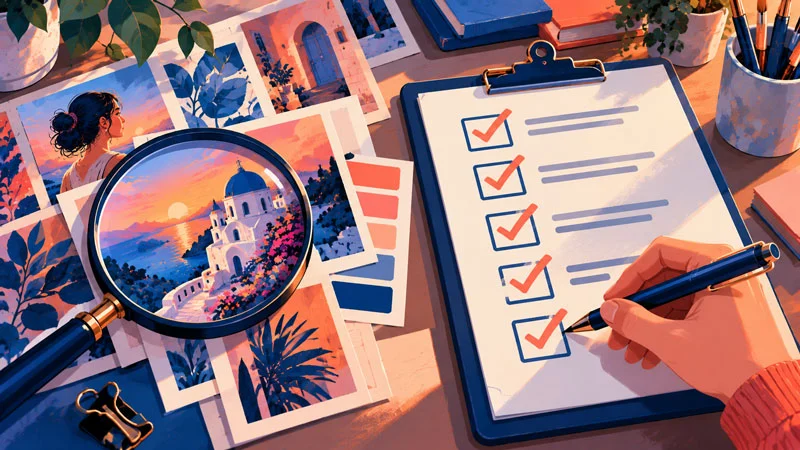
Before you publish or share a piece of work, ask yourself:
- Did I study why this works, not just what it looks like?
- Can I name my sources of inspiration?
- Did I change the subject, context and style in a meaningful way?
- Would the original creator recognize their finished work in mine?
- Am I comfortable crediting them publicly?
If you answered “no” to question 3 or “yes” to question 4, keep transforming.
The Mathematics of Creative Inspiration: 1+1=3
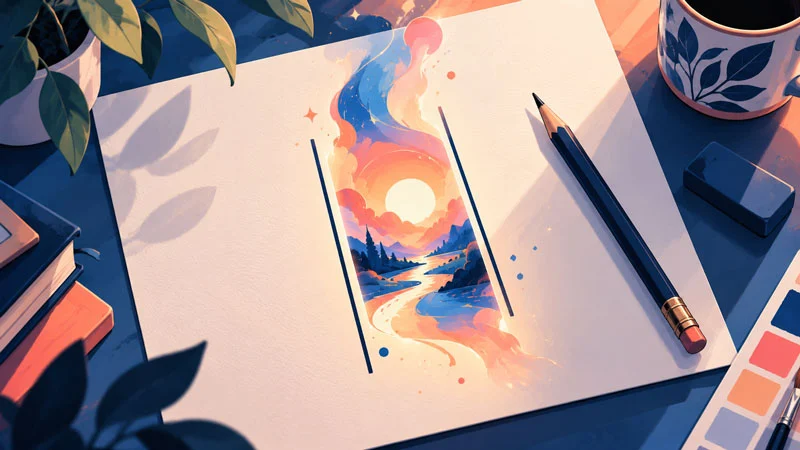
Here is a simple exercise, described by Austin Kleon in Steal Like an Artist, that shows how creativity works. Draw two parallel lines on a piece of paper.
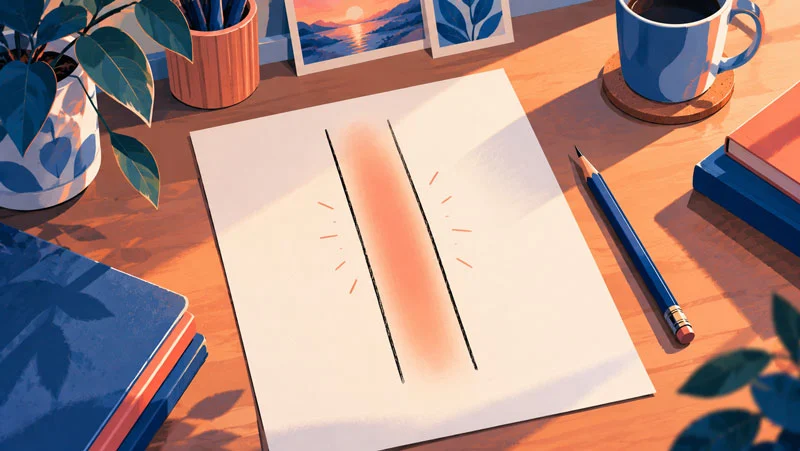
Between the two lines there is a third element: the space running between them. So 1 + 1 = 3. The space between creates something new.
The same principle shows up in nature. Look at genetics: you have a mother and a father. You carry features from both, yet the sum of you is bigger than their individual parts. You’re a unique remix of your parents and all of your ancestors. Something new emerges from the combination.
How Your Genealogy of Ideas Works
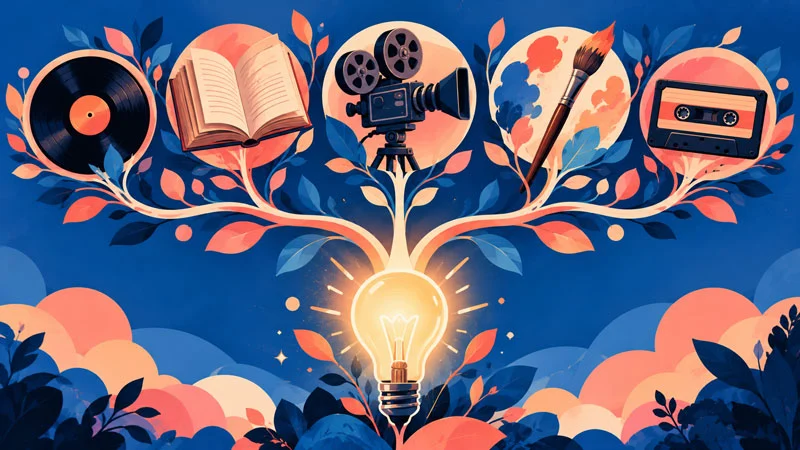
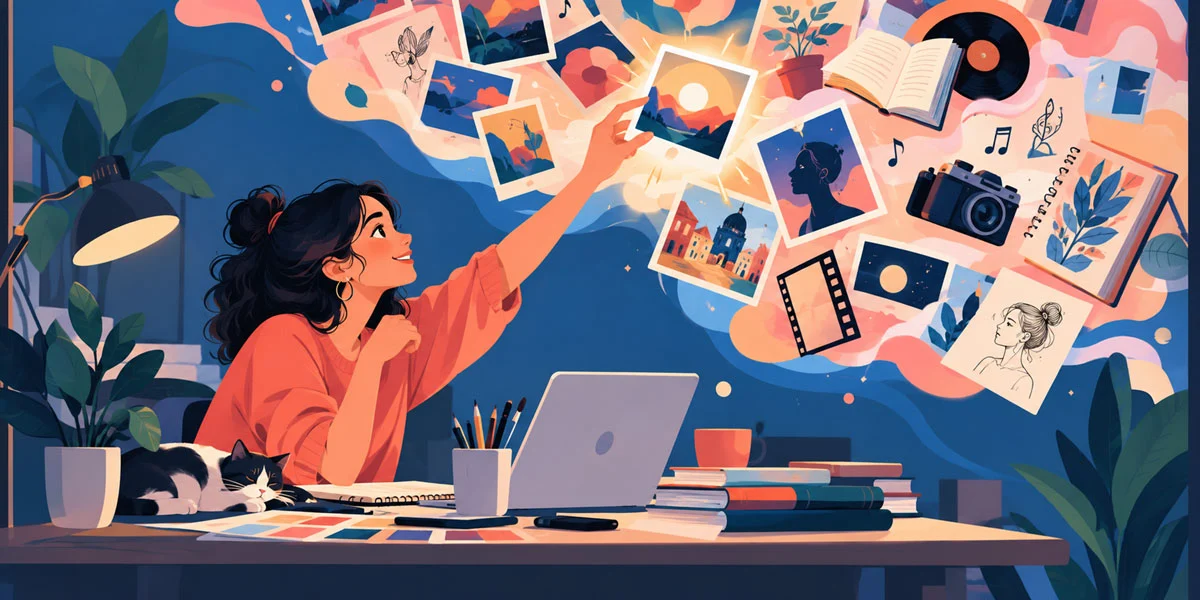
Just as you have a family genealogy, you also have a genealogy of ideas. You didn’t choose your biological family, but you can choose your teachers, your friends, the music you listen to, the books you read and the films you watch.
You are, in a sense, a mashup of what you choose to let into your life.
The German writer Goethe captured this: “We are shaped and fashioned by what we love.” Everything you expose yourself to, intentionally or not, becomes part of your creative DNA.
This is why conscious curation matters. The rapper and entrepreneur Jay-Z has described, in his book Decoded, how he and his friends found their “fathers” in records, on the streets and in history, getting to pick and choose the ancestors who would shape the world they were building for themselves.
You have the same power. Your creative ancestors don’t have to be living or from your generation. They can come from any time, culture or medium and by studying them you absorb part of what made them great.
You Are the Sum of Your Influences
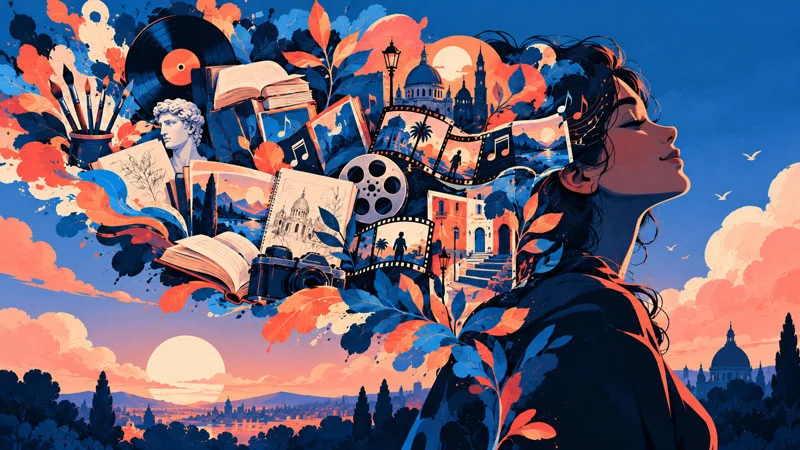
If you’re only as good as what surrounds you, your creative quality is tied to the influences you choose. A popular saying holds that your income is close to the average of your five closest friends’ incomes. Ideas work the same way: the quality of what you take in shapes the quality of what you make.
Your mother may have been right about “garbage in, garbage out.” Your job is to collect good ideas, and the more you collect, the more you have to draw from. This isn’t passive. It takes active, intentional curation.
Collecting Ideas Like a Professional Artist
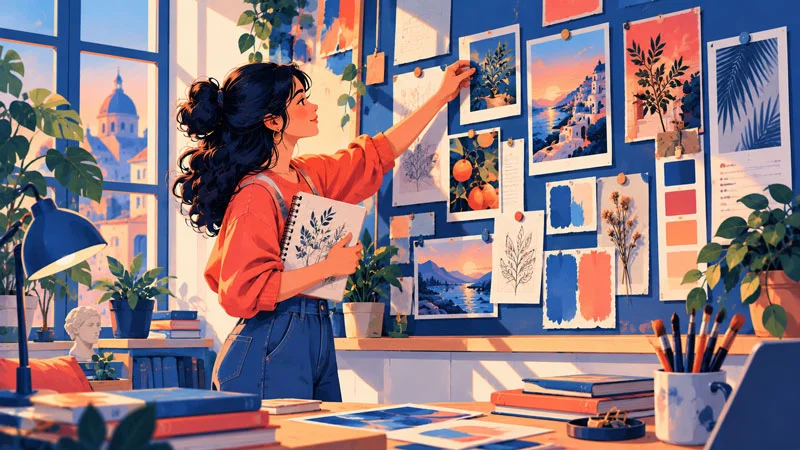
Artists are collectors, and that is different from being a hoarder. Hoarders gather everything without purpose. Artists collect selectively, keeping only what they really love.
Filmmaker Jim Jarmusch, in a well-known piece of advice published in MovieMaker Magazine, urges creators to take in everything, from old and new films to music, books, architecture, street signs and light and shadow. His filter is the important part: “Select only things to steal from that speak directly to your soul.”
Devour everything, but keep only what truly speaks to you. That is the difference between mindless consumption and intentional collection.
The Difference Between Hoarders and Collectors
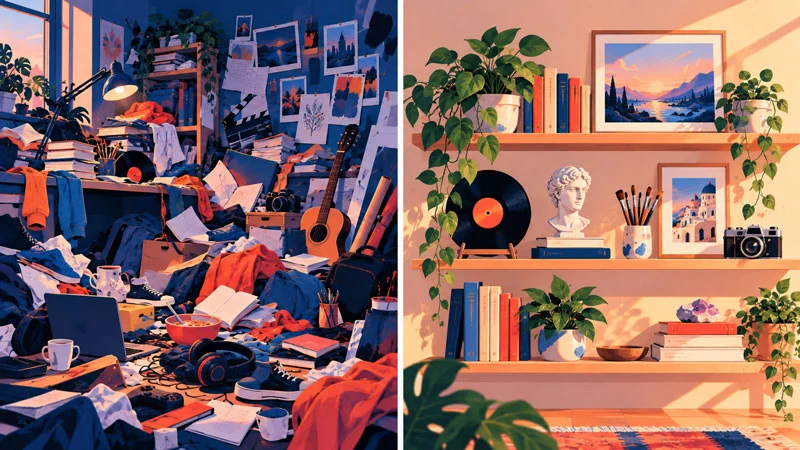
A hoarder accumulates for the sake of accumulating, and everything ends up piled together in an undifferentiated mass. A collector has criteria and taste. They know what matters to them and they’re selective about what they bring in.
Think about your own space. If you filled it with everything you encountered, it would become chaotic and overwhelming. When you keep only what you genuinely love, your space becomes a curated reflection of your aesthetic and values.
The same applies to ideas. Be ruthless about what you let into your creative life. Not everything deserves your time and attention and some things actively weaken your work. By being selective, you train your taste and sharpen your instincts.
Building Your Creative Lineage by Studying Masters
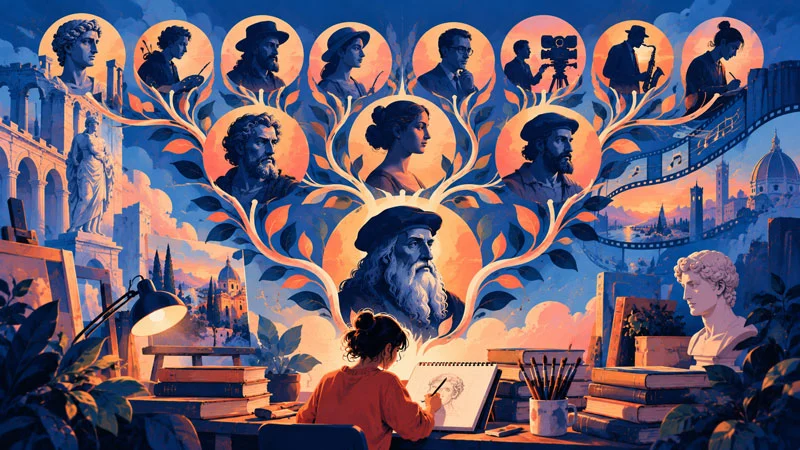
Marcel Duchamp is often quoted as saying, “I don’t believe in art. I believe in artists.” It suggests a practical method for studying: if you try to swallow the entire history of your field at once, you’ll choke on it.
Instead, choose one thinker, writer, artist or role model you really love, and study everything about them: their work, their philosophy, their influences, how they developed. Then find three people that person admired and study them. Then find the influences of those three, and repeat.
By climbing this tree, you’re not trying to learn everything. You’re going deep into lineages that matter to you and understanding the chain of ideas that led to the work you love.
Once you’ve built that tree, you’re ready to grow your own branch. Seeing yourself as part of a creative lineage helps you feel less alone when you begin making your own work. Many artists keep portraits or postcards of their heroes near their desks as a reminder of the tradition they belong to.
Studying masters of the past also gives you access that few teachers can match. You may never meet them, but their work is a lesson plan you can return to as often as you like.
Inspiration in the Design Classroom

In my design classes, I never ask students to “be original” on day one. I ask them to study something they admire. Take a poster you love and open it in Illustrator or Photoshop. Identify its grid, its type pairing and its color logic. Then rebuild it from scratch using your own subject matter.
Students quickly discover that structure can be borrowed while expression stays their own. The grid, the hierarchy and the spacing teach them how the original works, and their subject, color choices and personality make the result theirs.
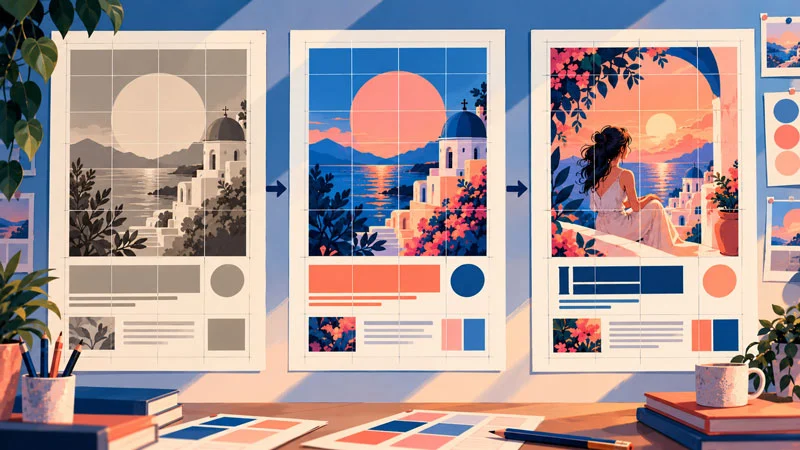
Here is how the exercise runs. Each student picks a classic Swiss-style poster they admire and spends the first session only analyzing it. They lay a grid over it, name the typefaces, and pull out its four or five colors. In the second session, they rebuild the layout in Illustrator for a completely different subject, such as a poster for a college tech fest or a neighborhood food stall.
The first rebuilds usually look almost identical to the original, and that is fine. The real learning starts when I ask students to change one thing at a time: first the colors, then the typeface, then the main image. By the third change, most of them have stopped copying and started designing. The grid stays, but the poster is no longer the original poster. It is theirs.
How Animators Learn by Borrowing
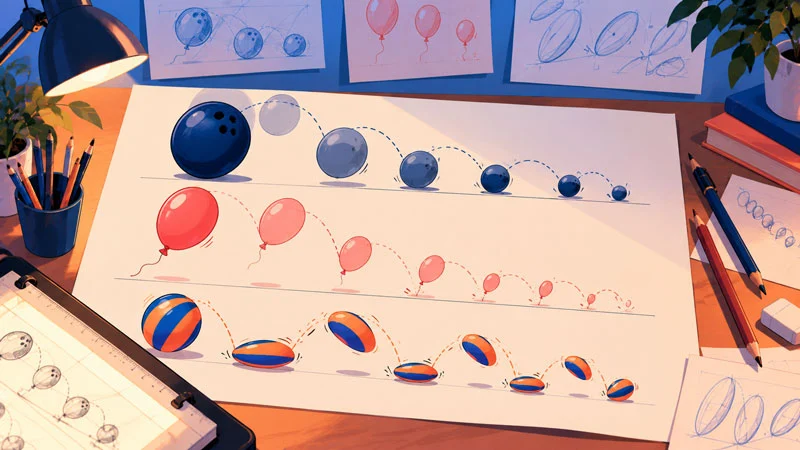
Animation works the same way. Beginners start by studying the established principles of motion, such as squash and stretch, timing and anticipation. They trace, redraw and analyse existing movement until those principles become instinct. Only then do they bend them into a personal style.
My first exercise is the classic bouncing ball. Students begin with a plain ball that bounces at an even speed, which usually looks stiff and lifeless. Then we apply the principles one at a time: squash and stretch as the ball hits the ground, slower timing at the top of each arc, and faster spacing near the floor.
Next, I ask everyone to animate the same bounce for a different object: a heavy bowling ball, a light balloon, a tired ball at the end of a long day. The physics is the same and the principles are the same, yet no two animations feel alike, because every student makes different choices about timing and spacing. That is exactly how a personal style begins: with borrowed principles and individual decisions.
The Importance of Self-Education

School and education aren’t always the same thing. Whether or not you’re enrolled somewhere, learning is ultimately your responsibility. Stay curious about the world you live in, chase down the references behind work you admire and go one layer deeper than everyone else. That’s how you get ahead.
The musician RZA put it simply: “Whether I went to school or not, I would always study.” Your formal education will end, but your self-education shouldn’t.
School vs. Real Education: Why Curiosity Matters Most

Formal schooling gives you structure, credentials and a social context. Self-directed learning gives you ownership and passion. The most successful creators take responsibility for their own education: they seek out knowledge, make connections and apply what they learn to their own work.
Search first, ask second. Before you ask someone a question, spend a few minutes searching. You’ll either find the answer or arrive at a better question. Don’t think of it as “doing research.” The act of searching is where the learning happens.
Libraries and bookshelves are worth your time, too. Read the bibliography at the back of a book you love, because the best book is often the one it points you to. Filmmaker John Waters said, “Nothing is more important than an unread library.” (John Waters, Role Models.) In other words, collect more books than you’ll ever finish and let them keep you curious.
Creating Your Own Swipe File: A Digital and Analog Approach
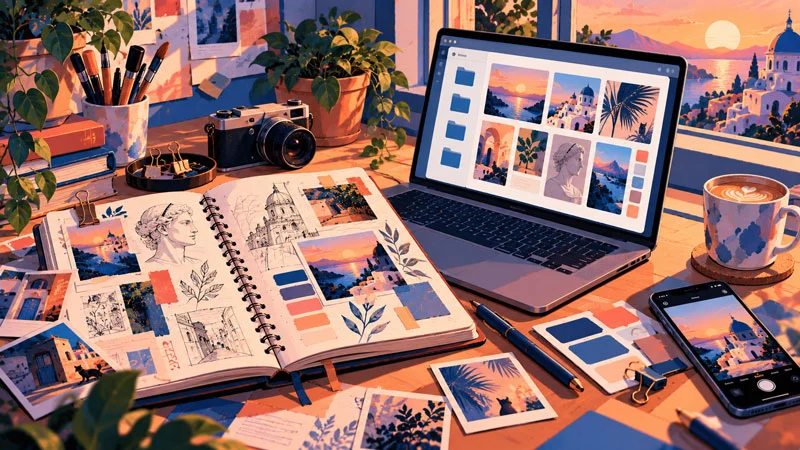
A swipe file is a personal collection of work that inspires you. The term comes from advertising and copywriting, and Austin Kleon brought it to a wider creative audience in Steal Like an Artist. It can be digital or analog; what matters is that it works for you.
Mine is a phone folder called “Swipe”, where I save screenshots of posters, layouts and color palettes, backed up by a Pinterest board for typography and a pocket sketchbook for quick thumbnails. Before starting a new project, I spend ten minutes scanning it. It isn’t there for copying. It reminds me what made me stop and look.
Whatever format you choose, carry a way to capture ideas wherever you go. A notebook and pen work well, and so do your phone’s camera and notes app. Copy favorite passages from books, jot down overheard phrases, screenshot layouts and color palettes and doodle while you think.
Newspaper journalists keep a similar archive called a “morgue file,” a place for old material that may be brought back to life in a future story. Your swipe file can serve the same purpose.
A line often attributed to Mark Twain captures the spirit: it’s better to take what doesn’t belong to you than to let it lie around neglected. Whoever said it, the point holds. Ideas you don’t save are ideas you lose, so put them where you can find and transform them later.
AI and Inspiration
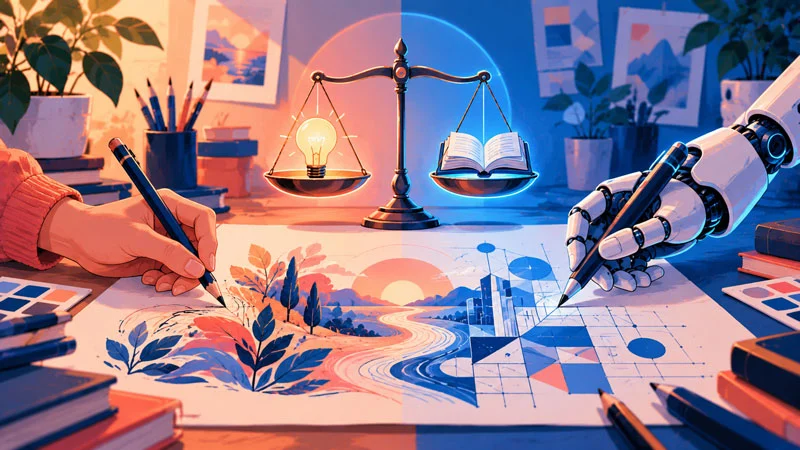
Today, AI tools can generate images in seconds, which makes the question of influence more important than ever. Using AI to explore ideas and speed up your process is fine. Producing work that closely replicates a living artist’s style, without thought, transformation or credit, is where the line blurs.
The same rule applies as always: study, transform, credit.
Your 5-Day Swipe File Challenge
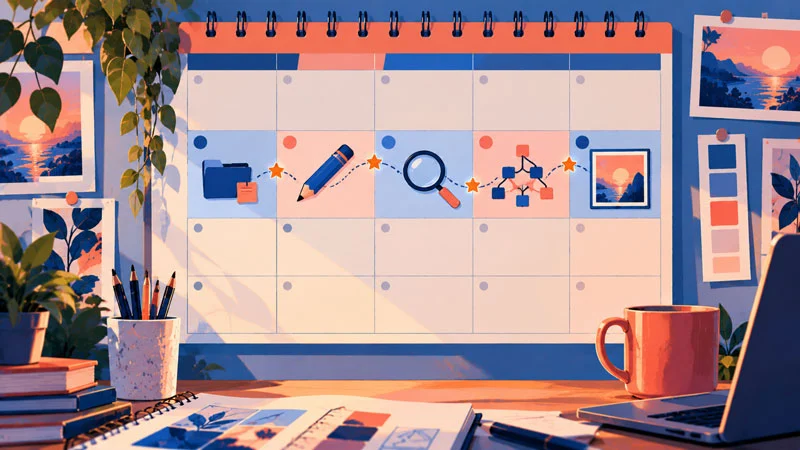
Put these ideas into practice with a simple five-day exercise:
- Day 1: Collect 10 things you love: posters, logos, film scenes, textures, anything.
- Day 2: Write one sentence on why you love each one.
- Day 3: Look for a pattern across your favorites, such as color, spacing or mood.
- Day 4: Find out who inspired your favorite creator, and look at their work.
- Day 5: Make one small piece that applies your pattern to a completely new subject.
Frequently Asked Questions

Is it okay to steal ideas as a creative?
Yes, if you mean studying and transforming ideas rather than copying finished work. Always credit the original source.
What is a swipe file?
A personal collection of inspiring work, saved digitally or on paper, that you revisit when you need ideas.
How do I know if my work is too similar to someone else’s?
If a viewer could easily recognize the original in your result, you haven’t transformed it enough.
How do designers find original ideas? By studying a few creators deeply, collecting references, and combining them with their own experience and subject matter.
Conclusion: Start Your Collection Today

Great creative work begins with understanding that you don’t need to invent ideas from thin air. You need to become a student of what you love: to collect, curate and study and to remember that all creativity is built on what came before. That isn’t a limitation. It’s liberation.
Start today. Pick one artist or creator you admire. Study their work deeply and find out what influenced them. Start your swipe file and fill it with things you love. Let those influences settle in your mind.
Your unique voice won’t come from trying to be original. It will come from the intersection of everything you choose to let into your life. The work you’re meant to make is waiting for you. All you have to do is learn from the best, credit them and make it your own.
Sources & Further Reading
- Austin Kleon, Steal Like an Artist: 10 Things Nobody Told You About Being Creative (Workman Publishing, 2012)
- Jonathan Lethem, “The Ecstasy of Influence,” Harper’s Magazine, February 2007
- Jim Jarmusch, “Things I’ve Learned,” MovieMaker Magazine, 2004
- Jay-Z, Decoded (Spiegel & Grau, 2010)
- John Waters, Role Models (Farrar, Straus and Giroux, 2010)
Continue Reading
Next in this series: Blog Post 2, “From Copying to Creating.” Explore more about developing your creative voice and learning from masters.
About the Author
Lalit M. S. Adhikari is a Digital Nomad and Educator since 2009 in design education, graphic design and animation. He’s taught 500+ students and created 200+ educational articles on design topics. His teaching approach emphasizes clarity, practical application and helping learners.
Learn more about Lalit Adhikari.
Last Updated: Oct 2026