

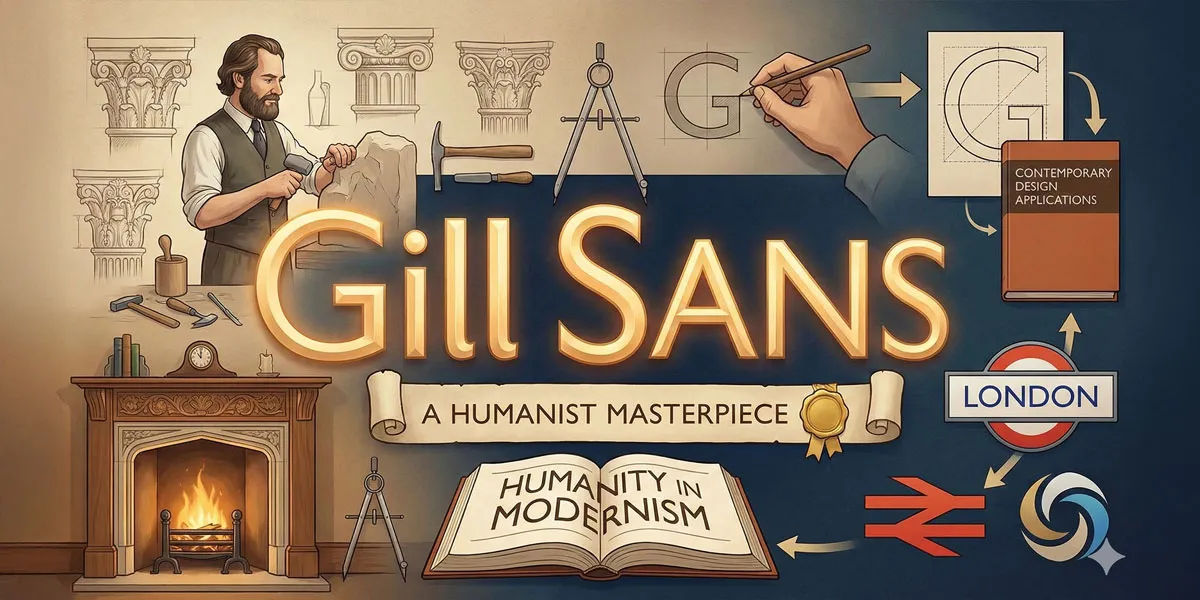
Discover Gill Sans’ revolutionary design history, Eric Gill’s humanist philosophy, and how this typeface bridged modernism and tradition while becoming one of the most beloved typefaces in design history.
My name is Lalit Adhikari and we are at LTY. Let’s begin!
Table of Contents
Introduction: The Typeface That Brought Humanity to Modernism
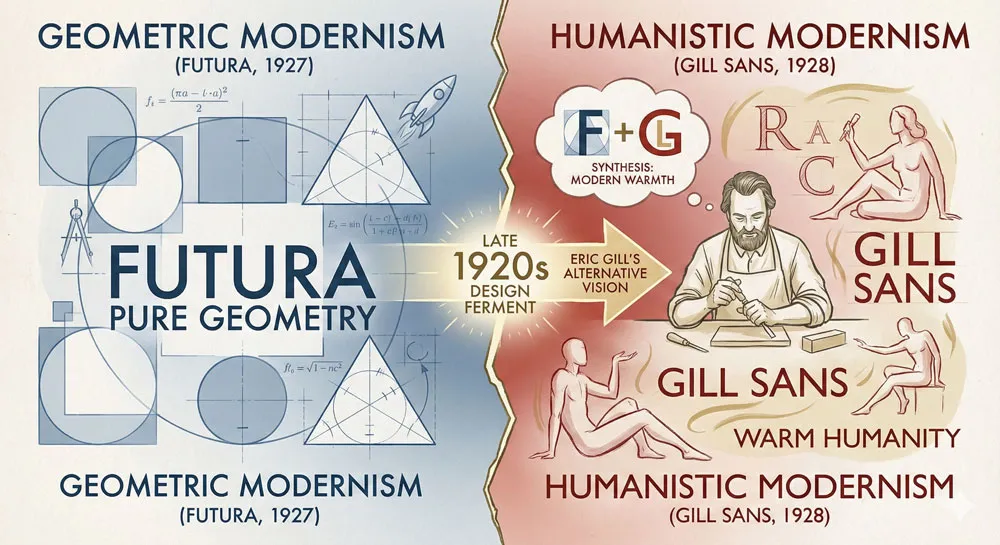
In the late 1920s, as geometric modernism was reaching its peak with typefaces like Futura (1927) embodying pure geometric rationality, a British typographer and designer named Eric Gill was developing a fundamentally different approach to typeface design.
Where Paul Renner believed that geometric purity represented progress and rationality, Eric Gill believed that typefaces should embody the human hand, human craftsmanship, and human warmth while still remaining thoroughly modern.
The result was Gill Sans, designed and released beginning in 1928. Gill Sans represented something revolutionary in the typography world: a sans-serif typeface that was thoroughly modern and clean, yet retained humanistic character and warmth.
The typeface was not based on pure geometric principles. Instead, it was based on careful observation of humanist letterforms—the ideal proportions of letters as they appeared in history, as they were drawn by skilled hands, as they communicated through their proportions and character.
What is remarkable about Gill Sans is that it succeeded commercially and culturally in a way that challenged the modernist orthodoxy of its time.
In an era when geometric purity was celebrated as the embodiment of progress and rationality, Gill Sans proved that humanistic refinement could be equally modern, equally communicative, and equally appropriate for contemporary design. The typeface became one of the most widely-adopted and beloved typefaces in history.
Nearly a century later, Gill Sans remains one of the most recognizable and culturally significant typefaces in the world. The typeface is used in countless contexts—from signage to corporate branding to publishing to informal communication.
Gill Sans has influenced virtually every subsequent humanist sans-serif typeface. The typeface is celebrated for its distinctive character, its warmth, its readability, and its ability to communicate both modernity and tradition.
Eric Gill’s life and work were complex and controversial. Gill was a brilliant designer and typographer, but his personal life and philosophical beliefs included deeply troubling dimensions. This exploration of Gill Sans must acknowledge both the typeface’s design brilliance and the complications of Gill’s character and history.
Yet despite these complications, Gill Sans stands as a masterpiece of humanist design—a typeface that proves modernism does not require the elimination of human warmth and character.
This comprehensive exploration traces Eric Gill’s life and design philosophy, examines Gill Sans’ creation within the modernist movement context, analyzes the typeface’s distinctive humanist characteristics, explores Gill Sans’ adoption and cultural impact, compares the typeface to other modernist approaches, and ultimately asks:
- what does Gill Sans reveal about the relationship between modernism and humanity, between geometric rationality and human warmth, between design principles and practical beauty?
Related Topics:
- Baskerville: Elegant Serif That Shaped Print Typography
- Bodoni Font: Serif That Defined Luxury Typography
- Garamond: Timeless Serif That Defined Classical Typography
Eric Gill: The Designer, Typographer, and Craftsman
A Life in Art, Design, and Craft
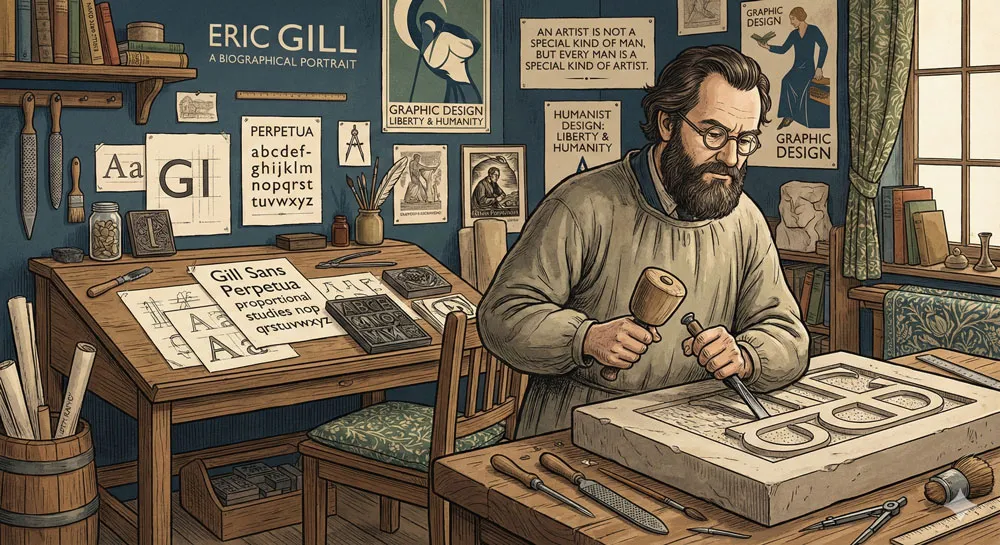
Eric Gill was born in 1882 in Brighton, England. He came of age during a period of artistic and design ferment in Britain, when the Arts and Crafts movement was influential and when designers and craftspeople were questioning industrial mass production and seeking to restore craftsmanship and human value to design and manufacture.
Gill initially trained as an architect and stone carver. His early work involved stone carving, typeface, and design work rooted in traditional craft methods.
Gill was deeply influenced by the Arts and Crafts movement, which believed that mechanized industrial production had devalued craft and that design should prioritize handwork, artisanal skill, and human creativity.
However, Gill was not a nostalgic romantic seeking to return to pre-industrial methods. Instead, Gill believed that modern design should be informed by craft principles even while embracing contemporary materials and methods.
Gill believed that good design required understanding traditional principles, applying them thoughtfully, and creating work that honored both craft traditions and contemporary needs.
Gill’s design practice encompassed numerous fields: stone carving, typeface design, illustration, sculpture, graphic design, and writing. Throughout his career, Gill maintained consistent philosophical commitments:
- belief in the value of craftsmanship, belief that design should serve human purposes, belief that beauty emerged from understanding proportion and form deeply, belief that designers should understand and respect their materials and traditions.
Gill’s Design Philosophy: Humanist Principles and Craft Values
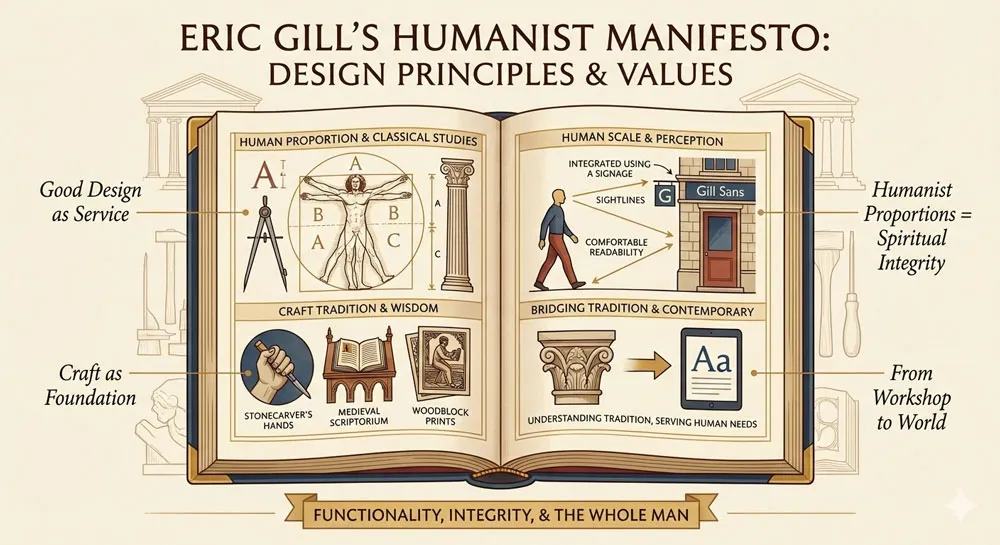
Central to Eric Gill’s design philosophy was a belief that good design emerged from understanding and respecting human proportions and human craftsmanship.
Gill believed that designers should study traditional proportions and forms—not to copy them, but to understand the underlying principles that made them work.
This philosophy distinguished Gill from many contemporary modernist designers. While modernists like Le Corbusier believed that design should be based on pure geometric principles and machine rationality, Gill believed that design should be rooted in human proportions, human craftsmanship, and human scale. Gill was modern without being mechanistic. Gill was rational without abandoning humanity.
Gill also believed deeply in the relationship between form and function. For Gill, beautiful design emerged from perfect understanding of functional requirements and careful execution in service of those requirements.
This belief aligned Gill with modernist functionalism, but Gill understood function in humanistic rather than mechanistic terms.
The Arts and Crafts Influence and British Design Tradition
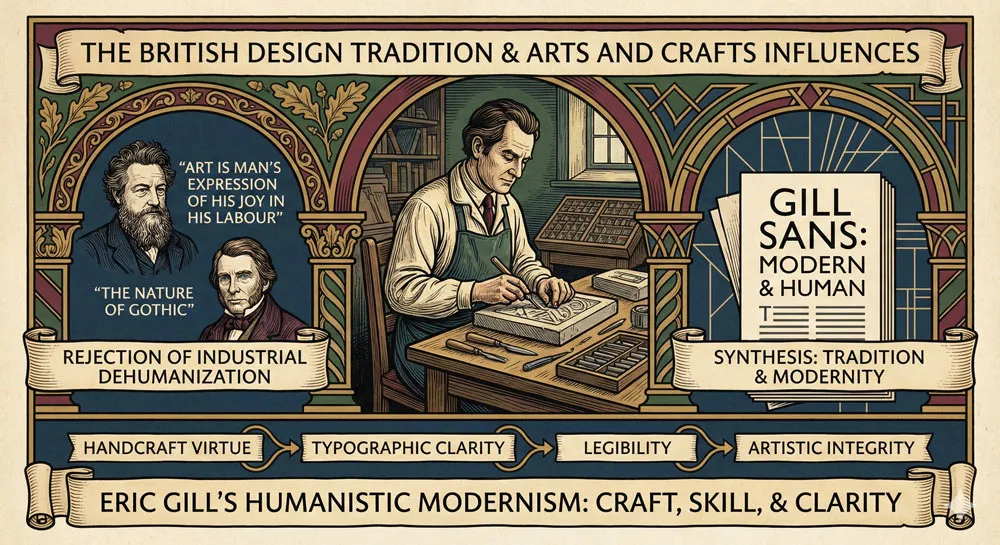
Gill’s design philosophy was deeply rooted in British design traditions, particularly the Arts and Crafts movement. The Arts and Crafts movement, influenced by thinkers like John Ruskin and designer William Morris, believed that industrial mechanization had dehumanized design and craft, and that modern design should prioritize craftsmanship, individual skill, and human creativity.
Gill was influenced by Arts and Crafts principles but was not nostalgic. Gill believed that contemporary design could honor craft principles while embracing modern materials and technologies.
This balance—between respecting traditional craft wisdom and embracing contemporary possibilities—shaped Gill’s entire design practice and directly influenced his approach to typeface design.
The British design tradition also valued legibility and clarity in typography. British designers had developed distinctive approaches to typeface design that prioritized readability and practical functionality. Gill’s design work continued and evolved this tradition.
Related Topics:
- The Worst Fonts in the World: A Typographic Hall of Shame
- Gill Sans and Tube: How Johnston and Gill Defined London
- Baskerville and Eaves: A Tale of Perfection, Passion and Revival
Creating Gill Sans: Design Philosophy and Process
The Design Brief and Context
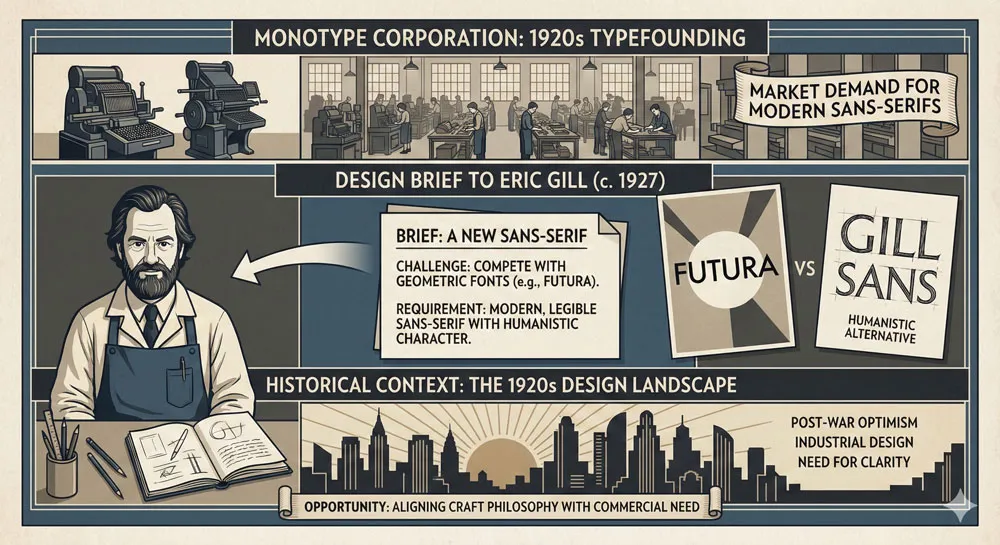
Gill Sans was created for the Monotype Corporation, a major typeface manufacturer. Monotype commissioned Gill to design a sans-serif typeface for contemporary use.
This commission came at a specific historical moment: geometric sans-serifs like Futura were proving commercially successful, and there was clear market demand for sans-serif typefaces.
Monotype wanted a distinctive sans-serif that would compete with other contemporary options.
However, Monotype’s brief to Gill was interesting: they wanted a sans-serif that retained humanistic character while being thoroughly modern.
This brief aligned perfectly with Gill’s design philosophy. Rather than creating a purely geometric sans-serif, Gill was given space to develop a humanistic approach.
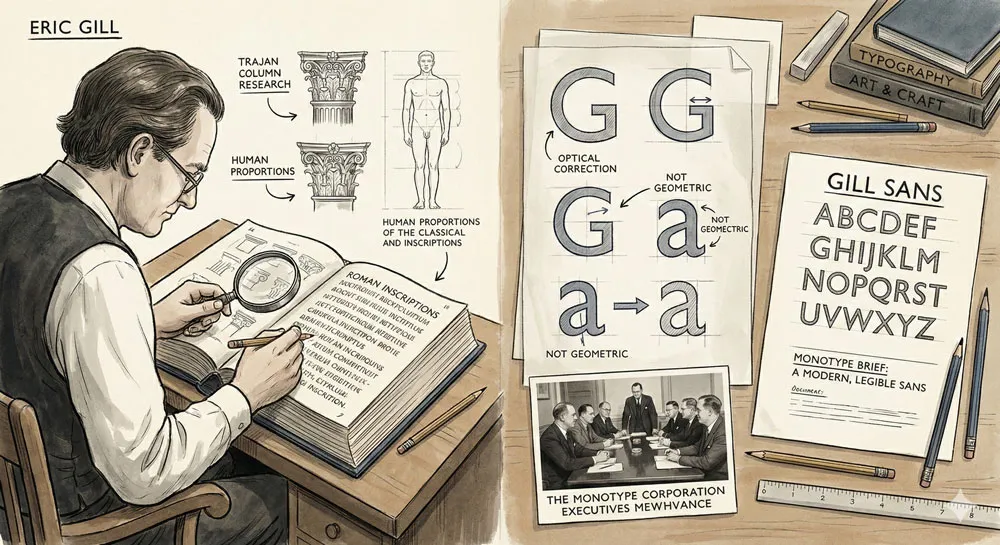
Gill’s design process began with research and observation. Gill studied historical letterforms, examining how proportions and forms developed through centuries of typographic tradition.
Gill was not interested in pure geometric construction but in understanding how human hands and eyes, through centuries of practice, had developed proportional relationships that communicated clearly and beautifully.
Developing Humanist Proportions
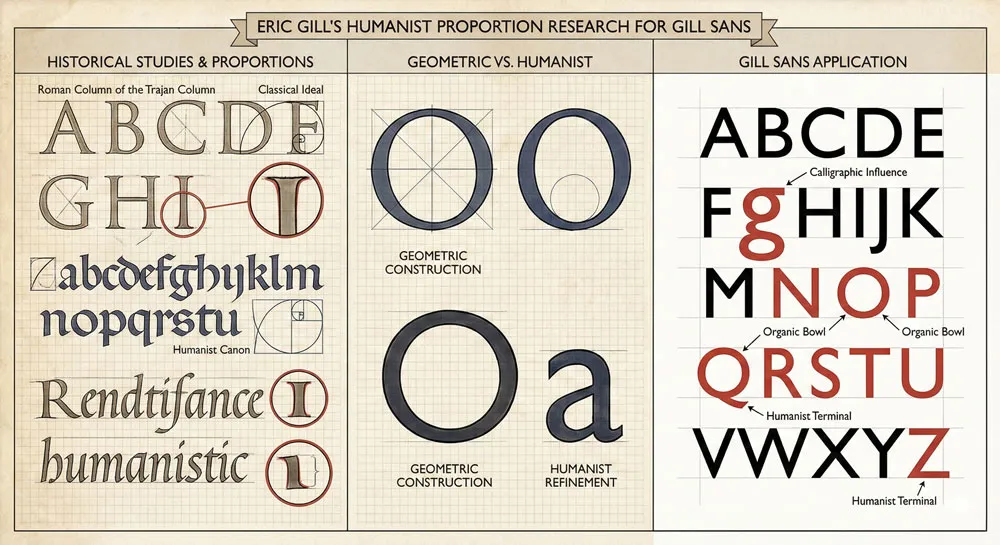
Unlike Futura’s explicit geometric construction, Gill Sans was based on careful observation and refinement of humanist proportions. Gill studied Roman proportions, classical letterforms, and the best historical typefaces.
He observed how these historical forms achieved clarity and beauty through careful proportion rather than geometric purity.
Gill then applied this historical understanding to create a thoroughly modern sans-serif. The letterforms of Gill Sans are based on humanist principles: they have the proportions and character of letters developed through centuries of refinement, yet they are rendered in a clean, modern, sans-serif style.
A crucial aspect of Gill’s approach was the treatment of letterforms. Gill included subtle refinements that acknowledge human proportion and perception: slightly rounded terminals (the ends of letters) rather than perfectly sharp angles, careful attention to stroke weight relationships, refined proportions based on historical study.
These refinements made Gill Sans warmer and more human than purely geometric sans-serifs.
The Relationship Between Legibility and Character
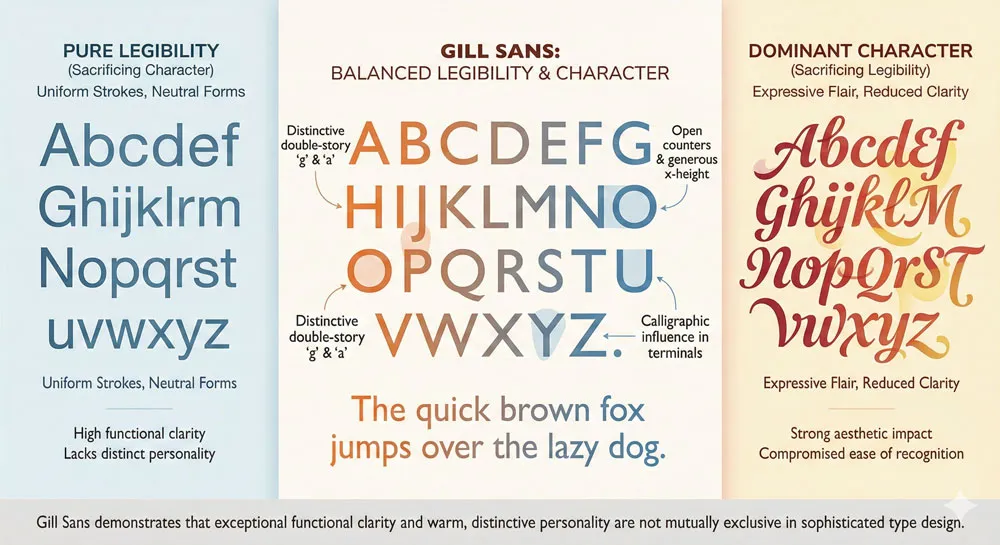
A central achievement of Gill Sans was proving that legibility and distinctive character were not mutually exclusive. Gill Sans is exceptionally legible—the letterforms are clear and easily distinguishable.
However, the typeface also has strong personality and character. The humanist refinements and careful proportions make Gill Sans immediately recognizable and distinctive.
This combination of legibility and character was crucial to Gill Sans’ success. The typeface could be used in contexts requiring maximum clarity (signage, information design) while also bringing warmth and personality to the communication.
This versatility—the ability to function in both utilitarian and aesthetic contexts—made Gill Sans infinitely adaptable.
Related Topics:
- Futura vs. The World: The Geometric Vision of Paul Renner
- Legibility vs. Readability: What Every Designer Needs to Know
- Secret Life of Symbols: History of Ampersand and Interrobang
Gill Sans’ Design Characteristics: Humanist Refinement and Modern Clarity
Distinctive Visual Character
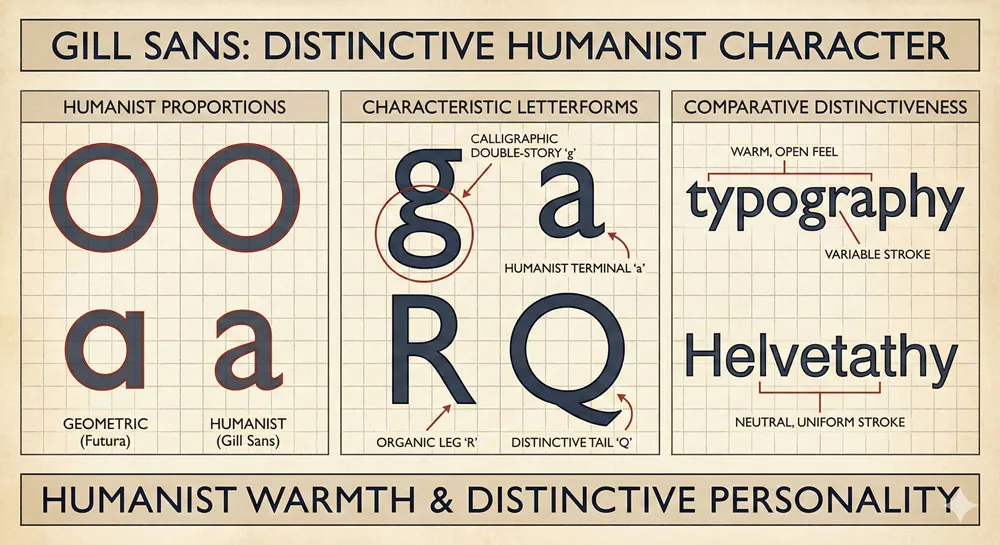
Gill Sans has an immediately recognizable visual character. The letterforms are distinctive and memorable. A viewer who has encountered Gill Sans multiple times can usually identify it.
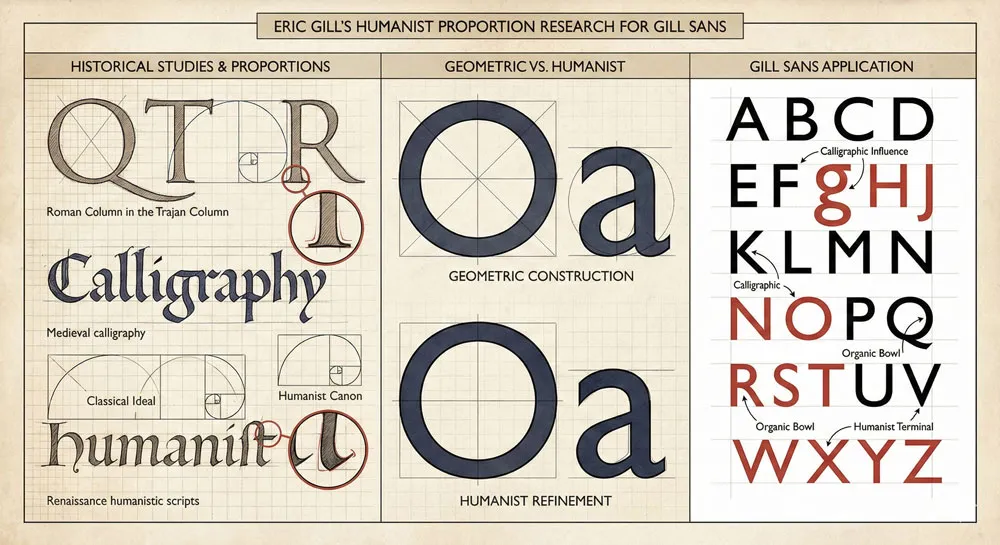
Several characteristics contribute to this distinctiveness. The proportions are based on humanist study rather than pure geometry.
The stroke weights are refined and carefully balanced. The terminals (ends of letters) have subtle refinement rather than sharp geometric angles. The overall appearance is clean and modern yet warm and humanistic.
Gill Sans also has characteristic proportions that make it immediately recognizable: wide letterforms with generous spacing, careful attention to counter shapes (the white space within letterforms), refined curves and transitions.
The typeface feels humanistic in a way that purely geometric sans-serifs do not.
The Balance Between Modernism and Tradition
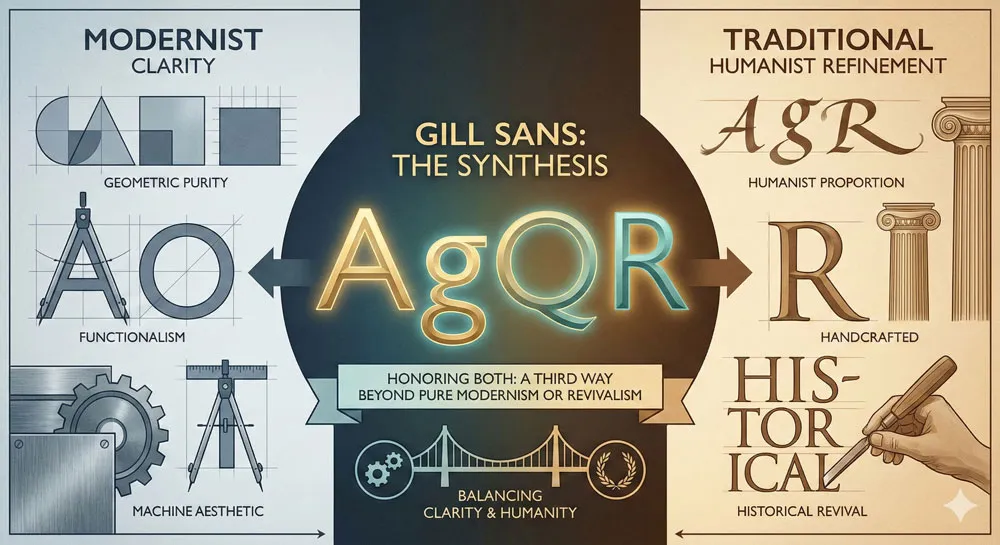
What is most distinctive about Gill Sans is the balance between modernist clarity and traditional humanist refinement. The typeface is thoroughly modern: it is a clean, contemporary sans-serif suitable for contemporary design.
Yet the typeface retains humanistic warmth and character. The letterforms acknowledge traditional proportions and human scale.
This balance distinguishes Gill Sans from both pure geometric modernists (like Futura) and typefaces attempting to revive historical forms.
Gill Sans is neither nostalgic nor coldly geometric. It represents a third way: modernism informed by humanistic understanding and craft values.
Warmth and Accessibility
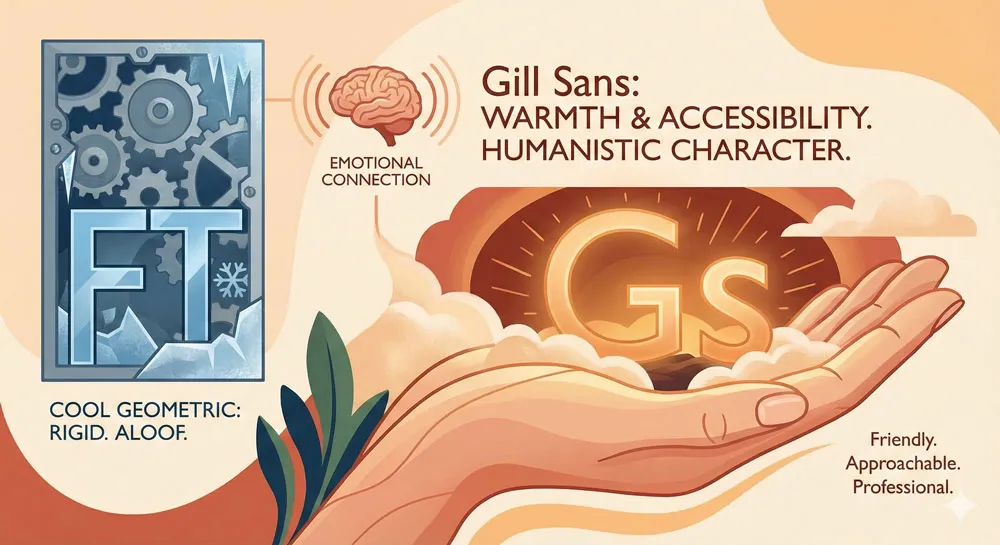
Unlike cool, rational geometric sans-serifs, Gill Sans communicates warmth and accessibility. The typeface feels friendly and approachable while remaining professional and contemporary. This warmth emerges from the humanist proportions, from the refined curves and transitions, from the typeface’s overall character and personality.
This warmth has made Gill Sans attractive to designers and organizations wanting to communicate that they are contemporary and professional while also being approachable and human. The typeface effectively communicates both authority and accessibility simultaneously.
Related Topics:
- Helvetica – Swiss Modernism’s Ubiquity Crisis
- Comic Sans – Accessibility & Gatekeeping Critique
- Gotham – Political Design & Elections Power
Gill Sans’ Historical Context: British Design and Alternative Modernism
Alternative Paths to Modernism
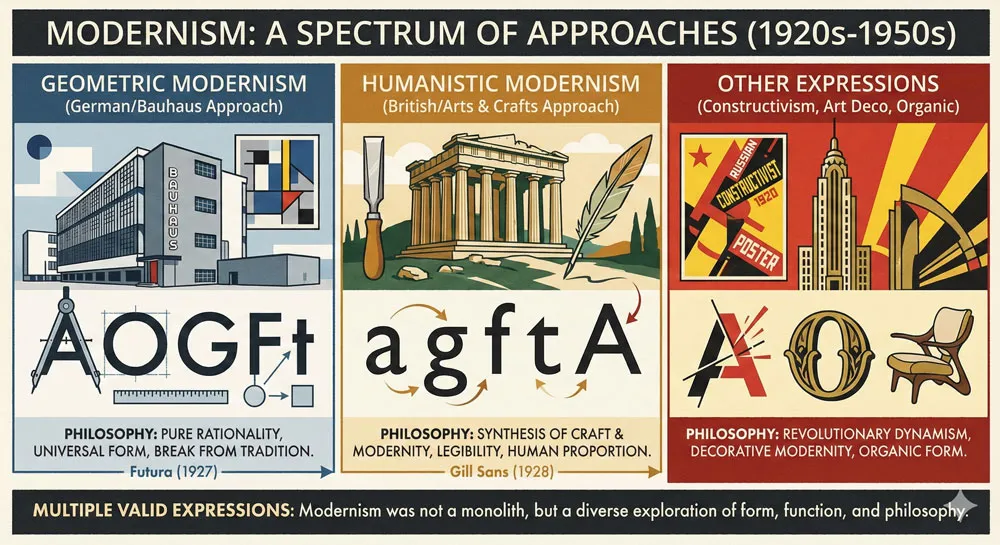
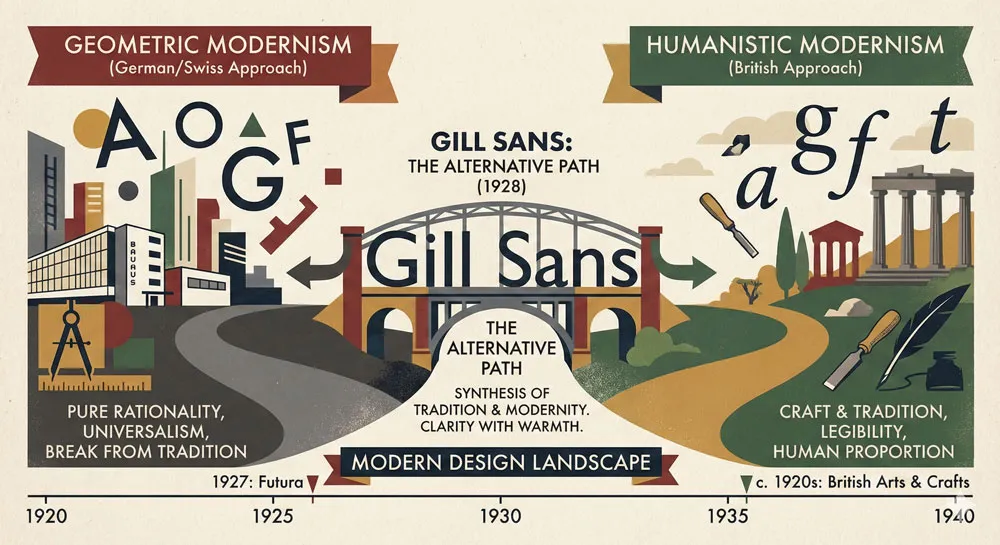
The 1920s and 1930s saw multiple different approaches to modernism in design. While German and Swiss designers were emphasizing geometric rationality and systematic design, British designers like Eric Gill were exploring alternative paths to modernism—approaches that maintained connection to craft traditions, humanistic values, and traditional proportional understanding.
These alternative modernist approaches were not hostile to geometric modernism. Rather, they represented different philosophical commitments about how modernism should relate to tradition, craft, and human values.
Gill Sans, in this context, represents an alternative modernism that was British, humanistic, and craft-informed rather than geometrically pure and mechanistic.
The British Design Tradition and Legibility
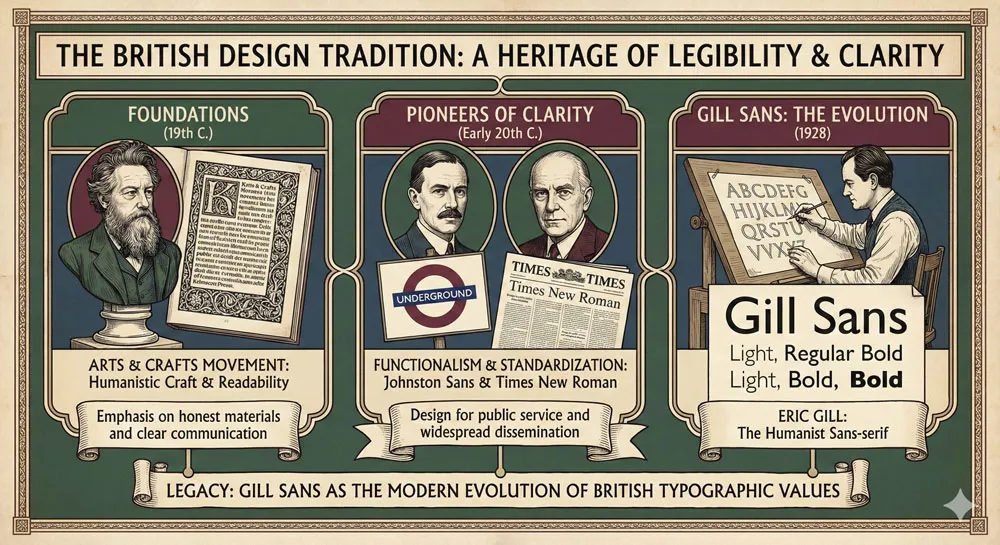
British design had a long tradition emphasizing legibility and clarity in typography. British designers had been at the forefront of developing readable, functional typefaces throughout the nineteenth and early twentieth centuries. Gill’s work continued this British tradition while bringing it into conversation with modernist design.
The British emphasis on legibility and functional clarity meant that British designers valued typefaces that communicated effectively and read clearly.
This emphasis influenced Gill’s approach: Gill Sans needed to be legible and clear, but it also needed to have character and personality. The typeface succeeds because it achieves both.
Monotype and Type Manufacturing Context
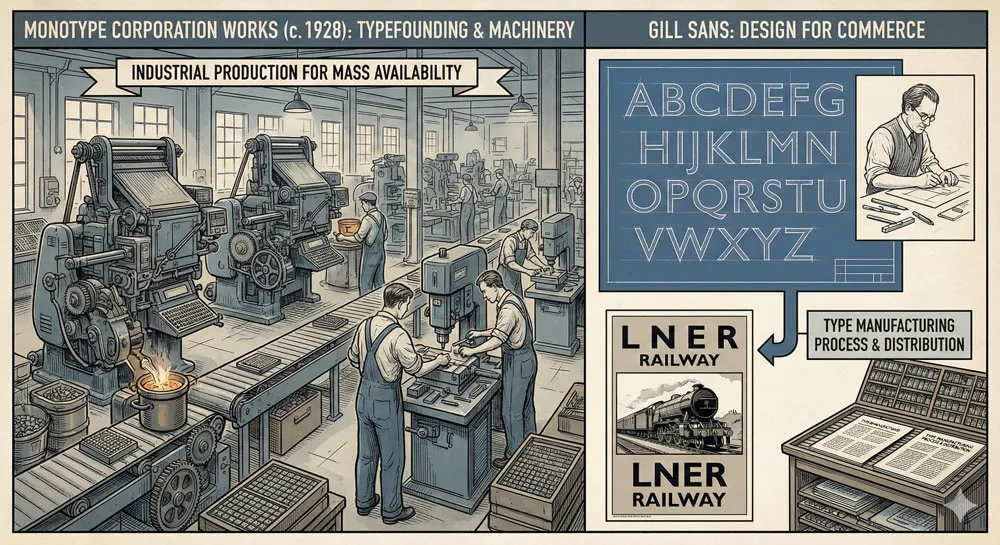
Gill Sans was created for Monotype Corporation, one of the major type manufacturing companies. Monotype had invested in mechanical type production and digital reproduction of typefaces.
The company was interested in developing contemporary typefaces that could compete in the market and could be reproduced in their mechanical and digital systems.
Gill’s design for Monotype was pragmatic: it needed to work in existing manufacturing systems, to be economically viable for the company, and to be commercially successful. The design succeeded on all counts.
Gill Sans became one of Monotype’s most successful typefaces and remains one of the company’s most significant contributions to typography.
Related Topics:
- Futura – Geometric Modernism Revolution
- Gill Sans – Humanist Alternative Modernism
- Baskerville – Print Excellence & Love Story
Gill Sans’ Adoption and 20th-Century Impact
Rapid Acceptance and Commercial Success
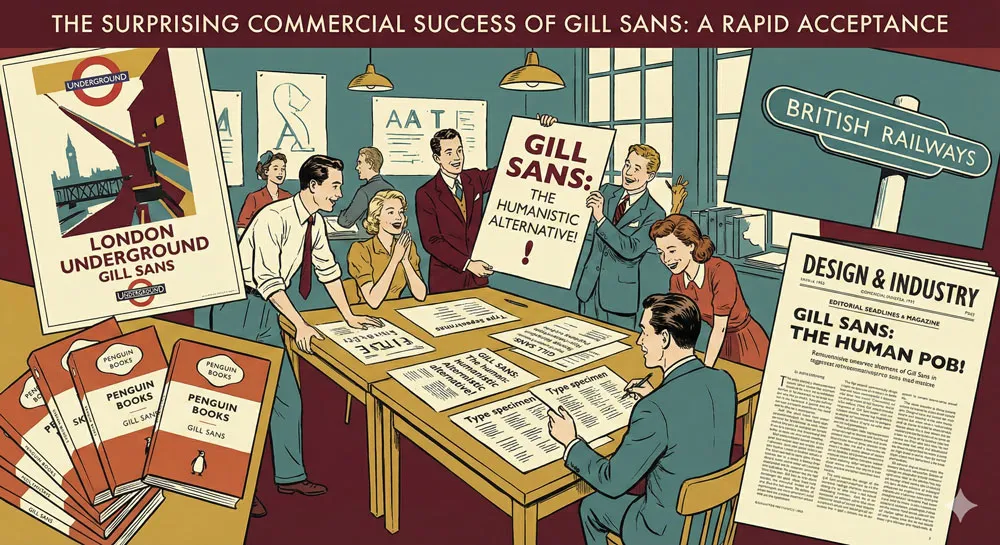
Despite its humanistic philosophical approach (which might have been seen as incompatible with modernism), Gill Sans achieved commercial success rapidly after its introduction in the late 1920s. Designers, design-conscious businesses, and institutions adopted Gill Sans enthusiastically.
The typeface appeared in advertising, in book design, in signage, in editorial contexts. Gill Sans became visually associated with contemporary British design. The typeface communicated that an organization or publication was modern, professional, and design-conscious while retaining warmth and accessibility.
Gill Sans’ success demonstrated that there was significant market demand for a humanistic sans-serif alternative to purely geometric modernist typefaces. The typeface appealed to designers and organizations wanting contemporary design that didn’t sacrifice warmth or personality.
Gill Sans in British Institutional and Cultural Contexts
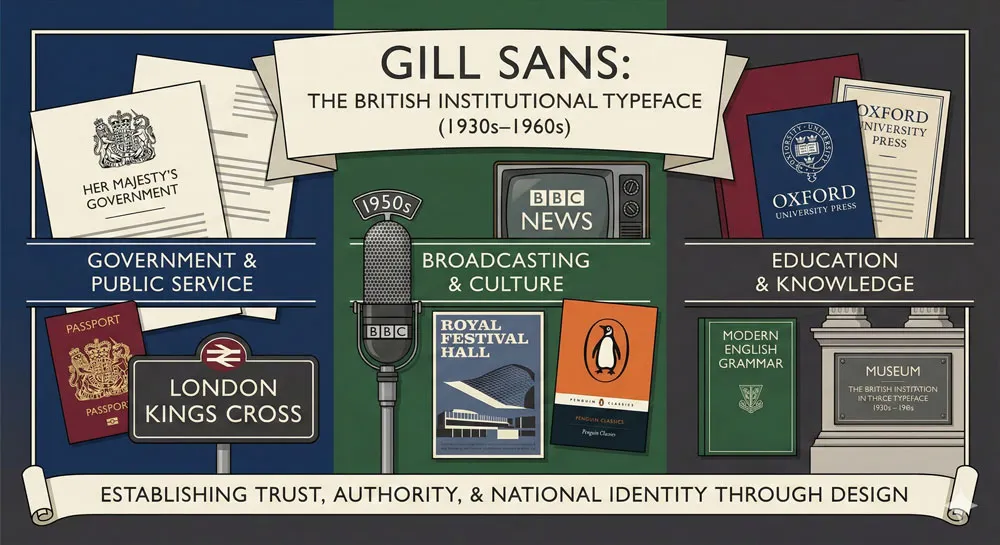
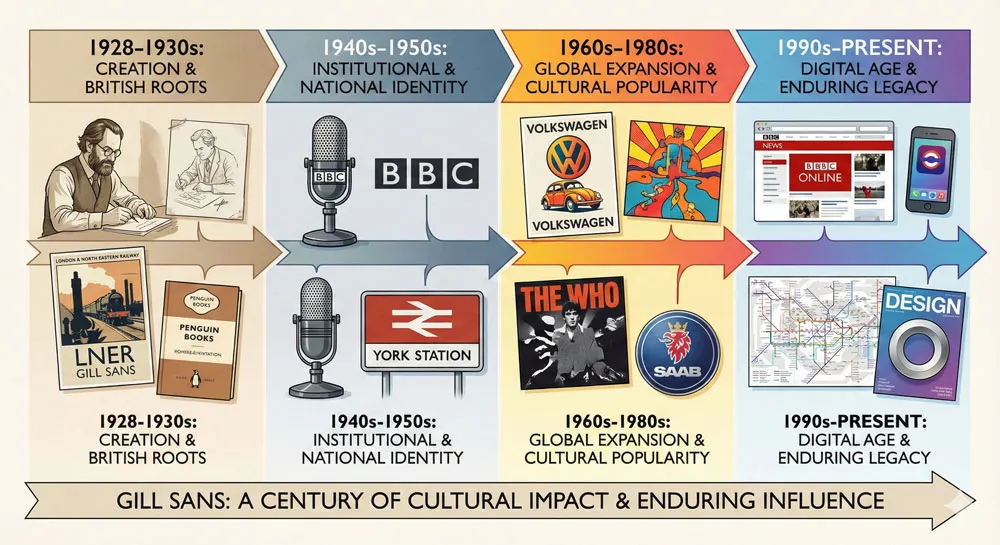
Gill Sans became strongly associated with British institutional and cultural design. The typeface appeared in government communications, educational materials, cultural institutions, and prestigious publications. Gill Sans became visually linked with British professional design and British cultural institutions.
One particularly significant application was the adoption of Gill Sans by the BBC (British Broadcasting Corporation) for institutional use. The BBC selected Gill Sans for its broadcasts, publications, and communications. This high-profile institutional adoption further cemented Gill Sans’ status as a significant contemporary typeface.
The association with British cultural institutions gave Gill Sans considerable prestige and visibility. The typeface became recognized not just by design professionals but by the general British public through its use in broadcasting, publications, and public communications.
Global Adoption and Influence
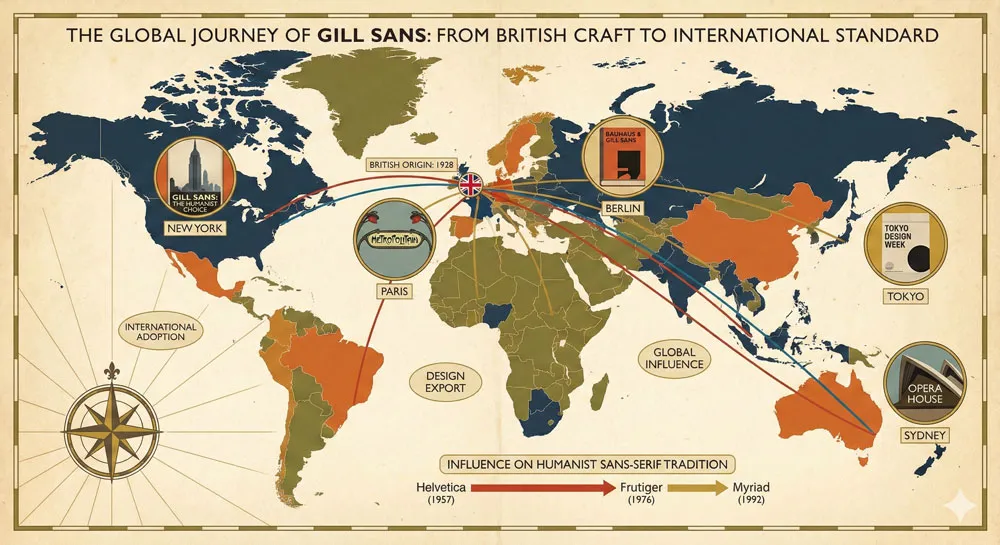
While Gill Sans was particularly prominent in British design contexts, the typeface achieved global adoption throughout the twentieth century. International designers recognized Gill Sans’ quality and appropriateness and selected the typeface for their own projects. Gill Sans appeared in design contexts globally, establishing itself as one of the most significant typefaces of the era.
The typeface’s global influence extended to influencing subsequent typeface design. Designers creating humanist sans-serifs were influenced by Gill Sans and sought to develop typefaces with similar qualities: humanistic proportions, warmth, legibility, and contemporary clarity.
Related Topics:
- Bodoni – Theatrical Prestige Aesthetics
- Garamond – Classical Foundation Principles
- Worst Fonts – Criticism & Gatekeeping Analysis
Gill Sans vs. Geometric Modernism: A Design Debate
The Philosophical Difference
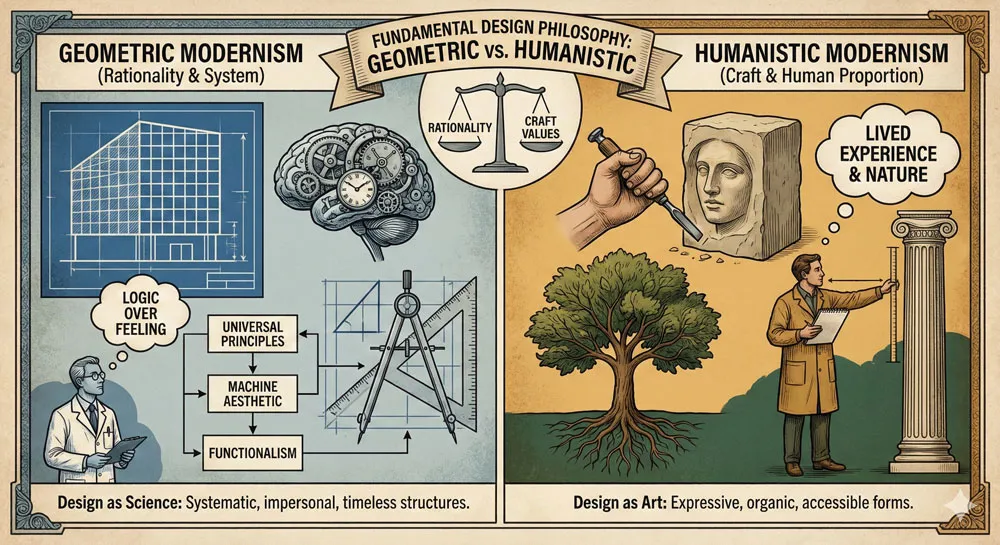
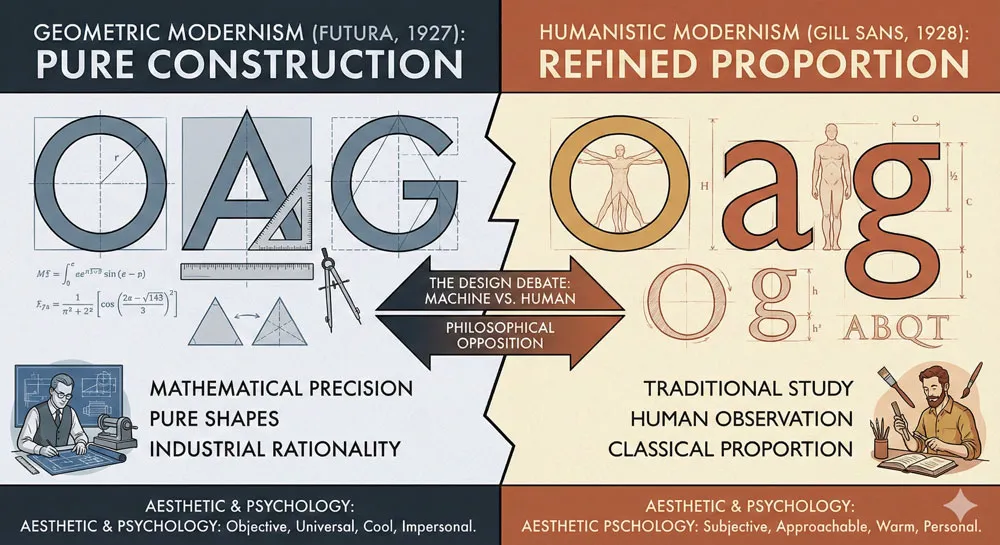
Gill Sans and Futura represent fundamentally different philosophical approaches to modernist typeface design. Futura is based on pure geometric principles—letterforms constructed from circles, squares, and lines. Gill Sans is based on humanist proportions and craft understanding—letterforms refined through centuries of development and human observation.
These different approaches led to very different visual results. Futura communicates cool rationality and geometric purity. Gill Sans communicates warm humanity and refined proportion. Both typefaces are modern, but they represent different understandings of what modernism means and how modernism should relate to tradition.
This philosophical difference was not merely aesthetic. It represented different worldviews about design’s role and purpose. For geometric modernists like Paul Renner, design should embody rationality and systematic principles. For humanistic designers like Eric Gill, design should embody human values, craft understanding, and humanistic proportion.
Contemporary Reception and Debate
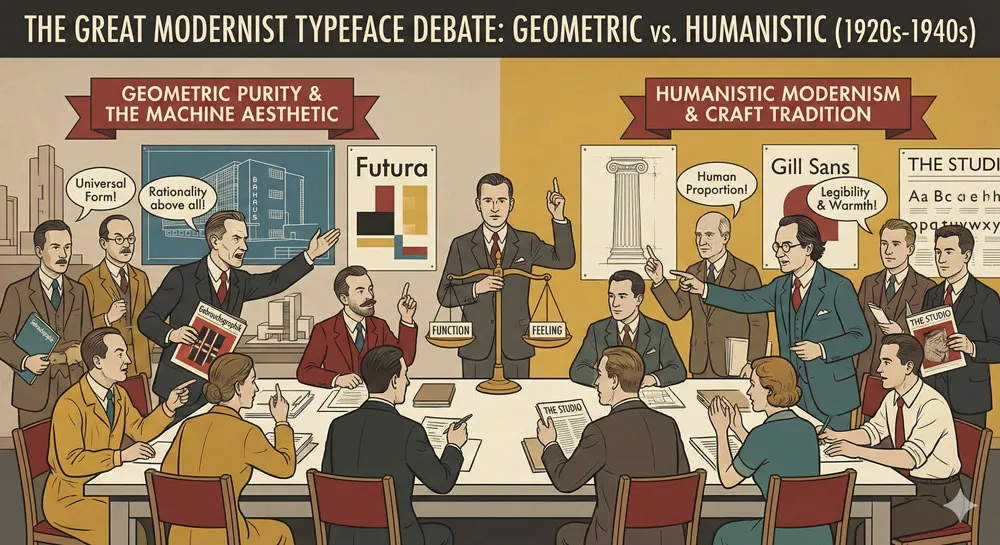
During the 1920s-1940s era, there was genuine design and philosophical debate about which approach was superior. Some modernists argued that Gill Sans’ humanistic approach was insufficiently radical and compromised with tradition. Some defenders of Gill Sans argued that geometric modernism was inhumanly cold and disconnected from human values and proportions.
In retrospect, it seems clear that both approaches had merit. Futura succeeded in communicating modernist ideals and influenced subsequent geometric sans-serif design significantly. Gill Sans succeeded in proving that modernism could be humanistic and that geometric purity was not necessary for contemporary design.
Continued Philosophical Questions
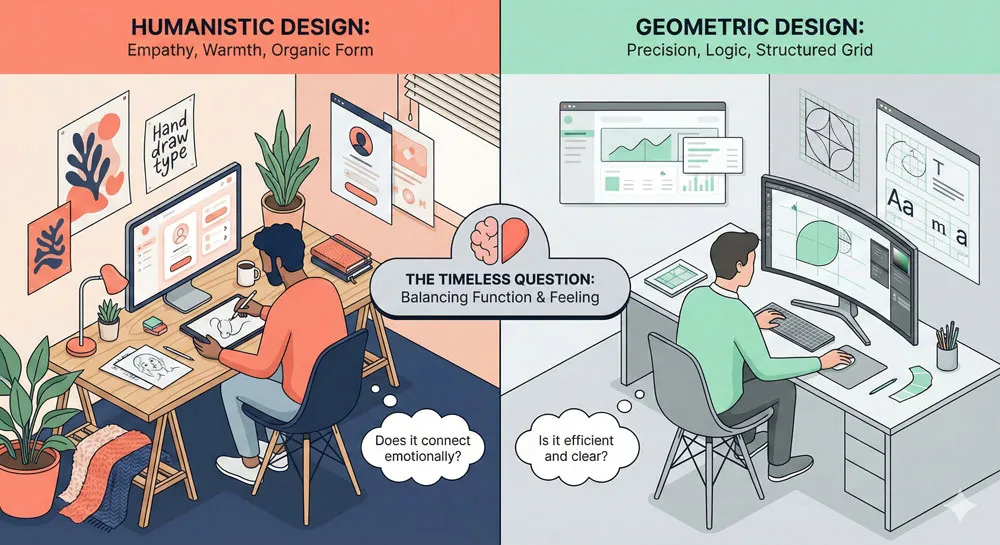
The debate between geometric modernism and humanistic modernism continues in contemporary design. Contemporary designers must decide: should design be based on pure principles and geometric rationality, or should design be grounded in human observation and humanistic understanding? Should design emphasize systematic order, or should it acknowledge human complexity and warmth?
Gill Sans represents one answer to these questions: modernism can be humanistic. Contemporary design can be both systematic and warm, both clear and personal, both rational and human.
Related Topics:
- Gill Sans & The Tube – Urban Identity Infrastructure
- Baskerville & Mrs. Eaves – Love, Partnership & Revival
- Futura & Paul Renner – Geometric Vision & Revolution
Eric Gill: Complication, Controversy, and Legacy
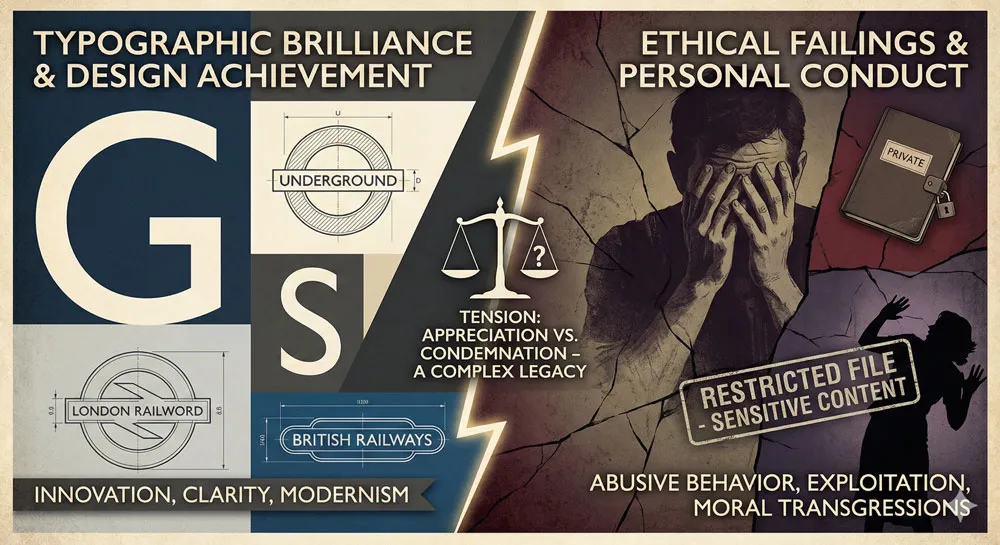
The Complexity of Eric Gill
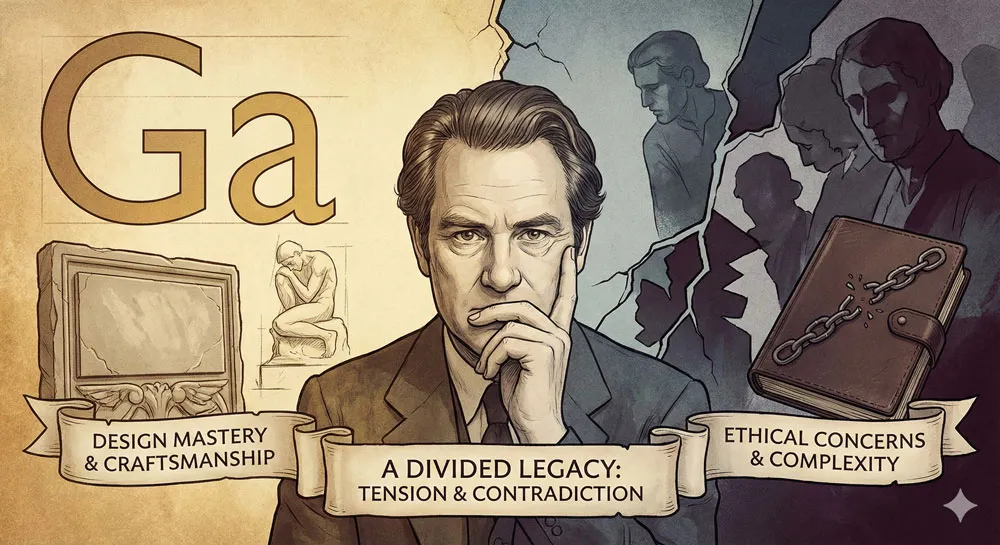
Eric Gill’s life and work are complicated by serious ethical and moral concerns. Gill’s personal life included deeply troubling dimensions—allegations of sexual abuse, incest, and behavior that would be recognized today as predatory and criminal. These facts cannot be ignored or minimized.
This complication raises important questions about how we evaluate and appreciate the work of problematic historical figures. Gill Sans is a genuine design masterpiece—a typeface of great beauty and influence. Yet it was created by a person whose personal conduct was deeply troubling.
This tension—between appreciating genuine artistic and design achievement while acknowledging the creator’s moral failings—is not unique to Gill but is particularly acute in his case due to the severity of the allegations and the importance of his design contributions.
Separating Art from Artist
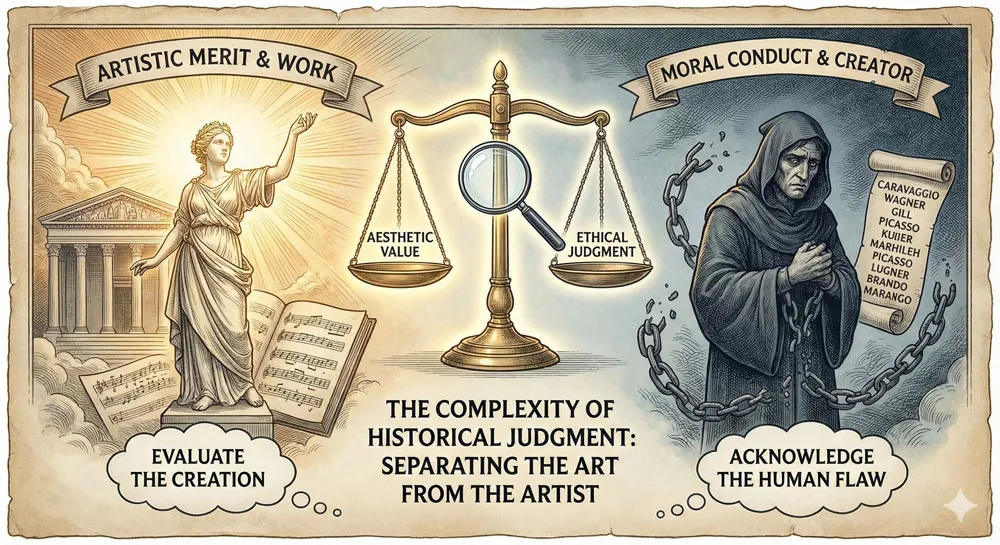
Different people navigate this tension differently. Some argue that we should entirely reject Gill’s work due to his personal conduct. Others argue that we can appreciate the design achievement while condemning the personal behavior. Still others argue for more complex positions acknowledging both dimensions.
This exploration takes the position that Gill Sans can be appreciated as a genuine design achievement while acknowledging and not minimizing Gill’s personal failings. The typeface represents humanistic design values—warmth, accessibility, human proportion—even though the designer himself violated basic human ethics and dignity.
This complexity is uncomfortable but important to acknowledge. Design history, like all history, involves people who created important work while also doing serious harm. Honest engagement with this history requires holding both truths simultaneously.
Gill Sans’ Lasting Legacy
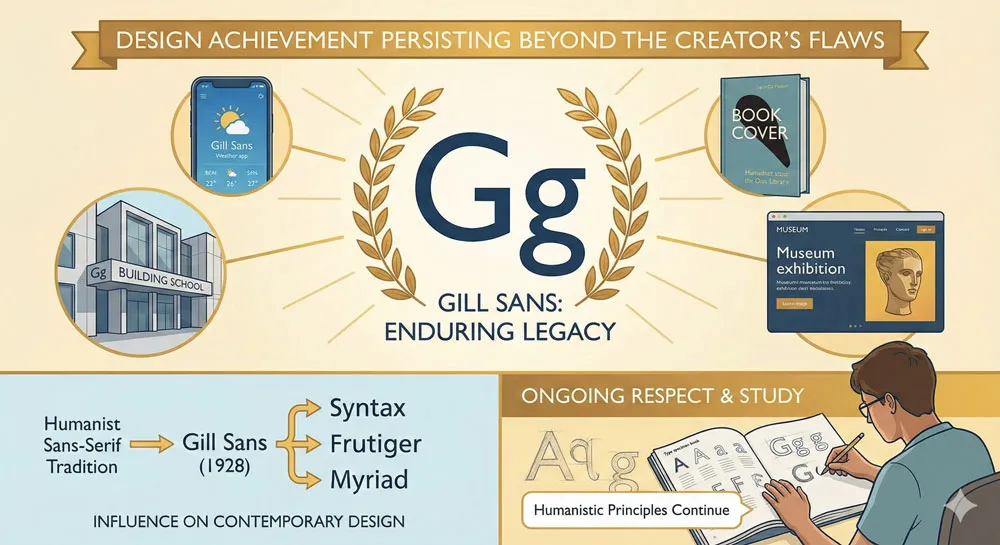
Despite the complications, Gill Sans remains one of the most significant and influential typefaces in history. The typeface continues to be used, studied, and respected. Gill Sans has influenced subsequent humanist sans-serif design. The typeface continues to appear in contemporary design contexts.
The legacy of Gill Sans is the design achievement itself—the humanistic approach to modernist typeface design, the proof that modernism could be warm and human, the demonstration that geometric purity was not necessary for contemporary design. This legacy, while created by a morally flawed individual, remains valuable and influential.
Related Topics:
- Legibility vs. Readability – Typography Fundamentals
- Ampersand & Interrobang – Symbol Histories
- Futura: The Geometric Vision of Paul Renner
Gill Sans in Contemporary Design: Enduring Relevance
Continued Presence in Contemporary Applications
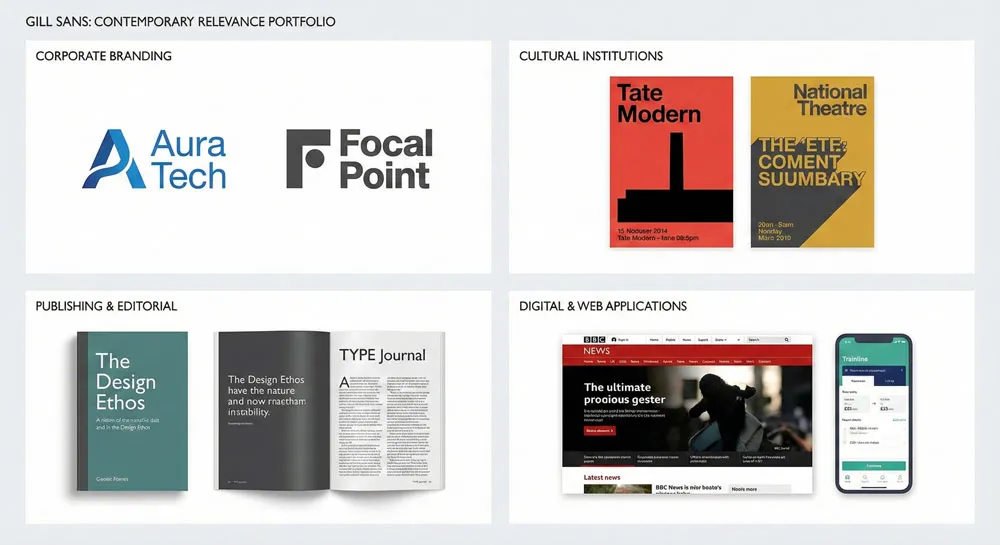
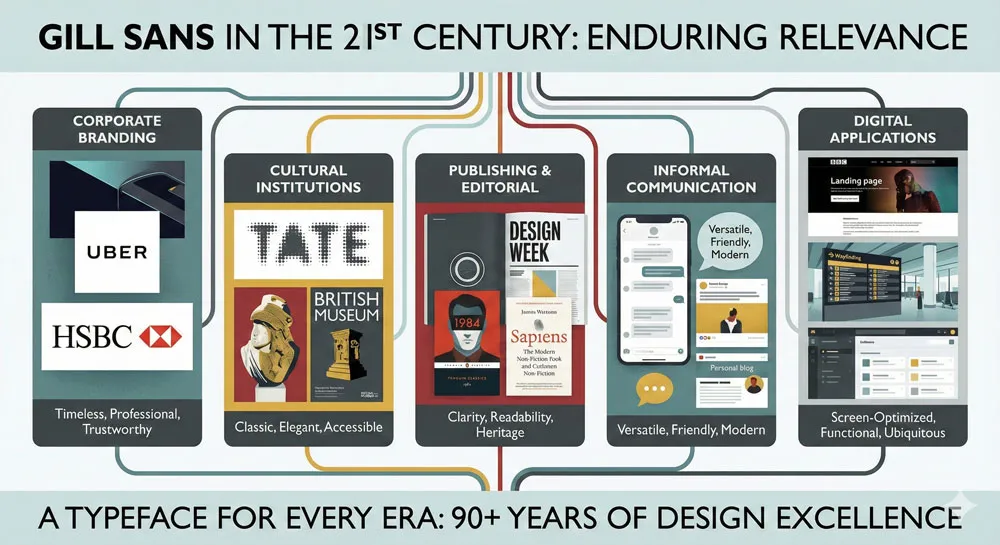
Despite being nearly a century old, Gill Sans remains widely used in contemporary design. The typeface appears in corporate branding, in cultural institutions, in publishing, in informal communication. Organizations continue to select Gill Sans because it effectively communicates what they want to communicate.
Gill Sans’ continued presence is remarkable. Most typefaces become dated or are replaced by newer options. Gill Sans remains contemporary and appropriate precisely because its humanistic approach, warm character, and refined legibility continue to be valuable regardless of design fashion.
Humanist Sans-Serifs and Design Evolution
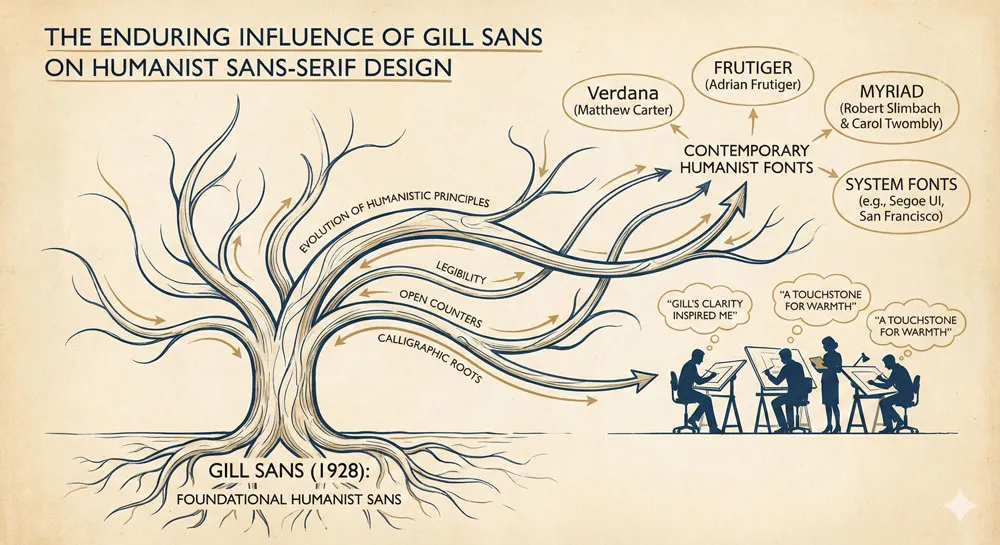
Gill Sans has influenced the entire tradition of humanist sans-serif typeface design. Contemporary humanist sans-serifs like Verdana (designed for screen legibility), system fonts used in contemporary technology, and numerous other contemporary typefaces carry forward the humanistic principles that Gill established.
Contemporary type designers often credit Gill Sans as an influence on their work. The typeface remains a model for how to achieve modernist clarity while maintaining humanistic warmth and character.
British Cultural Association
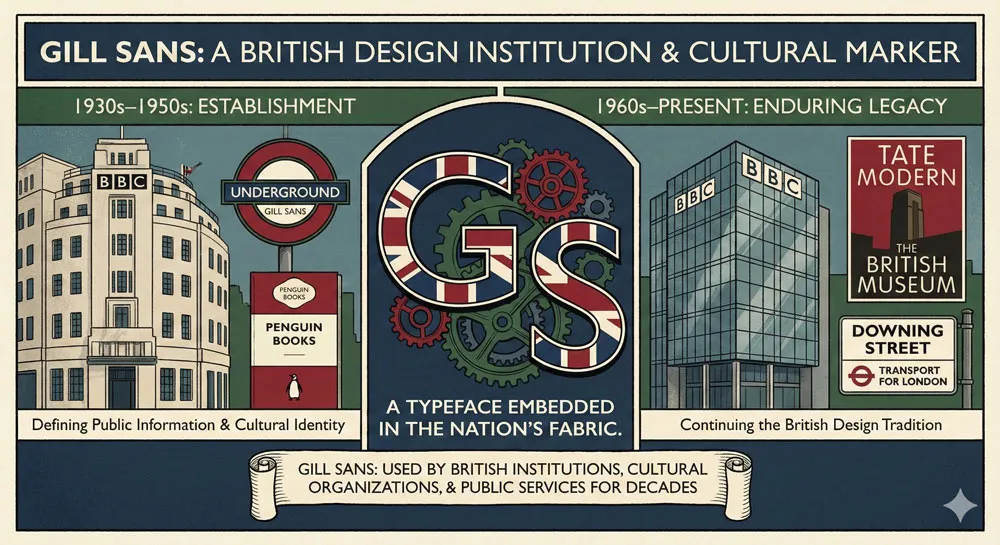
Gill Sans remains strongly associated with British design and British cultural institutions. The typeface continues to appear in British institutional contexts and in design that deliberately invokes British design traditions. This cultural association has remained consistent for nearly a century.
Related Topics:
- Gotham: Font That Won an Election And Changed Design Forever
- Comic Sans: True Story Behind the World’s Most Hated Font
- Helvetica Effect: One Font Conquered Global Design
FAQ: Common Questions About Gill Sans
Q: Who designed Gill Sans and when?
A: Eric Gill designed Gill Sans beginning in 1928. Gill was a British typographer, designer, and craftsperson influenced by Arts and Crafts principles and humanistic design philosophy.
Q: How is Gill Sans different from Futura?
A: Futura is based on pure geometric principles with letterforms constructed from circles and squares. Gill Sans is based on humanist proportions observed through historical study. Futura is cool and rational; Gill Sans is warm and humanistic.
Q: Why is Gill Sans considered humanist?
A: Gill Sans is humanist because it is based on human proportions and craft understanding rather than pure geometric principles. The typeface acknowledges traditional letterform proportions developed through centuries of human practice and observation.
Q: Is Gill Sans still used in contemporary design?
A: Yes. Gill Sans remains widely used in contemporary design contexts. The typeface’s warmth, legibility, and distinctive character make it appropriate for many contemporary applications.
Q: What does Gill Sans communicate psychologically?
A: Gill Sans communicates warmth, approachability, professionalism, and contemporary design sophistication. The typeface feels both modern and humanistic, both authoritative and accessible.
Q: Can I use Gill Sans in my design project?
A: Gill Sans is available in digital form from multiple sources. Whether to use Gill Sans depends on your specific design context and goals. The typeface remains appropriate for many contemporary design applications.
Q: How did Eric Gill’s personal conduct affect his design legacy?
A: Eric Gill’s personal conduct was deeply troubling and would be recognized today as criminal. This complicates his legacy. However, Gill Sans remains a significant and influential design achievement that can be appreciated while condemning Gill’s personal behavior.
Q: What influenced Eric Gill’s design philosophy?
A: Gill was influenced by British Arts and Crafts movement principles, belief in the value of craftsmanship, humanistic understanding of proportion, and British design traditions emphasizing legibility and clarity.
Q: Why did Gill Sans succeed when it represented alternative modernism?
A: Gill Sans succeeded because it solved genuine design problems effectively. The typeface was legible, distinctive, and communicated appropriately in numerous contexts. Its success demonstrated that alternative approaches to modernism were viable.
Q: Is Gill Sans better than Helvetica or other sans-serifs?
A: This is subjective and context-dependent. Gill Sans, Helvetica, and other sans-serifs are each appropriate in different contexts. Gill Sans’ humanistic approach works well in some applications; other typefaces work better in other contexts.
Related Topics:
Conclusion: Humanistic Modernism and Enduring Design Excellence
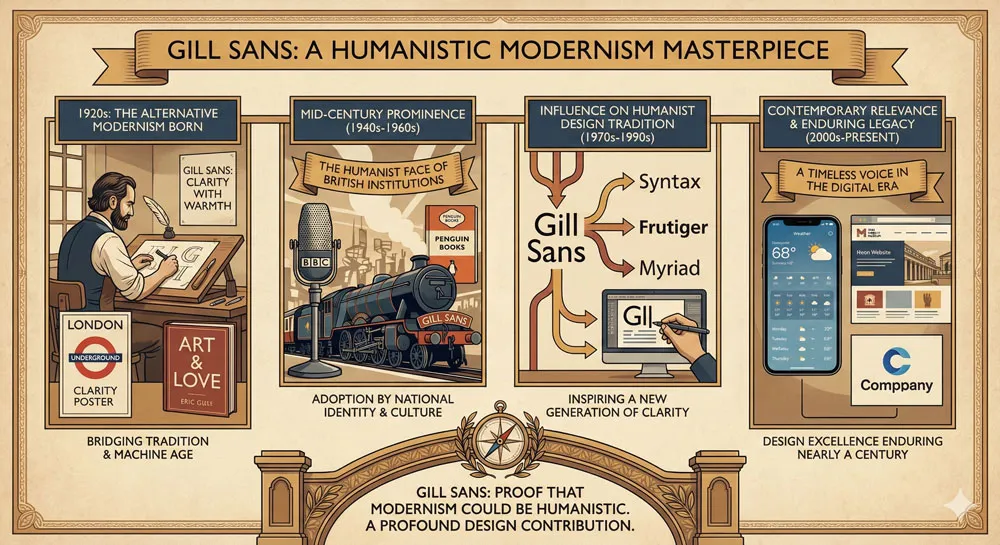
Gill Sans represents a crucial achievement in design history: the proof that modernism did not require the elimination of humanity, warmth, or craft values.
In an era when geometric modernism was celebrated as the embodiment of progress and rationality, Eric Gill proved that modernism could be humanistic, warm, and still thoroughly contemporary.
The typeface is also remarkable for its longevity. Nearly a century after its creation, Gill Sans remains in active use and continues to be respected by design professionals.
This longevity is testament both to the enduring value of Gill’s design achievement and to the universality of the principles Gill embodied: legibility, warmth, appropriateness, and refined beauty.
Eric Gill’s personal conduct was deeply troubling and cannot be excused. Yet the design achievement represented by Gill Sans remains significant and valuable.
The typeface communicates humanistic values and proves that design excellence can be achieved through careful observation, craft understanding, and humanistic principle.
Gill Sans stands as a masterpiece of humanist design and as a crucial alternative path through modernism—one that valued human warmth and craft principle alongside contemporary clarity and functionality.
In doing so, Gill Sans demonstrated that there were multiple valid approaches to modernist design, and that the most beautiful and effective designs might be those that honored both tradition and innovation, both human values and contemporary needs.
About the Author
Lalit M. S. Adhikari is a Digital Nomad and Educator since 2009 in design education, graphic design and animation. He’s taught 500+ students and created 200+ educational articles on design topics. His teaching approach emphasizes clarity, practical application and helping learners.
Learn more about Lalit Adhikari.